

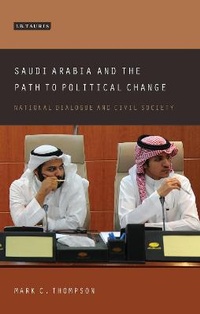
Saudi Arabia and the Path to Political Change
National Dialogue and Civil Society
Published on 16. June 2014
Book
Hardback
400 pages
978-1-78076-671-3 (ISBN)
Description
State-society dialogue in Saudi Arabia is one of the most contested issues in the country today, yet little is known about the National Dialogue process, and its relationship with Saudi society is frequently and widely misunderstood. The first to examine the Saudi Arabian National Dialogue process in its entirety, Mark C. Thompson investigates the relationship between the King Abdulaziz Center for National Dialogue (KACND) and the key social constituencies of Saudi society. Since its establishment in 2003, the KACND has attempted to promote a culture of dialogue and has encouraged the debate of contentious socio-political issues by bringing individuals together from across the Kingdom. Drawing on Antonio Gramsci's theory of hegemony, the author asks whether the Saudi socio-political system is moving from a form of patrimonial state to one of ideological hegemony and, if this is the case, whether the KACND is a catalyst, or even a driving force, in this transition.
Saudi Arabia and the Path to Political Change investigates the practices and the impact of the KACND and assesses the extent to which the institution's activities, and the ongoing National Dialogue process, represent a viable attempt to address emerging political concerns in Saudi Arabia. Covering pivotal issues including women's empowerment, public health and employment, the author here explores the extensive impact of the KACND's activities on internal cross-constituency communication and discourse and shows how the process relates to wider regime strategies and to the evolution of the Saudi polity. Based on approximately 120 interviews conducted in Saudi Arabia from 2009 to 2011 and drawing on the evidence of a wide range of focus groups and interviews with National Dialogue participants, KACND officials, government ministers, lawyers and journalists, this book provides a unique insight into the effects and consequences of Saudi National Dialogue, and questions the extent to which wider ideological debate is possible in the Kingdom.
Saudi Arabia and the Path to Political Change investigates the practices and the impact of the KACND and assesses the extent to which the institution's activities, and the ongoing National Dialogue process, represent a viable attempt to address emerging political concerns in Saudi Arabia. Covering pivotal issues including women's empowerment, public health and employment, the author here explores the extensive impact of the KACND's activities on internal cross-constituency communication and discourse and shows how the process relates to wider regime strategies and to the evolution of the Saudi polity. Based on approximately 120 interviews conducted in Saudi Arabia from 2009 to 2011 and drawing on the evidence of a wide range of focus groups and interviews with National Dialogue participants, KACND officials, government ministers, lawyers and journalists, this book provides a unique insight into the effects and consequences of Saudi National Dialogue, and questions the extent to which wider ideological debate is possible in the Kingdom.
Reviews / Votes
'This is a substantial, well-researched and theoretically engaged book. The author articulately pursues a theme which is distinctly different from that pursued by others, adopts a Gramscian framework of analysis which is also new in terms of work on Saudi Arabia, and investigates his topic thoroughly.' (Prof. Tim Niblock, Institute of Arab and Islamic Studies, University of Exeter) "A very fine book which tackles an important subject that has so far been under researched. It truly adds to the, relatively speaking, thin body of literature that is available on socio-political developments in the Kingdom of Saudi Arabia - it is the first in-depth study on the activities of King Abdulaziz Center for National Dialogue (KACND). The author has gathered a wealth of material both by reading and interviewing - a real achievement.' (Paul Aarts, Senior Lecturer in International Relations, University of Amsterdam) "Mark Thompson has done a invaluable service to anyone interested in Saudi politics and society, not only by a balanced and intimately informed analysis of the trends in socio-political dynamics generally, but by by detailing and interpreting, for the first time anywhere, the significance and role of the National Dialogue process and institutions: these are shown to mean, in subtle ways, far more than meets the eye on superficial contact, as often as not in ways that are indirect and unintentional. They both affect and reflect dynamics in the Saudi polity that are much more nuanced than usually acknowledged. This book should become a key point of reference for scholars and practitioners alike." Professor Gerd Nonneman, Dean of Georgetown University's School of Foreign Service in Qatar, and Professor of International Relations & Gulf Studies.More details
Language
English
Place of publication
United Kingdom
Publishing group
Bloomsbury Publishing PLC
Target group
College/higher education
Dimensions
Height: 216 mm
Width: 138 mm
Weight
648 gr
ISBN-13
978-1-78076-671-3 (9781780766713)
Copyright in bibliographic data and cover images is held by Nielsen Book Services Limited or by the publishers or by their respective licensors: all rights reserved.
Schweitzer Classification
Other editions
Additional editions
E-Book
06/2014
1st Edition
I.B. Tauris
€144.99
Available for download
E-Book
06/2014
I.B. Tauris
€144.99
Available for download
Person
Mark C. Thompson is Assistant Professor of Middle East Studies at King Fahd University of Petroleum and Minerals, Saudi Arabia. He completed his PhD in Arab and Islamic Studies at the University of Exeter. He has worked in Saudi Arabia intermittently since January 2001.
Content
Introduction
CHAPTER ONE: THE TRANSITION FROM A PATRIMONIAL STATE TO A HEGEMONIC STATE
CHAPTER TWO: STATE AND SOCIETY: KEY STATE ACTORS, NON-STATE ACTORS AND CONSTITUENCIES
CHAPTER THREE: THE GENESIS OF THE KING ABDULLAH CENTER FOR NATIONAL DIALOGUE
CHAPTER FOUR: SAUDI NATIONAL DIALOGUE AND SAUDI CONSTITUENCIES I: DOMINANT IDEOLOGY, POLITICAL SPACE AND RELIGIOUS MINORITIES
CHAPTER FIVE: SAUDI NATIONAL DIALOGUE AND SAUDI CONSTITUENCIES II: KACND AND SOCIETAL CONSTITUENCIES
CHAPTER SIX: INDIRECT CONSEQUENCES OF THE SAUDI NATIONAL DIALOGUE
CONCLUSION: AN INSTITUIONALISED FORM OF EXPRESSION OF OPINION
CHAPTER ONE: THE TRANSITION FROM A PATRIMONIAL STATE TO A HEGEMONIC STATE
CHAPTER TWO: STATE AND SOCIETY: KEY STATE ACTORS, NON-STATE ACTORS AND CONSTITUENCIES
CHAPTER THREE: THE GENESIS OF THE KING ABDULLAH CENTER FOR NATIONAL DIALOGUE
CHAPTER FOUR: SAUDI NATIONAL DIALOGUE AND SAUDI CONSTITUENCIES I: DOMINANT IDEOLOGY, POLITICAL SPACE AND RELIGIOUS MINORITIES
CHAPTER FIVE: SAUDI NATIONAL DIALOGUE AND SAUDI CONSTITUENCIES II: KACND AND SOCIETAL CONSTITUENCIES
CHAPTER SIX: INDIRECT CONSEQUENCES OF THE SAUDI NATIONAL DIALOGUE
CONCLUSION: AN INSTITUIONALISED FORM OF EXPRESSION OF OPINION