

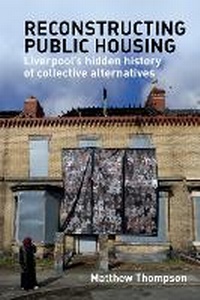
Reconstructing public housing
Liverpool's hidden history of collective alternatives
Published on 4. August 2020
Book
Paperback/Softback
408 pages
978-1-78962-108-2 (ISBN)
Description
An Open Access edition of this book is available on the Liverpool University Press website and the OAPEN library.
Reconstructing Public Housing unearths Liverpool's hidden history of radical alternatives to municipal housing development and builds a vision of how we might reconstruct public housing on more democratic and cooperative foundations. In this critical urban history, Matthew Thompson brings to light how and why this remarkable city became host to two pioneering social movements in collective housing and urban regeneration experimentation. In the 1970s, Liverpool produced one of Britain's largest, most democratic and socially innovative housing co-op movements, including the country's first new-build co-op to be designed, developed and owned by its member-residents. Four decades later, in some of the very same neighbourhoods, several campaigns for urban community land trusts are growing from the grassroots - including the first ever architectural or housing project to be nominated for and win, in 2015, the artworld's coveted Turner Prize. Thompson traces the connections between these movements; how they were shaped by, and in turn transformed, the politics, economics, culture and urbanism of Liverpool. Drawing on theories of capitalism and cooperativism, property and the commons, institutional change and urban transformation, Thompson reconsiders Engels' housing question, reflecting on how collective alternatives work in, against and beyond the state and capital, in often surprising and contradictory ways.
Reconstructing Public Housing unearths Liverpool's hidden history of radical alternatives to municipal housing development and builds a vision of how we might reconstruct public housing on more democratic and cooperative foundations. In this critical urban history, Matthew Thompson brings to light how and why this remarkable city became host to two pioneering social movements in collective housing and urban regeneration experimentation. In the 1970s, Liverpool produced one of Britain's largest, most democratic and socially innovative housing co-op movements, including the country's first new-build co-op to be designed, developed and owned by its member-residents. Four decades later, in some of the very same neighbourhoods, several campaigns for urban community land trusts are growing from the grassroots - including the first ever architectural or housing project to be nominated for and win, in 2015, the artworld's coveted Turner Prize. Thompson traces the connections between these movements; how they were shaped by, and in turn transformed, the politics, economics, culture and urbanism of Liverpool. Drawing on theories of capitalism and cooperativism, property and the commons, institutional change and urban transformation, Thompson reconsiders Engels' housing question, reflecting on how collective alternatives work in, against and beyond the state and capital, in often surprising and contradictory ways.
Reviews / Votes
'This book makes a very significant contribution to housing and urban studies. Extremely readable, making complex theory understandable, and theorists accessible, it is articulate and well-written - a pleasure to read.'Dr Quintin Bradley, Leeds Beckett University 'The author successfully combines a visionary idealism with a realistic assessment of limits, conditions and barriers that have confined us to a few glimpses of how utopian collectivism and commons could provide a real alternative to the historic statist tradition of public housing.'
Professor David Mullins, Emeritus Professor of Housing Policy, University of Birmingham 'Reconstructing Public Housing is ideologically inspiring, although politically fluid... characterized by a consistent desire to flit between pragmatism and radicalism.'
Hamish Kallin, Space and Polity 'This monograph represents a significant advancement in theorizing urban housing commons, alongside a political ambition for both the community-led housing sector and academic Housing Studies. Thompson demonstrates the potential of "centring housing" within political solutions for the multiple, interrelated crises of social reproduction evident in contemporary England, at every scale.'
Martha Mingay, Housing Studies 'This is a book with wide appeal beyond readers who are interested in Liverpool and/or the history of housing cooperatives. The first chapters provide a genealogy of critical urbanist ideas about commoning, self-build housing and participatory architecture. Thompson places the issue of housing in the context of broader discussions about dwelling, community-building and place-making... This book is encyclopaedic in its treatment of collective housing in Liverpool.' Peggy Kohn, International Journal of Urban and Regional Research
More details
Language
English
Place of publication
Liverpool
United Kingdom
Target group
Professional and scholarly
Illustrations
6 Illustrations, black and white
Dimensions
Height: 234 mm
Width: 156 mm
ISBN-13
978-1-78962-108-2 (9781789621082)
Copyright in bibliographic data and cover images is held by Nielsen Book Services Limited or by the publishers or by their respective licensors: all rights reserved.
Schweitzer Classification
Person
Matthew Thompson, is a Leverhulme Early Career Research Fellow at the Heseltine Institute for Public Policy, Practice and Place, University of Liverpool.
Content
List of Figures
List of Abbreviations
Acknowledgement
Prologue
Part 1: Introducing collective housing alternatives
Part 2: The Housing Question
Part 3: The Neighbourhood Question
Part 4: The Urban Question
Part 5: Reconstructing Public Housing (History)
Epilogue: translating between inward, upward and outward languages
Bibliography
Index
List of Abbreviations
Acknowledgement
Prologue
Part 1: Introducing collective housing alternatives
Part 2: The Housing Question
Part 3: The Neighbourhood Question
Part 4: The Urban Question
Part 5: Reconstructing Public Housing (History)
Epilogue: translating between inward, upward and outward languages
Bibliography
Index