

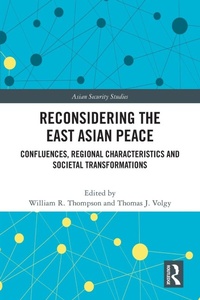
Reconsidering the East Asian Peace
Confluences, Regional Characteristics and Societal Transformations
1st Edition
Published on 26. December 2025
Book
Paperback/Softback
222 pages
978-1-032-76524-2 (ISBN)
Description
This volume re-examines the notion of the East Asian peace, arguing that it requires updating for the current and near-future context of US-Chinese rivalry.
The "East Asian peace" refers to the remarkable change in conflict levels in eastern Eurasia over the past 80 years or even the past 130 years or so. Prior to the late 1970s, East Asia was regarded as the most conflictual region on the planet. Although insurgencies have continued in places such as Myanmar, Thailand, and the Philippines, after the 1980s East and Southeast Asia became one of the world's least conflictual regions. Geopolitics and economic development worked hand in hand to reduce conflict in the region and, in this respect, the East Asian peace has been a confluential peace. The general problem with a confluential peace is that the factors that shape it evolve over time, and the specific circumstances in question seem to be evolving in a different direction, with East Asia shaping up to be the most central locale of the contest between US and Chinese hegemony, both regionally and perhaps globally. This book argues that the idea of the East Asian peace now requires adjustment to the current and near-future context. The more general arguments presented here focus on alternative interpretations of how regional peace and order should be interpreted, while the more specific arguments involve interpretations of Chinese and other countries' behavior in the context of the heightened rivalry between China and the United States.
This book will be of much interest to students of East Asian politics, peace studies, foreign policy, and international relations.
The "East Asian peace" refers to the remarkable change in conflict levels in eastern Eurasia over the past 80 years or even the past 130 years or so. Prior to the late 1970s, East Asia was regarded as the most conflictual region on the planet. Although insurgencies have continued in places such as Myanmar, Thailand, and the Philippines, after the 1980s East and Southeast Asia became one of the world's least conflictual regions. Geopolitics and economic development worked hand in hand to reduce conflict in the region and, in this respect, the East Asian peace has been a confluential peace. The general problem with a confluential peace is that the factors that shape it evolve over time, and the specific circumstances in question seem to be evolving in a different direction, with East Asia shaping up to be the most central locale of the contest between US and Chinese hegemony, both regionally and perhaps globally. This book argues that the idea of the East Asian peace now requires adjustment to the current and near-future context. The more general arguments presented here focus on alternative interpretations of how regional peace and order should be interpreted, while the more specific arguments involve interpretations of Chinese and other countries' behavior in the context of the heightened rivalry between China and the United States.
This book will be of much interest to students of East Asian politics, peace studies, foreign policy, and international relations.
More details
Series
Language
English
Place of publication
London
United Kingdom
Publishing group
Taylor & Francis Ltd
Target group
College/higher education
Professional and scholarly
Postgraduate, Professional Reference, and Undergraduate Advanced
Illustrations
29 s/w Tabellen, 31 s/w Zeichnungen, 31 s/w Abbildungen
29 Tables, black and white; 31 Line drawings, black and white; 31 Illustrations, black and white
Dimensions
Height: 234 mm
Width: 156 mm
Thickness: 13 mm
Weight
360 gr
ISBN-13
978-1-032-76524-2 (9781032765242)
Copyright in bibliographic data and cover images is held by Nielsen Book Services Limited or by the publishers or by their respective licensors: all rights reserved.
Schweitzer Classification
Other editions
Additional editions
William R. Thompson | Thomas J. Volgy
Reconsidering the East Asian Peace
Confluences, Regional Characteristics and Societal Transformations
Book
08/2024
1st Edition
Routledge
€178.60
Shipment within 10-20 days
William R. Thompson | Thomas J. Volgy
Reconsidering the East Asian Peace
Confluences, Regional Characteristics and Societal Transformations
E-Book
08/2024
1st Edition
Routledge
€60.99
Available for download
William R. Thompson | Thomas J. Volgy
Reconsidering the East Asian Peace
Confluences, Regional Characteristics and Societal Transformations
E-Book
08/2024
1st Edition
Routledge
€60.99
Available for download
Persons
William R. Thompson is a Distinguished Professor and the Donald A. Rogers Professor of Political Science Emeritus at Indiana University, USA.
Thomas J. Volgy is a Professor of Government and Public Policy at the University of Arizona, USA.
Thomas J. Volgy is a Professor of Government and Public Policy at the University of Arizona, USA.
Content
1. Re-evaluating the East Asian Peace? 2. Transformational versus Confluential Peace: The East Asian Peace and How Five Models Work Better Together Than Apart 3. Regional and Extra-regional Conflict in East Asia: An Analysis of Political Events, 1985-2018 4. How Solid is the Third Leg of the Kantian Triad? Exploring the Relationship Between Trade and Peace in East Asia 5. Hierarchy and Political Capacity in East Asia's Post-Cold War Regional Order 6. The East Asian Peace and the Emergence of the Indo-Pacific 7. Explaining the Rising Chinese Nationalist Revisionism: Implications for Regional Stability 8. Taiwan as a Flash Point: Possible Lessons from the War in Ukraine 9. There is no East Asian Balancing against China 10. Conclusion: Whither the East Asian Peace?