

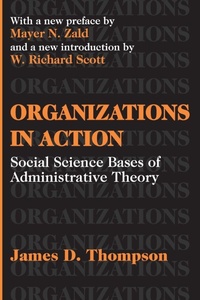
Organizations in Action
Social Science Bases of Administrative Theory
1st Edition
Published on 30. April 2003
Book
Paperback/Softback
222 pages
978-0-7658-0991-9 (ISBN)
Description
Organizations act, but what determines how and when they will act? There is precedent for believing that the organization is but an extension of one or a few people, but this is a deceptively simplified approach and, in reality, makes any generalization in organizational theory enormously difficult. Modern-day organizations-manufacturing firms, hospitals, schools, armies, community agencies-are extremely complex in nature, and several strategies, employing a variety of disciplines, are needed to gain a proper understanding of them.
Organizations in Action is a classic multidisciplinary study of the behavior of complex organizations as entities. Previous books on the subject focused on the behavior of people in organizational contexts, but this volume considers individual behavior only to the extent that it helps explain the nature of organizations. James D. Thompson offers ninety-five distinct propositions about the behavior of organizations, all relevant regardless of the culture in which they are found. Thompson classifies organizations according to their technologies and environments. That organizations must meet and handle uncertainty is central to his thesis.
Organizations in Action is firmly grounded in concepts and theories in the social and behavioral sciences. While it does not offer an actual theory of administration, the book successfully extends the scientific base upon which any emerging administrative theory must rest. This classic work is of continuing value to organizational and management specialists, behavioral scientists, sociologists, administrators, and policymakers.
Organizations in Action is a classic multidisciplinary study of the behavior of complex organizations as entities. Previous books on the subject focused on the behavior of people in organizational contexts, but this volume considers individual behavior only to the extent that it helps explain the nature of organizations. James D. Thompson offers ninety-five distinct propositions about the behavior of organizations, all relevant regardless of the culture in which they are found. Thompson classifies organizations according to their technologies and environments. That organizations must meet and handle uncertainty is central to his thesis.
Organizations in Action is firmly grounded in concepts and theories in the social and behavioral sciences. While it does not offer an actual theory of administration, the book successfully extends the scientific base upon which any emerging administrative theory must rest. This classic work is of continuing value to organizational and management specialists, behavioral scientists, sociologists, administrators, and policymakers.
More details
Series
Language
English
Place of publication
Somerset
United Kingdom
Publishing group
Taylor & Francis Inc
Target group
College/higher education
Professional and scholarly
Dimensions
Height: 234 mm
Width: 156 mm
Thickness: 13 mm
Weight
348 gr
ISBN-13
978-0-7658-0991-9 (9780765809919)
Copyright in bibliographic data and cover images is held by Nielsen Book Services Limited or by the publishers or by their respective licensors: all rights reserved.
Schweitzer Classification
Other editions
Additional editions
Book
07/2017
1st Edition
Routledge
€207.50
Shipment within 10-20 days
E-Book
07/2017
Routledge
€64.49
Available for download
E-Book
07/2017
Routledge
€64.49
Available for download
Person
James D. Thompson taught business administration and sociology at Indiana University and Vanderbilt University. He contributed numerous articles to scholarly journals, including American Journal of Sociology, Administrative Science Quarterly, and American Sociological Review. Mayer N. Zald is professor emeritus of sociology at the University of Michigan. He is the author of Occupations and Organizations in American Society, and co-author (with John McCarthy) of Social Movements in an Organizational Society, available from Transaction. W. Richard Scott is professor emeritus of sociology at Stanford University. He is the author of Organizations: Rational, Natural and Open Systems and Institutions and Organizations, and is a former editor of Annual Review of Sociology.
Content
PREFACE TO THE TRANSACTION EDITION,
INTRODUCTION TO THE TRANSACTION EDITION: THOMPSON'S BRIDGE OVER TROUBLED WATERS, PREFACE, Part One, 1. Strategies for Studying Organizations, 2. Rationality in Organizations, 3. Domains of Organized Action, 4. Organizational Design, 5. Technology and Structure, 6. Organizational Rationality and Structure, 7. The Assessment of Organizations, Part Two, 8. The Variable Human, 9. Discretion and Its Exercise, 10. The Control of Complex Organizations, 11. The Administrative Process, 12. Conclusion, BIBLIOGRAPHY, NAME INDEX, SUBJECT INDEX
INTRODUCTION TO THE TRANSACTION EDITION: THOMPSON'S BRIDGE OVER TROUBLED WATERS, PREFACE, Part One, 1. Strategies for Studying Organizations, 2. Rationality in Organizations, 3. Domains of Organized Action, 4. Organizational Design, 5. Technology and Structure, 6. Organizational Rationality and Structure, 7. The Assessment of Organizations, Part Two, 8. The Variable Human, 9. Discretion and Its Exercise, 10. The Control of Complex Organizations, 11. The Administrative Process, 12. Conclusion, BIBLIOGRAPHY, NAME INDEX, SUBJECT INDEX