

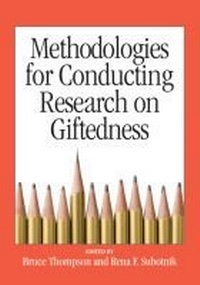
Methodologies for Conducting Research on Giftedness
Will be published approx. on 15. February 2010
Book
Hardback
266 pages
978-1-4338-0714-5 (ISBN)
Description
Bruce Thompson and Rena F. Subotnik have gathered a distinguished group of pioneers in measurement and statistics to offer creative solutions to a number of methodological challenges in research centered on gifted children.
More details
Language
English
Place of publication
Washington DC
United States
Target group
College/higher education
Professional and scholarly
Dimensions
Height: 254 mm
Width: 178 mm
ISBN-13
978-1-4338-0714-5 (9781433807145)
Copyright in bibliographic data and cover images is held by Nielsen Book Services Limited or by the publishers or by their respective licensors: all rights reserved.
Schweitzer Classification
Persons
Bruce Thompson is a distinguished professor and distinguished research fellow of educational psychology and a distinguished professor of library sciences, Texas A amp M University. He is also an adjunct professor of family and community medicine, Baylor College of Medicine (Houston). He has been coeditor of the teaching, learning, and human development section of the American Educational Research Journal (AERJ:TLHD), and past editor of Educational and Psychological Measurement, the series, Advances in Social Science Methodology, and two other journals. He is the author/editor of 2 2 articles, and several books, including the recently published Foundations of Behavioral Statistics. His contributions have been especially influential in moving the field as regards greater emphasis on effect size reporting and interpretation, and promoting improved understanding of score reliability.
Rena F. Subotnik, PhD, began her position as director of the Center for Psychology in the Schools and Education at the American Psychological Association (APA) in January 2 2. From 98 through 2 , Dr. Subotnik was a professor at Hunter College, where she coordinated the secondary education program and served as research and curriculum liaison to the Hunter College laboratory schools for gifted children (grades PK- 2). From 977- 984 she was a gifted education specialist in the Seattle Public Schools.
Dr. Subotnik is also director of the Center for Gifted Education Policy at the APA. The center's mission is to generate public awareness, advocacy, clinical applications, and cutting-edge research ideas that will enhance the achievement and performance of children and adolescents with special gifts and talents in all domains (including the academic disciplines, the performing arts, sports, and the professions).
Dr. Subotnik has been awarded grants from the McDonnell Foundation, the Institute for Education Sciences, Jack Kent Cooke Foundation, Camille and Henry Dreyfus Foundation, the American Psychological Foundation, National Science Foundation, U.S. Department of Education Javits program, and the Spencer Foundation.
She is co-editor of Developing Giftedness and Talent Across the Life Span (with F. D. Horowitz and D. Matthews), Optimizing Student Success with the Other Three R's: Reasoning, Resilience and Responsibility (with R. J. Sternberg), The Scientific Basis of Educational Productivity (with H. Walberg), The International Handbook of Research on Giftedness and Talent (2nd Edition with F. Monks K. Heller, R. J. Sternberg), Remarkable Women: Perspectives on Female Talent Development (with K. Arnold and K. Noble), and Beyond Terman: Contemporary Longitudinal Studies of Giftedness and Talent (with K. Arnold). She is the first author of Genius Revisited: High IQ Children Grown Up (with L. Kassan, A. Wasser, and E. Summers).
Dr. Subotnik was the 2 2 recipient of the National Association for Gifted Children NAGC Distinguished Scholar award. She was also selected as a 2 9 American Educational Research Association Fellow.
Rena F. Subotnik, PhD, began her position as director of the Center for Psychology in the Schools and Education at the American Psychological Association (APA) in January 2 2. From 98 through 2 , Dr. Subotnik was a professor at Hunter College, where she coordinated the secondary education program and served as research and curriculum liaison to the Hunter College laboratory schools for gifted children (grades PK- 2). From 977- 984 she was a gifted education specialist in the Seattle Public Schools.
Dr. Subotnik is also director of the Center for Gifted Education Policy at the APA. The center's mission is to generate public awareness, advocacy, clinical applications, and cutting-edge research ideas that will enhance the achievement and performance of children and adolescents with special gifts and talents in all domains (including the academic disciplines, the performing arts, sports, and the professions).
Dr. Subotnik has been awarded grants from the McDonnell Foundation, the Institute for Education Sciences, Jack Kent Cooke Foundation, Camille and Henry Dreyfus Foundation, the American Psychological Foundation, National Science Foundation, U.S. Department of Education Javits program, and the Spencer Foundation.
She is co-editor of Developing Giftedness and Talent Across the Life Span (with F. D. Horowitz and D. Matthews), Optimizing Student Success with the Other Three R's: Reasoning, Resilience and Responsibility (with R. J. Sternberg), The Scientific Basis of Educational Productivity (with H. Walberg), The International Handbook of Research on Giftedness and Talent (2nd Edition with F. Monks K. Heller, R. J. Sternberg), Remarkable Women: Perspectives on Female Talent Development (with K. Arnold and K. Noble), and Beyond Terman: Contemporary Longitudinal Studies of Giftedness and Talent (with K. Arnold). She is the first author of Genius Revisited: High IQ Children Grown Up (with L. Kassan, A. Wasser, and E. Summers).
Dr. Subotnik was the 2 2 recipient of the National Association for Gifted Children NAGC Distinguished Scholar award. She was also selected as a 2 9 American Educational Research Association Fellow.
Content
Contributors
Foreword
-Robert J. Sternberg
Introduction: A Promising Future for Research in Gifted Education
-Rena F. Subotnik and Bruce Thompson
I. Advanced Techniques
Use of Factor Analysis Techniques in the Study of Giftedness
-Robin K. Henson
Q-Technique Factor Analysis as a Vehicle to Intensively Study Especially Interesting People
-Bruce Thompson
p Values Versus Confidence Intervals as Warrants for Conclusions That Results Will Replicate
-Geoff Cumming
Statistical Significance, Result Worthiness and Evidence: What Lessons Are There for Giftedness Education in Oother Disciplines?
-Fiona Fidler
Reliability Generalization Methods in the Context of Giftedness Research
-Kevin M. Kieffer, Robert J. Reese, and Tammi Vacha-Haase
Mixed Data Collection and Analysis for Conducting Research on Giftedness and Beyond
-Anthony J. Onwuegbuzie, Kathleen M. T. Collins, Nancy L. Leech and Qun G. Jiao
II. Complex Analyses
Promise and Pitfalls of Structural Equation Modeling in Gifted Research
-Rex B. Kline
Hierarchical Linear Modeling Applications in the Context of Giftedness Research
-J. Kyle Roberts, Kim Nimon, and Lindsey Martin
Contemporary Methods for Handling Missing Data in Observational Studies of Giftedness
-Jason E. King and Brian G. Dates
III. Reflections From Leaders in the Field
Two Perspectives on Statistics in Gifted Education
-Paula Olszewski-Kubilius
Moving the Field of Gifted Studies Toward Increasingly Sophisticated Approaches to Research: An Homage to Michael Pyryt
-Tracy L. Cross and Jennifer R. Cross
Research Methods for Gifted Studies: Comments and Future Directions
-D. Betsy McCoach
Index
About the Editors
Foreword
-Robert J. Sternberg
Introduction: A Promising Future for Research in Gifted Education
-Rena F. Subotnik and Bruce Thompson
I. Advanced Techniques
Use of Factor Analysis Techniques in the Study of Giftedness
-Robin K. Henson
Q-Technique Factor Analysis as a Vehicle to Intensively Study Especially Interesting People
-Bruce Thompson
p Values Versus Confidence Intervals as Warrants for Conclusions That Results Will Replicate
-Geoff Cumming
Statistical Significance, Result Worthiness and Evidence: What Lessons Are There for Giftedness Education in Oother Disciplines?
-Fiona Fidler
Reliability Generalization Methods in the Context of Giftedness Research
-Kevin M. Kieffer, Robert J. Reese, and Tammi Vacha-Haase
Mixed Data Collection and Analysis for Conducting Research on Giftedness and Beyond
-Anthony J. Onwuegbuzie, Kathleen M. T. Collins, Nancy L. Leech and Qun G. Jiao
II. Complex Analyses
Promise and Pitfalls of Structural Equation Modeling in Gifted Research
-Rex B. Kline
Hierarchical Linear Modeling Applications in the Context of Giftedness Research
-J. Kyle Roberts, Kim Nimon, and Lindsey Martin
Contemporary Methods for Handling Missing Data in Observational Studies of Giftedness
-Jason E. King and Brian G. Dates
III. Reflections From Leaders in the Field
Two Perspectives on Statistics in Gifted Education
-Paula Olszewski-Kubilius
Moving the Field of Gifted Studies Toward Increasingly Sophisticated Approaches to Research: An Homage to Michael Pyryt
-Tracy L. Cross and Jennifer R. Cross
Research Methods for Gifted Studies: Comments and Future Directions
-D. Betsy McCoach
Index
About the Editors