

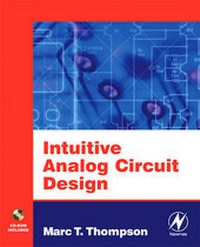
Intuitive Analog Circuit Design
Published on 12. June 2006
Book
Paperback/Softback
496 pages
978-0-7506-7786-8 (ISBN)
Description
This book reflects Marc Thompson's twenty years of experience designing and teaching analog circuit design. He describes intuitive and "back of the envelope? techniques for designing and analyzing analog circuits, including transistor amplifiers (CMOS and bipolar), transistor switching, thermal circuit design, magnetic circuit design, control systems, and the like. The application of some simple rules-of-thumb and design techniques is the first step in developing an intuitive understanding of the behavior of complex electrical systems. This book outlines some ways of thinking about analog circuits and systems that hopefully develops such "circuit intuition? and a "feel? for what a good, working analog circuit design should be.
More details
Language
English
Place of publication
Oxford
United Kingdom
Publishing group
Elsevier Science & Technology
Target group
Professional and scholarly
Analog, linear, and power supply engineers; electronics engineering students
Illustrations
Approx. 500 illustrations
Dimensions
Height: 235 mm
Width: 191 mm
Weight
1020 gr
ISBN-13
978-0-7506-7786-8 (9780750677868)
Copyright in bibliographic data and cover images is held by Nielsen Book Services Limited or by the publishers or by their respective licensors: all rights reserved.
Schweitzer Classification
Other editions
New editions
Marc Thompson
Intuitive Analog Circuit Design
Book
11/2013
2nd Edition
Newnes
€56.50
Shipment within 15-20 days
Additional editions
Marc Thompson
Intuitive Analog Circuit Design
E-Book
06/2006
1st Edition
Elsevier
€62.95
Available for download
Person
Dr. Thompson specializes in custom R/D, analysis, and failure investigations into multi-disciplinary electrical, magnetic, electromechanical and electronic systems at Thompson Consulting, Inc. (Harvard MA).The author is also Teaching Professor of Electrical and Computer Engineering at Worcester Polytechnic Institute. He teaches graduate-level and undergraduate seminars in analog, power quality, power electronics, electomechanics, electric motors, rotating machinery, and power distribution for high-tech companies. He has taught for University of Wisconsin-Madison, covering classes in electric motors, electromechanical systems, power electronics and magnetic design.
Content
Introduction and motivation; Bode plots, Review of pole-zero plots, Second-order systems, Relationship between bandwidth and risetime; Bipolar device models; Review of feedback systems; Bandwidth estimation techniques; Transistor switching and switching speed estimation; Transistor extended models; CMOS amplifiers; Advanced transistor amplifier design techniques; Operational amplifier topologies; Real-world op-amps; Operational amplifier circuit potpourri; Analog filtering; PC board layout; Impedance of a PC board trace, Power supply bypassing; Passive components; Mechanical circuit analogies, Thermal circuits, Magnetic circuits