

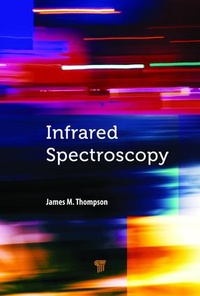
Infrared Spectroscopy
1st Edition
Published on 1. February 2018
Book
Hardback
210 pages
978-981-4774-78-9 (ISBN)
Description
It is estimated that there are about 10 million organic chemicals known, and about 100,000 new organic compounds are produced each year. Some of these new chemicals are made in the laboratory and some are isolated from natural products. The structural determination of these compounds is the job of the chemist. There are several instrumental techniques used to determine the structures of organic compounds. These include NMR, UV/visible, infrared spectroscopy, mass spectrometry, and X-ray crystallography. Of all the instrumental techniques listed, infrared spectroscopy and mass spectrometry are the two most popular techniques, mainly because they tend to be less expensive and give us the most structural information.
This book is an introductory text designed to acquaint undergraduate and graduate students with the basic theory and interpretative techniques of infrared spectroscopy. Much of the material in this text has been used over a period of several years for teaching courses in materials characterization and chemical analysis. It presents the infrared spectra of the major classes of organic compounds and correlates the infrared bands (bond vibrations) of each spectrum with the structural features of the compound it represents. This has been done for hydrocarbons, organic acids, ketones, aldehydes, esters, anhydrides, phenols, amines, and amides. The text discusses the origin of the fragments, techniques, innovations, and applications in infrared spectroscopy. It is interspersed with many illustrations, examples, an adequate but not overwhelming bibliography, and problems for students. It will serve as a lecture text for a one-semester course in infrared spectroscopy or can be used to teach the infrared spectroscopy portion of a broader course in material characterization and chemical analysis.
This book is an introductory text designed to acquaint undergraduate and graduate students with the basic theory and interpretative techniques of infrared spectroscopy. Much of the material in this text has been used over a period of several years for teaching courses in materials characterization and chemical analysis. It presents the infrared spectra of the major classes of organic compounds and correlates the infrared bands (bond vibrations) of each spectrum with the structural features of the compound it represents. This has been done for hydrocarbons, organic acids, ketones, aldehydes, esters, anhydrides, phenols, amines, and amides. The text discusses the origin of the fragments, techniques, innovations, and applications in infrared spectroscopy. It is interspersed with many illustrations, examples, an adequate but not overwhelming bibliography, and problems for students. It will serve as a lecture text for a one-semester course in infrared spectroscopy or can be used to teach the infrared spectroscopy portion of a broader course in material characterization and chemical analysis.
More details
Language
English
Place of publication
Singapore
Singapore
Target group
College/higher education
Professional and scholarly
Academic and Postgraduate
Dimensions
Height: 229 mm
Width: 152 mm
Weight
550 gr
ISBN-13
978-981-4774-78-9 (9789814774789)
Copyright in bibliographic data and cover images is held by Nielsen Book Services Limited or by the publishers or by their respective licensors: all rights reserved.
Schweitzer Classification
Other editions
Additional editions
James M. Thompson
Infrared Spectroscopy
E-Book
01/2018
1st Edition
Routledge
€101.99
Available for download
James M. Thompson
Infrared Spectroscopy
E-Book
01/2018
1st Edition
Routledge
€101.99
Available for download
Person
James M. Thompson is emeritus professor at the Department of Chemistry and former chair of the Department of Natural and Physical Sciences at Alabama A&M University. He taught organic chemistry and instrumental methods for many years at the university. He received his PhD in 1975 from the University of Delaware under the supervision of Dr. Richard F. Heck (recipient of the Nobel Prize in Chemistry in 2010). Prof. Thompson's research interests are in organic chemistry, use of mass spectra, infrared spectra, C-13 and proton nuclear magnetic resonance spectra, and structural determination of organic compounds. He performed research for NASA in the area of thermal gravimetric analysis for about 15 years and is a recipient of more than 50 awards and recognitions.
Content
Some Fundamentals of Infrared Spectroscopy. The Analysis of Infrared Spectra. Techniques, Innovations, and Applications in Infrared Spectroscopy. Problems in Infrared Spectroscopy. Appendix.