

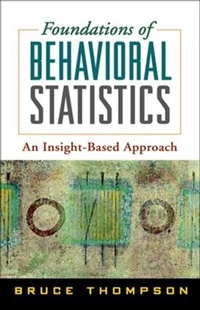
Foundations of Behavioral Statistics
An Insight-Based Approach
1st Edition
Published on 4. May 2006
Book
Hardback
457 pages
978-1-59385-285-6 (ISBN)
Description
With humor, extraordinary clarity, and carefully paced explanations and examples, Bruce Thompson shows readers how to use the latest techniques for interpreting research outcomes as well as how to make statistical decisions that result in better research. Utilizing the general linear model to demonstrate how different statistical methods are related to each other, Thompson integrates a broad array of methods involving only a single dependent variable, ranging from classical and robust location descriptive statistics, through effect sizes, and on through ANOVA, multiple regression, loglinear analysis and logistic regression. Special features include SPSS and Excel demonstrations that offer opportunities, in the book's datasets and on Thompson's website, for further exploration of statistical dynamics.
Reviews / Votes
"This is a very useful book that graduate students should read to help them understand and use their statistical tools. And not just grad students could stand to read it--some of the issues raised, such as statistical significance and size effects, plague the vast majority of social research. As editor of Social Problems, I very frequently came across sophisticated papers that simply reported the statistical significance of findings without saying a word about the magnitude of the effect purportedly being examined, or the importance or impact of the phenomenon under discussion."--James A. Holstein, Department of Social and Cultural Sciences, Marquette University"This book would be suited for professional and/or class use. The benefit for professional use is the vast number of resources and references cited throughout. This wealth of seminal works from some of the best minds in the field of statistics would provide professionals with supplemental knowledge and information on many crucial statistical issues that have recently been proposed, debated, challenged, and mandated (APA)."--Victoria Rodlin, Statistical Consultant (former faculty, Department of Psychology, California State University, Fullerton)
"This book will encourage both students and experienced researchers to 'think through' the process, critically examine their hypotheses, and choose the statistical method best suited to their theory. Thompson's repeated emphasis regarding the importance of interpreting an analysis by comparing results with those across prior related studies is vital and well stated throughout."--Victoria Rodlin, Statistical Consultant (former faculty, Department of Psychology, California State University, Fullerton)
"I mainly teach statistics to nursing students, and I could easily see myself switching to Thompson's book because it is basically one of the most readable serious statistics books I have seen. This is a book that deals with univariate and bivariate statistics and those multivariate statistics where there's only a single dependent variable. It emphasizes the general linear model as a unifying concept, as well as emphasizing effect sizes and confidence intervals in addition to null hypothesis statistical testing."--Kenneth A. Wallston, School of Nursing, Vanderbilt University
"There are a lot of quite simple introductory statistics texts out there ('too cold!'), and a large number of really comprehensive ones, perhaps best digested over two semesters ('too hot!'). However, I found Thompson's treatment and coverage to be 'just right.' I especially appreciated his conservatism in using and interpreting statistics."--Bruce Thyer, College of Social Work, Florida State University
"An important contribution to improving data analysis and interpretation methods in the social sciences. This book treats many important topics that are ignored in most statistics books. Examples include the limitations of statistical significance tests, the importance of effect size indices, the important role of distribution shapes in determining ceilings on linear relationships, problems of capitalization on sampling error in stepwise regression, and many, many others. The Statistical Significance chapter is excellent and one of the crown jewels of this book. This is the kind of understanding of significance testing that we should seek to impart to students and researchers. No other stat book, to my knowledge, has a chapter like this one. This is the direction in which things are moving today."--Frank L. Schmidt, College of Business, University of Iowa
"A nice contribution to the field, providing a gentle introduction to statistics and simultaneously introducing the student to some important advances. The writing, which includes plenty of examples from a broad range of applications, is accessible to the beginning graduate student and is entertaining to boot. The tables and figures are clear and provide a nice complement to the narrative."--Jeffrey D. Kromrey, Department of Educational Measurement and Research, University of South Florida
"This is a very well-thought-out book. It is not the same old inferential statistics. It has some snap to it. The author takes on thorny issues that often are not addressed in introductory texts. It is very conceptual and would be appropriate for a number of undergraduate or graduate courses in statistics for students without much in the way of math backgrounds, which is to say, most of the social, behavioral, and biomedical areas."--Paul R. Swank, Department of Pediatrics, University of Texas Health Science Center at Houston
"The exercises in a conceptual book like this should be reflective and thought provoking, rather than computational/m-/just like these were done!"--Paul R. Swank, Department of Pediatrics, University of Texas Health Science Center at Houston
"This is an outstanding text that represents a new era in the learning and reporting of statistics in the behavioral sciences. Thompson focuses on analytic thinking rather than mathematical number-crunching, unlike others who emphasize calculations at the expense of critical thinking. The use of humor throughout the book is also a distinctive feature and it brings a considerable amount of 'realism' to the text. This book is at the leading edge of methodological advances regarding the interpretation of research outcomes, and will serve a critical role in the continued evolution of the behavioral statistics field."--Robin K. Henson, Department of Technology and Cognition, University of North Texas
"The Reflection Problems are an outstanding extension that most other statistics texts do not have."--Robin K. Henson, Department of Technology and Cognition, University of North Texas
"This is the best book for graduate students in statistics, due to the clarity and simplicity of the exposition."--Pedro Reyes, PhD, Department of Educational Administration, University of Texas at Austin "This is the best book for graduate students in statistics, due to the clarity and simplicity of the exposition."--Pedro Reyes, PhD, Department of Educational Administration, University of Texas at Austin "This text has a clear and logical approach that allows its use across a variety of fields and levels of instruction."--Kirk E. Wheeler, PhD, Adjunct Lecturer, Indiana University School of Nursing
"Thompson is an expert at presenting outcomes on a level that challenges students to question how and why, and sometimes forces them to abandon their math anxiety and look at numeric outcomes in new ways. For example, one student, in an 'aha moment,' exclaimed, 'I just figured out what the standard error is.' That's big!"--Gail Delicio, E.T. Moore School of Education, Clemson University
"I found the book very useful as an instructor, and the students really enjoyed the straightforward approach to explaining statistical methods. The accessible style made it easy for students to grasp and apply statistical concepts."--Tammy Kolbe, Department of Education Policy and Leadership, University of Maryland-College Park "I found the book very useful as an instructor, and the students really enjoyed the straightforward approach to explaining statistical methods. The accessible style made it easy for students to grasp and apply statistical concepts." - Tammy Kolbe, Department of Education Policy and Leadership, University of Maryland-College Park, USA
"This is a very useful book that graduate students should read to help them understand and use their statistical tools. And not just grad students could stand to read it-some of the issues raised, such as statistical significance and size effects, plague the vast majority of social research. As editor of Social Problems, I very frequently came across sophisticated papers that simply reported the statistical significance of findings without saying a word about the magnitude of the effect purportedly being examined, or the importance or impact of the phenomenon under discussion." - James A. Holstein, Department of Social and Cultural Sciences, Marquette University, USA
"There are a lot of quite simple introductory statistics texts out there ('too cold!'), and a large number of really comprehensive ones, perhaps best digested over two semesters ('too hot!'). However, I found Thompson's treatment and coverage to be 'just right.' I especially appreciated his conservatism in using and interpreting statistics." - Bruce Thyer, College of Social Work, Florida State University, USA
"An important contribution to improving data analysis and interpretation methods in the social sciences....The Statistical Significance chapter is excellent and one of the crown jewels of this book. This is the kind of understanding of significance testing that we should seek to impart to students and researchers." - Frank L. Schmidt, College of Business, University of Iowa, USA
"This is an outstanding text that represents a new era in the learning and reporting of statistics in the behavioral sciences. Thompson focuses on analytic thinking rather than mathematical number-crunching, unlike others that emphasize calculations at the expense of critical thinking....This book is at the leading edge of methodological advances regarding the interpretation of research outcomes, and will serve a critical role in the continued evolution of the behavioral statistics field." - Robin K. Henson, Department of Technology and Cognition, University of North Texas, USA
More details
Language
English
Place of publication
New York
United States
Target group
College/higher education
Professional and scholarly
Dimensions
Height: 254 mm
Width: 178 mm
Weight
994 gr
ISBN-13
978-1-59385-285-6 (9781593852856)
Copyright in bibliographic data and cover images is held by Nielsen Book Services Limited or by the publishers or by their respective licensors: all rights reserved.
Schweitzer Classification
Other editions
Additional editions
Book
04/2008
1st Edition
Guilford Publications
€81.89
Article exhausted; check different version
Person
Bruce Thompson is Distinguished Professor of Educational Psychology and Distinguished Professor of Library Sciences, Texas A&M University, and Adjunct Professor of Family and Community Medicine, Baylor College of Medicine, Houston. He is the coeditor of the teaching, learning, and human development section of the American Educational Research Journal and past editor of Educational and Psychological Measurement, the series Advances in Social Science Methodology, and two other journals. He is the author or editor of 10 books, has written over 175 research articles, and has made contributions that have been influential in promoting greater emphasis on effect size reporting and interpretation, and improved understanding of score reliability.
Content
Preface
1. Introductory Terms and Concepts
Definitions of Some Basic Terms
Levels of Scale
Some Experimental Design Considerations
Some Key Concepts
Reflection Problems
2. Location
Reasonable Expectations for Statistics
Location Concepts
Three Classical Location Descriptive Statistics
Four Criteria for Evaluating Statistics
Two Robust Location Statistics
Some Key Concepts
Reflection Problems
3. Dispersion
Quality of Location Descriptive Statistics
Important in Its Own Right
Measures of Score Spread
Variance
Situation-Specific Maximum Dispersion
Robust Dispersion Descriptive Statistics
Standardized Score World
Some Key Concepts
Reflection Problems
4. Shape
Two Shape Descriptive Statistics
Normal Distributions
Two Additional Univariate Graphics
Some Key Concepts
Reflection Problems
5. Bivariate Relationships
Pearson's r
Three Features of r
Three Interpretation Contextual Factors
Psychometrics of the Pearson r
Spearman's rho
Two Other r -Equivalent Correlation Coefficients
Bivariate Normality
Some Key Concepts
Reflection Problems
6. Statistical Significance
Sampling Distributions
Hypothesis Testing
Properties of Sampling Distributions
Standard Error/Sampling Error
Test Statistics
Statistical Precision and Power
pCALCULATED
Some Key Concepts
Reflection Problems
7. Practical Significance
Effect Sizes
Confidence Intervals
Confidence Intervals for Effect Sizes
Some Key Concepts
Reflection Problems
8. Multiple Regression Analysis: Basic GLM Concepts
Purposes of Regression
Simple Linear Prediction
Case #1: Perfectly Uncorrelated Predictors
Case #2: Correlated Predictors, No Suppressor
Effects
Case #3: Correlated Predictors, Suppressor
Effects Present
b Weights versus Structure Coefficients
A Final Comment on Collinearity
Some Key Concepts
Reflection Problems
9. A GLM Interpretation Rubric
Do I Have Anything?
Where Does My Something Originate?
Stepwise Methods
Invoking Some Alternative Models
1. Introductory Terms and Concepts
Definitions of Some Basic Terms
Levels of Scale
Some Experimental Design Considerations
Some Key Concepts
Reflection Problems
2. Location
Reasonable Expectations for Statistics
Location Concepts
Three Classical Location Descriptive Statistics
Four Criteria for Evaluating Statistics
Two Robust Location Statistics
Some Key Concepts
Reflection Problems
3. Dispersion
Quality of Location Descriptive Statistics
Important in Its Own Right
Measures of Score Spread
Variance
Situation-Specific Maximum Dispersion
Robust Dispersion Descriptive Statistics
Standardized Score World
Some Key Concepts
Reflection Problems
4. Shape
Two Shape Descriptive Statistics
Normal Distributions
Two Additional Univariate Graphics
Some Key Concepts
Reflection Problems
5. Bivariate Relationships
Pearson's r
Three Features of r
Three Interpretation Contextual Factors
Psychometrics of the Pearson r
Spearman's rho
Two Other r -Equivalent Correlation Coefficients
Bivariate Normality
Some Key Concepts
Reflection Problems
6. Statistical Significance
Sampling Distributions
Hypothesis Testing
Properties of Sampling Distributions
Standard Error/Sampling Error
Test Statistics
Statistical Precision and Power
pCALCULATED
Some Key Concepts
Reflection Problems
7. Practical Significance
Effect Sizes
Confidence Intervals
Confidence Intervals for Effect Sizes
Some Key Concepts
Reflection Problems
8. Multiple Regression Analysis: Basic GLM Concepts
Purposes of Regression
Simple Linear Prediction
Case #1: Perfectly Uncorrelated Predictors
Case #2: Correlated Predictors, No Suppressor
Effects
Case #3: Correlated Predictors, Suppressor
Effects Present
b Weights versus Structure Coefficients
A Final Comment on Collinearity
Some Key Concepts
Reflection Problems
9. A GLM Interpretation Rubric
Do I Have Anything?
Where Does My Something Originate?
Stepwise Methods
Invoking Some Alternative Models