

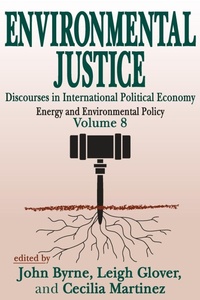
Environmental Justice
International Discourses in Political Economy
1st Edition
Published on 31. December 2001
Book
Paperback/Softback
310 pages
978-0-7658-0751-9 (ISBN)
Description
Environmental justice is one of the most controversial and important issues in contemporary social science. Volume 8 of the Energy and Environmental Policy series challenges our understanding of environmental justice in a global context. It includes theoretical investigations and case studies by leading authors in the field.
Global forces of technology and the development of global markets are transforming social life and the natural order. These changes require a critical examination of nature-society relations. Increasingly, modernization assigns the risks of modernity to those with the least power and greatest vulnerability to environmental harm. Conventional environmentalism, which focuses on critique of the effects of humanity against nature, is inadequate to the challenges of globalization. In particular, it fails to explain sources of persistent patterns of social injustice that accompany escalating environmental exploitation. As the capacity for environmental destruction expands, broader concerns about environmental injustice have come to the fore, including awareness of threats to whole cultures, ways of life, and entire ecologies. The volume's authors consider the links between expanded patterns of environmental injustice and the structures and forces underlying and shaping the international political economy.
Environmental injustice is examined across a variety of cultures in the developed and developing world. Through case studies of climate colonialism, revolutionary ecology, and environmental commodification, the global and local dimensions of the problem are presented.The latest volume in this important series demonstrates that environmental justice cannot be reduced to simple parables of indifference, prejudice, or appropriation. It forges understanding of environmental injustice as a development of international political economy itself. Likewise, initiatives on behalf of environmental justice are seen as elements of broader movements to secure self-determination in a globalizing world. This book will be of interest to policymakers, energy and environmental experts, and all those interested in the environment and environmental law. It provides new perspectives on the place of environmental justice in international political and economic conflict.
Global forces of technology and the development of global markets are transforming social life and the natural order. These changes require a critical examination of nature-society relations. Increasingly, modernization assigns the risks of modernity to those with the least power and greatest vulnerability to environmental harm. Conventional environmentalism, which focuses on critique of the effects of humanity against nature, is inadequate to the challenges of globalization. In particular, it fails to explain sources of persistent patterns of social injustice that accompany escalating environmental exploitation. As the capacity for environmental destruction expands, broader concerns about environmental injustice have come to the fore, including awareness of threats to whole cultures, ways of life, and entire ecologies. The volume's authors consider the links between expanded patterns of environmental injustice and the structures and forces underlying and shaping the international political economy.
Environmental injustice is examined across a variety of cultures in the developed and developing world. Through case studies of climate colonialism, revolutionary ecology, and environmental commodification, the global and local dimensions of the problem are presented.The latest volume in this important series demonstrates that environmental justice cannot be reduced to simple parables of indifference, prejudice, or appropriation. It forges understanding of environmental injustice as a development of international political economy itself. Likewise, initiatives on behalf of environmental justice are seen as elements of broader movements to secure self-determination in a globalizing world. This book will be of interest to policymakers, energy and environmental experts, and all those interested in the environment and environmental law. It provides new perspectives on the place of environmental justice in international political and economic conflict.
More details
Series
Language
English
Place of publication
Somerset
United Kingdom
Publishing group
Taylor & Francis Inc
Target group
College/higher education
Professional and scholarly
Dimensions
Height: 229 mm
Width: 152 mm
Thickness: 17 mm
Weight
455 gr
ISBN-13
978-0-7658-0751-9 (9780765807519)
Copyright in bibliographic data and cover images is held by Nielsen Book Services Limited or by the publishers or by their respective licensors: all rights reserved.
Schweitzer Classification
Other editions
Additional editions
E-Book
09/2017
Routledge
€67.49
Available for download
E-Book
09/2017
Routledge
€67.49
Available for download
Book
09/2017
1st Edition
Routledge
€206.90
Shipment within 10-20 days
Person
Paul Thompson
Content
I: Defining the Discourse; 1: A Brief on Environmental Justice; 2: Ecology, Justice, and the End of Development; II: Case Studies; 3: A Revolution in Environmental Justice and Sustainable Development: The Political Ecology of Nicaragua; 4: The Long March for Livelihoods: Struggle Against the Narmada Dam in India; 5: A 'Necessary Sacrifice:' Industrialization and American Indian Lands; 6: The Circle of Life: Preserving American Indian Traditions and Facing the Nuclear Challenge; 7: Powering Injustice: Hydroelectric Development in Northern Manitoba; 8: The Global Commons and Environmental Justice-Climate Change; III: Expanding the Discourse; 9: Ecosocialization and Environmental Justice; 10: globalization.com vs. ecologicaljustice.org : Contesting the End of History; 11: The Production of Unequal Nature