

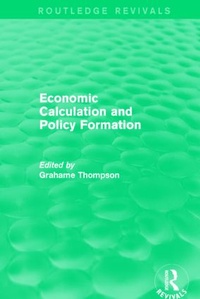
Economic Calculations and Policy Formation (Routledge Revivals)
1st Edition
Published on 22. September 2014
Book
Hardback
200 pages
978-1-138-82964-0 (ISBN)
Description
These essays develop a Marxist response to and approach to aspects of the recent economic past in the United Kingdom. They reflect issues and controversies that have arisen within economic policy debate and the economic theory associated with the debate, highlighting the problematic nature of economic policy in the period since the mid-1970s. The book, first published in 1986, develops a line of argument organized around issues of 'calculation', thus challenging the orthodox Marxist framework and presenting a neo-Marxist analysis.
More details
Series
Language
English
Place of publication
London
United Kingdom
Publishing group
Taylor & Francis Ltd
Target group
College/higher education
Dimensions
Height: 234 mm
Width: 156 mm
Weight
476 gr
ISBN-13
978-1-138-82964-0 (9781138829640)
Copyright in bibliographic data and cover images is held by Nielsen Book Services Limited or by the publishers or by their respective licensors: all rights reserved.
Schweitzer Classification
Other editions
Additional editions
Grahame Thompson
Economic Calculations and Policy Formation (Routledge Revivals)
Book
04/2016
1st Edition
Routledge
€67.03
Shipment within 10-20 days
Grahame Thompson
Economic Calculations and Policy Formation (Routledge Revivals)
E-Book
11/2014
1st Edition
Routledge
€52.49
Available for download
Grahame Thompson
Economic Calculations and Policy Formation (Routledge Revivals)
E-Book
11/2014
1st Edition
Routledge
€52.49
Available for download
Person
Thompson Grahame
Content
1. Introduction 2. The relationship between the financial and industrial sector in the United Kingdom economy 3. Capitalist profit calculation and inflation accounting 4. Capitalist profit calculation and inflation accounting: a comment 5. Economic calculation as 'sign'? A reply to Angelo Reati 6. Monetarism and economic ideology 7. The firm as a 'dispersed' social agency