

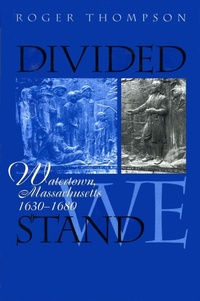
Divided We Stand
Watertown, Massachusetts, 1630-1680
Will be published approx. on 30. September 2012
Book
Paperback/Softback
288 pages
978-1-55849-961-4 (ISBN)
Description
Established in 1630, Watertown was among the original six towns of Massachusetts. Its early history was marked by frequent disputes, a penchant for questioning authority, and an atmosphere of tension and discord. In recounting the story of Watertown's formative years, Roger Thompson examines how the community managed to avoid descending into anarchy. He also explores the ways in which English settlers preserved their habits of behavior in a new-world environment, even as they were obliged to innovate and embrace change. Thompson describes Watertown's early government, its relations with Native Americans and neighboring communities, its religious and economic affairs, and the day-to-day experiences of its people. Conflict occurred over a wide variety of issues: land allocation, administrative accountability, religious orthodoxy and exclusivity, generational and gender differences, livestock and fencing, haves and have-nots.
Thompson brings these disputes to life through a series of vivid case studies drawn from the unpublished Middlesex County Court Records. Among others, we meet John Sawin, who despite his best efforts at subterfuge was convicted of stealing and selling a neighbor's horse; Susanna Woodward, whose pregnancy resulted in a fiercely contested paternity case; and Edward Sanders, whose punishment for child abuse was both a whipping and a ruling that when in public he must "wear a rope round his neck openly to be seen hanging down two feet."
Throughout the book, the same themes reappear: continuity and change, the persistent conflicts of the first two generations, and the countervailing forces of communal cohesion.
Thompson brings these disputes to life through a series of vivid case studies drawn from the unpublished Middlesex County Court Records. Among others, we meet John Sawin, who despite his best efforts at subterfuge was convicted of stealing and selling a neighbor's horse; Susanna Woodward, whose pregnancy resulted in a fiercely contested paternity case; and Edward Sanders, whose punishment for child abuse was both a whipping and a ruling that when in public he must "wear a rope round his neck openly to be seen hanging down two feet."
Throughout the book, the same themes reappear: continuity and change, the persistent conflicts of the first two generations, and the countervailing forces of communal cohesion.
Reviews / Votes
This elegantly organized and lucidly written history of a Massachusetts town before 1680 demonstrates that the genre of 'microhistory,' or traditional 'community studies,' remains vibrant." - Choice"Deeply learned and artistically accomplished. In this study, the people of Watertown emerge as individuals, the geography is vivid, the sense of place is strong on both sides of the Atlantic, and the coverage of topics is impressive. Divided We Stand is the leading candidate in my own mind as the best 17th-century New England town study." - Barry Levy, author of Quakers and the American Family: British Quakers in the Delaware Valley, 1650-1765
More details
Language
English
Place of publication
Massachusetts
United States
Target group
Professional and scholarly
Product notice
Paperback (trade)
Dimensions
Height: 234 mm
Width: 156 mm
Thickness: 15 mm
Weight
411 gr
ISBN-13
978-1-55849-961-4 (9781558499614)
Copyright in bibliographic data and cover images is held by Nielsen Book Services Limited or by the publishers or by their respective licensors: all rights reserved.
Schweitzer Classification
Person
Roger Thompson teaches American studies at the University of East Anglia, England. He is author of Sex in Middlesex: Popular Mores in a Massachusetts County, 1649-1699, and Mobility and Migration: East Anglian Founders of New England, 1629-1640.