

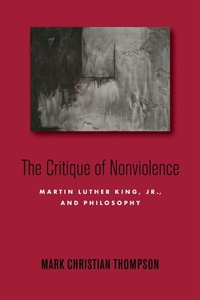
The Critique of Nonviolence
Martin Luther King, Jr., and Philosophy
Published on 28. June 2022
Book
Hardback
232 pages
978-1-5036-3113-7 (ISBN)
Description
How does Martin Luther King, Jr., understand race philosophically and how did this understanding lead him to develop an ontological conception of racist police violence?
In this important new work, Mark Christian Thompson attempts to answer these questions, examining ontology in Martin Luther King, Jr.'s philosophy. Specifically, the book reads King through 1920s German academic debates between Martin Heidegger, Rudolf Bultmann, Hans Jonas, Carl Schmitt, Eric Voegelin, Hannah Arendt, and others on Being, gnosticism, existentialism, political theology, and sovereignty. It further examines King's dissertation about Tillich, as well other key texts from his speculative writings, sermons, and speeches, positing King's understanding of divine love as a form of Heideggerian ontology articulated in beloved community.
Tracking the presence of twentieth-century German philosophy and theology in his thought, the book situates King's ontology conceptually and socially in nonviolent protest. In so doing, The Critique of Nonviolence reads King's "Letter from a Birmingham Jail" (1963) with Walter Benjamin's "Critique of Violence" (1921) to reveal the depth of King's political-theological critique of police violence as the illegitimate appropriation of the racialized state of exception. As Thompson argues, it is in part through its appropriation of German philosophy and theology that King's ontology condemns the perpetual American state of racial exception that permits unlimited police violence against Black lives.
In this important new work, Mark Christian Thompson attempts to answer these questions, examining ontology in Martin Luther King, Jr.'s philosophy. Specifically, the book reads King through 1920s German academic debates between Martin Heidegger, Rudolf Bultmann, Hans Jonas, Carl Schmitt, Eric Voegelin, Hannah Arendt, and others on Being, gnosticism, existentialism, political theology, and sovereignty. It further examines King's dissertation about Tillich, as well other key texts from his speculative writings, sermons, and speeches, positing King's understanding of divine love as a form of Heideggerian ontology articulated in beloved community.
Tracking the presence of twentieth-century German philosophy and theology in his thought, the book situates King's ontology conceptually and socially in nonviolent protest. In so doing, The Critique of Nonviolence reads King's "Letter from a Birmingham Jail" (1963) with Walter Benjamin's "Critique of Violence" (1921) to reveal the depth of King's political-theological critique of police violence as the illegitimate appropriation of the racialized state of exception. As Thompson argues, it is in part through its appropriation of German philosophy and theology that King's ontology condemns the perpetual American state of racial exception that permits unlimited police violence against Black lives.
Reviews / Votes
"Reading King with Heidegger and Benjamin, Thompson's study is a welcome and intellectually engaging contribution to the recent renaissance of scholarship devoted to King's philosophical thought."-Robert J Gooding-Williams, Columbia University "A tour de force! Essential for students of King, Black Power, and twentieth-century Africana and European philosophy. Thompson's King is an important counterweight to the simple, sanitized saint that haunts mainstream politics."-Paul C. Taylor, Vanderbilt University "Thompson invites us to rethink King's nonviolent strategy as a conceptually rigorous moral, philosophical, and racial commitment. Critical for scholars and students interested in King, peace studies, Black studies, history, religious studies, and philosophy."-James Haile III, University of Rhode IslandMore details
Edition
New edition
Language
English
Place of publication
Palo Alto
United States
Target group
Professional and scholarly
Edition type
New edition
Product notice
Cloth
Dimensions
Height: 157 mm
Width: 231 mm
Thickness: 20 mm
Weight
476 gr
ISBN-13
978-1-5036-3113-7 (9781503631137)
Copyright in bibliographic data and cover images is held by Nielsen Book Services Limited or by the publishers or by their respective licensors: all rights reserved.
Schweitzer Classification
Other editions
Additional editions

E-Book
08/2022
Stanford University Press
from
€57.99
Available for download

Book
03/2020
Stanford University Press
€26.50
Shipment within 15-20 days
Person
Mark Christian Thompson is Krieger-Eisenhower Professor of English at Johns Hopkins University. His most recent book is Phenomenal Blackness: Black Power, Philosophy, and Theory (2022).
Content
Introduction: Ontology and Nonviolence
1. Being and Nonviolence
2. Nonbeing and Nonviolence
3. Black Power as Nonviolence
4. Gnosticism and Nonviolence
5. Divine Nonviolence
Conclusion: Eros as Nonviolence
1. Being and Nonviolence
2. Nonbeing and Nonviolence
3. Black Power as Nonviolence
4. Gnosticism and Nonviolence
5. Divine Nonviolence
Conclusion: Eros as Nonviolence