

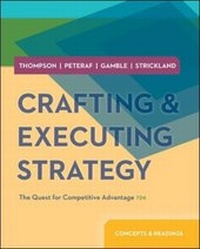
Crafting and Executing Strategy: Concepts and Readings
19th Edition
Published on 17. January 2013
Book
Paperback/Softback
600 pages
978-0-07-753707-4 (ISBN)
Description
The distinguishing mark of the 19th edition is its enriched and enlivened presentation of the material in each of the 12 chapters, providing an as up-to-date and engrossing discussion of the core concepts and analytical tools as you will find anywhere. There is an accompanying line-up of exciting new cases that bring the content to life and are sure to provoke interesting classroom discussions, deepening students' understanding of the material in the process. While this 19th edition retains the 12-chapter structure of the prior edition, every chapter - indeed every paragraph and every line - has been re - examined, refined, and refreshed.
New content has been added to keep the material in line with the latest developments in the theory and practice of strategic management. In other areas, coverage has been trimmed to keep the book at a more manageable size. Scores of new examples have been added, along with 16 new Illustration
Capsules, to enrich understanding of the content and to provide students with a ringside view of strategy in action.
The result is a text that cuts straight to the chase in terms of what students really need to know and gives instructors a leg up on teaching that material effectively. It remains, as always, solidly mainstream and balanced, mirroring both the penetrating insight of academic thought and the pragmatism of real-world strategic management.
Thompson 19e, your best case scenario!
New content has been added to keep the material in line with the latest developments in the theory and practice of strategic management. In other areas, coverage has been trimmed to keep the book at a more manageable size. Scores of new examples have been added, along with 16 new Illustration
Capsules, to enrich understanding of the content and to provide students with a ringside view of strategy in action.
The result is a text that cuts straight to the chase in terms of what students really need to know and gives instructors a leg up on teaching that material effectively. It remains, as always, solidly mainstream and balanced, mirroring both the penetrating insight of academic thought and the pragmatism of real-world strategic management.
Thompson 19e, your best case scenario!
More details
Edition
19th edition
Language
English
Place of publication
London
United States
Publishing group
McGraw-Hill Education - Europe
Target group
College/higher education
Dimensions
Height: 251 mm
Width: 203 mm
Thickness: 20 mm
Weight
1027 gr
ISBN-13
978-0-07-753707-4 (9780077537074)
Schweitzer Classification
Persons
Arthur A. Thompson, Jr., earned his B.S and Ph.D. degrees in economics from The University of Tennessee, spent three years on the economics faculty at Virginia Tech, and served on the faculty of The University of Alabama's College of Commerce and Business Administration for 24 years. In 1974 and again in 1982, Dr. Thompson spent semester-long sabbaticals as a visiting scholar at the Harvard Business School.
His areas of specialization are business strategy, competition and market analysis, and the economics of business enterprises. In addition to publishing over 30 articles in some 25 different professional and trade publications, he has authored or co-authored five textbooks and six computer-based simulation exercises. His textbooks and strategy simulations have been used at well over 1,000 college and university campuses worldwide.
Dr. Thompson spends much of his off-campus time giving presentations, putting on management development programs, working with companies, and helping operate a business simulation enterprise in which he is a major partner.
Dr.Thompson and his wife of 56 years have two daughters, two grandchildren, and a Yorkshire terrier.
A.J. (Lonnie) Strickland received a BS in Math and Physics from the University of Georgia, an MS in Industrial Management from Georgia Institute of Technology, and a PhD from Georgia State university. He currently holds the rank of Professor of Strategic Management in the Graduate School of Business at the University of Alabama. He has done extensive consulting and research work. In recent years, he was honored with the Outstanding Professor Award for the Graduate School of Business, and was the recipient of the Outstanding Commitment to Teaching Award for the University of Alabama.
John E. Gamble is currently Associate Dean and Professor of Management in the Mitchell College of Business at the University of South Alabama. His teaching specialty at USA is strategic management and he also conducts a course in strategic management in Germany, which is sponsored by the University of Applied Sciences in Worms. Dr. Gamble's research interests center on strategic issues in entrepreneurial, health care, and manufacturing settings. His work has been published in various scholarly journals and he is the author or co-author of more than 50 case studies published in an assortment of strategic management and strategic marketing texts. He has done consulting on industry and market analysis for clients in a diverse mix of industries. Professor Gamble received his Ph.D. in management from the University of Alabama in 1995. Dr. Gamble also has a Bachelor of Science degree and a Master of Arts degree from the University of Alabama.
His areas of specialization are business strategy, competition and market analysis, and the economics of business enterprises. In addition to publishing over 30 articles in some 25 different professional and trade publications, he has authored or co-authored five textbooks and six computer-based simulation exercises. His textbooks and strategy simulations have been used at well over 1,000 college and university campuses worldwide.
Dr. Thompson spends much of his off-campus time giving presentations, putting on management development programs, working with companies, and helping operate a business simulation enterprise in which he is a major partner.
Dr.Thompson and his wife of 56 years have two daughters, two grandchildren, and a Yorkshire terrier.
A.J. (Lonnie) Strickland received a BS in Math and Physics from the University of Georgia, an MS in Industrial Management from Georgia Institute of Technology, and a PhD from Georgia State university. He currently holds the rank of Professor of Strategic Management in the Graduate School of Business at the University of Alabama. He has done extensive consulting and research work. In recent years, he was honored with the Outstanding Professor Award for the Graduate School of Business, and was the recipient of the Outstanding Commitment to Teaching Award for the University of Alabama.
John E. Gamble is currently Associate Dean and Professor of Management in the Mitchell College of Business at the University of South Alabama. His teaching specialty at USA is strategic management and he also conducts a course in strategic management in Germany, which is sponsored by the University of Applied Sciences in Worms. Dr. Gamble's research interests center on strategic issues in entrepreneurial, health care, and manufacturing settings. His work has been published in various scholarly journals and he is the author or co-author of more than 50 case studies published in an assortment of strategic management and strategic marketing texts. He has done consulting on industry and market analysis for clients in a diverse mix of industries. Professor Gamble received his Ph.D. in management from the University of Alabama in 1995. Dr. Gamble also has a Bachelor of Science degree and a Master of Arts degree from the University of Alabama.
Content
Part One: Concepts and Techniques for Crafting and Executing Strategy
Section A: Introduction and Overview
Chapter 1: What Is Strategy and Why Is It Important?
Chapter 2: Charting a Company's Direction: Its Vision, Mission, Objectives, and Strategy
Section B: Core Concepts and Analytical Tools
Chapter 3: Evaluating a Company's External Environment
Chapter 4: Evaluating a Company's Resources, Capabilities, and Competitiveness
Section C: Crafting a Strategy
Chapter 5: The Five Generic Competitive Strategies
Chapter 6: Strengthening a Company's Competitive Position
Chapter 7: Strategies for Competing in International Markets
Chapter 8: Corporate Strategy
Chapter 9: Ethics, Corporate Social Responsibility, Environmental Sustainability, and Strategy
Section D: Executing the Strategy
Chapter 10: Building an Organization Capable of Good Strategy Execution
Chapter 11: Managing Internal Operations
Chapter 12: Corporate Culture and Leadership
Part Two: Readings
Section A: What Is Strategy and How Is the Process of Crafting and Executing Strategy Managed?
Reading 1: The Perils of Bad Strategy
Reading 2: How to Identify New Business Models
Reading 3: Strategy Making: The Approach Matters
Reading 4: The Real Job of Boards
Section B: Crafting Strategy in Single-Business Companies
Reading 5: Which Strategy When?
Reading 6: A Shared Fate
Reading 7: Adaptability: The New Competitive Advantage
Reading 8: Dynamic Capabilities: A Guide for Managers
Reading 9: Profiting When Customers Choose Value over Price
Reading10: Competing against Free
Reading 11: The New M&A Playbook
Reading 12: Adding Value through Offshoring
Section C: Crafting Strategy in International and Diversified Companies
Reading 13: Is Your Emerging-Market Strategy Local Enough?
Reading 14: Strategic Orchestration
Reading 15: Diversification: Best Practices of the Leading Companies
Reading 16: Successful Divestitures Need Proper Cultivation
Section D: Strategy, Ethics, Social Responsibility, and Sustainability
Reading 17: How to Do Well and Do Good
Reading 18: Managing Moral Distress: A Strategy for Resolving Ethical Dilemmas
Section E: Executing Strategy
Reading 19: The Role of Perceived Benefits of Training in Generating Affective Commitment and High Value of Firms
Reading 20: The Learning Enterprise
Reading 21: Why Operational Excellence Matters
Reading 22: Using Knowledge Brokering to Improve Business Processes
Reading 23: Corporate Culture: Its Value as a Resource for Competitive Advantage
Reading 24: What Matters Now
Section A: Introduction and Overview
Chapter 1: What Is Strategy and Why Is It Important?
Chapter 2: Charting a Company's Direction: Its Vision, Mission, Objectives, and Strategy
Section B: Core Concepts and Analytical Tools
Chapter 3: Evaluating a Company's External Environment
Chapter 4: Evaluating a Company's Resources, Capabilities, and Competitiveness
Section C: Crafting a Strategy
Chapter 5: The Five Generic Competitive Strategies
Chapter 6: Strengthening a Company's Competitive Position
Chapter 7: Strategies for Competing in International Markets
Chapter 8: Corporate Strategy
Chapter 9: Ethics, Corporate Social Responsibility, Environmental Sustainability, and Strategy
Section D: Executing the Strategy
Chapter 10: Building an Organization Capable of Good Strategy Execution
Chapter 11: Managing Internal Operations
Chapter 12: Corporate Culture and Leadership
Part Two: Readings
Section A: What Is Strategy and How Is the Process of Crafting and Executing Strategy Managed?
Reading 1: The Perils of Bad Strategy
Reading 2: How to Identify New Business Models
Reading 3: Strategy Making: The Approach Matters
Reading 4: The Real Job of Boards
Section B: Crafting Strategy in Single-Business Companies
Reading 5: Which Strategy When?
Reading 6: A Shared Fate
Reading 7: Adaptability: The New Competitive Advantage
Reading 8: Dynamic Capabilities: A Guide for Managers
Reading 9: Profiting When Customers Choose Value over Price
Reading10: Competing against Free
Reading 11: The New M&A Playbook
Reading 12: Adding Value through Offshoring
Section C: Crafting Strategy in International and Diversified Companies
Reading 13: Is Your Emerging-Market Strategy Local Enough?
Reading 14: Strategic Orchestration
Reading 15: Diversification: Best Practices of the Leading Companies
Reading 16: Successful Divestitures Need Proper Cultivation
Section D: Strategy, Ethics, Social Responsibility, and Sustainability
Reading 17: How to Do Well and Do Good
Reading 18: Managing Moral Distress: A Strategy for Resolving Ethical Dilemmas
Section E: Executing Strategy
Reading 19: The Role of Perceived Benefits of Training in Generating Affective Commitment and High Value of Firms
Reading 20: The Learning Enterprise
Reading 21: Why Operational Excellence Matters
Reading 22: Using Knowledge Brokering to Improve Business Processes
Reading 23: Corporate Culture: Its Value as a Resource for Competitive Advantage
Reading 24: What Matters Now