

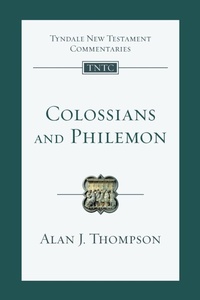
Colossians and Philemon
An Introduction and Commentary
Published on 16. June 2022
Book
Paperback/Softback
288 pages
978-1-78974-304-3 (ISBN)
Description
Paul's letters to the Colossians and Philemon are both brief, but full of theological riches. In the letter to the Colossians, he points us to the sufficiency of Christ for all our needs and shows how us how we must reflect Christ's character in all our relationships. In Philemon we see the power of the gospel to liberate captives, of sin and circumstance, to a new way of living in Christ.
In this comprehensive introduction and commentary to both letters, Alan Thompson explores how these letters still have much to teach Christians in the twenty-first century. With astute understanding, he shows how Colossians and Philemon unpack and apply the beauty of the gospel of God's grace and Christ's supremacy.
A new volume in the Tyndale New Testament commentary series, Colossians and Philemon: An Introduction and Commentary examines the text section-by-section - exploring the context in which it was written, providing thoughtful commentary on the letters to the Colossians and to Philemon, and then unpacking their theology. It will leave you with a thorough understanding of the content and structure of Paul's writing, as well as its meaning and continued relevance for Christians today.
The Tyndale New Testament Commentaries are ideal bible commentaries for students and teachers of theology, as well as being usable for preachers and individual Christians looking to delve deeper into the riches of Scripture and discover its meaning for today.
With clarity and comprehensiveness, Alan Thompson's commentary on Colossians and Philemon is a brilliant introduction that will give you a renewed appreciation for these two significant letters and a greater understanding of how Christians today can learn from them.
In this comprehensive introduction and commentary to both letters, Alan Thompson explores how these letters still have much to teach Christians in the twenty-first century. With astute understanding, he shows how Colossians and Philemon unpack and apply the beauty of the gospel of God's grace and Christ's supremacy.
A new volume in the Tyndale New Testament commentary series, Colossians and Philemon: An Introduction and Commentary examines the text section-by-section - exploring the context in which it was written, providing thoughtful commentary on the letters to the Colossians and to Philemon, and then unpacking their theology. It will leave you with a thorough understanding of the content and structure of Paul's writing, as well as its meaning and continued relevance for Christians today.
The Tyndale New Testament Commentaries are ideal bible commentaries for students and teachers of theology, as well as being usable for preachers and individual Christians looking to delve deeper into the riches of Scripture and discover its meaning for today.
With clarity and comprehensiveness, Alan Thompson's commentary on Colossians and Philemon is a brilliant introduction that will give you a renewed appreciation for these two significant letters and a greater understanding of how Christians today can learn from them.
Reviews / Votes
The Tyndale New Testament Commentary series is being revised for a third time, showing that these volumes have stood the test of time, having been read now for generations. Alan Thompson's volume on Colossians and Philemon fits admirably with the purpose and rationale for the series as a whole, as he has written a lucid commentary on these letters, one that is familiar with scholarship but focuses on unpacking the text for pastors, teachers, and lay readers. The commentary is exegetically insightful, theologically rich, and practically applicable, and I can imagine many passing on Thompson's insights in all kinds of venues. Thompson is relentless in unpacking the text, effectively and repeatedly drawing attention to how different parts of the letters relate to one another. He also draws connections between Colossians and Philemon in quite a few places in a way that is illuminating and instructive. * Thomas R. Schreiner, SBTS [Review in Bulletin for Biblical Research] * Thompson has written a reliable introductory commentary and I commend it as such. And in so doing, Thompson has perhaps given us the greatest gift of all, an insight that sparks further reflection on the text. Hopefully future scholars will follow his cue and explore the mutually-interpreting relationship between these two letters. * Adam Copenhaver, Grace Church of Mabton [Review in Themelios] *More details
Series
Language
English
Place of publication
Nottingham
United Kingdom
Product notice
Paperback (UK-trade)
Dimensions
Height: 210 mm
Width: 140 mm
Thickness: 15 mm
Weight
342 gr
ISBN-13
978-1-78974-304-3 (9781789743043)
Copyright in bibliographic data and cover images is held by Nielsen Book Services Limited or by the publishers or by their respective licensors: all rights reserved.
Schweitzer Classification
Other editions
Additional editions
E-Book
06/2022
Inter-Varsity Press
€23.49
Available for download
Previous edition
Book
11/1993
Inter-Varsity Press
€41.03
Article exhausted; check for reprint
Content
General preface vii
Author's preface ix
Abbreviations xi
Select bibliography xiv
COLOSSIANS
Introduction 1
1. Who wrote this letter? 2
2. Where is Colossae and who is Paul writing to? 8
3. Where is Paul when he writes to the Colossians (and Philemon)? 11
4. Why did Paul write to the Colossians? 15
5. How does Paul's argument develop? 23
Analysis 25
Commentary 27
PHILEMON
Introduction 205
1. Why was this letter written to Philemon? 207
Analysis 211
Commentary 213
Author's preface ix
Abbreviations xi
Select bibliography xiv
COLOSSIANS
Introduction 1
1. Who wrote this letter? 2
2. Where is Colossae and who is Paul writing to? 8
3. Where is Paul when he writes to the Colossians (and Philemon)? 11
4. Why did Paul write to the Colossians? 15
5. How does Paul's argument develop? 23
Analysis 25
Commentary 27
PHILEMON
Introduction 205
1. Why was this letter written to Philemon? 207
Analysis 211
Commentary 213