

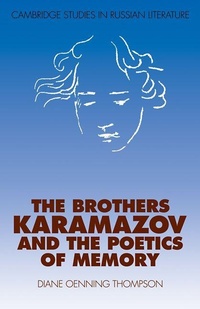
The Brothers Karamazov and the Poetics of Memory
Published on 7. May 2009
Book
Paperback/Softback
380 pages
978-0-521-11147-8 (ISBN)
Description
The Brothers Karamazov is Dostoevsky's last and most complex novel. It represents the fullest expression of his quest to achieve a literary work which would express the dilemmas and aspirations of his time and also represent the eternal, absolute values he perceived in the Christian tradition. Diane Thompson's study focuses on the meaning and poetic function of memory in the novel, and seeks to show how Dostoevsky used cultural memory to create a synthesis between his Christian ideal and art. Memory is considered not only as a theme or subject, but also as a principle of artistic composition. This interpretation identifies those aspects of cultural memory Dostoevsky incorporated into his novel, and analyses how he used them as significant components of his characters' memories. This challenging study sets Dostoevsky's work in a new perspective. It will appeal to scholars of Russian and comparative literature.
More details
Series
Language
English
Place of publication
Cambridge
United Kingdom
Target group
Professional and scholarly
Product notice
Paperback (trade)
Illustrations
Worked examples or Exercises
Dimensions
Height: 216 mm
Width: 140 mm
Thickness: 22 mm
Weight
535 gr
ISBN-13
978-0-521-11147-8 (9780521111478)
Copyright in bibliographic data and cover images is held by Nielsen Book Services Limited or by the publishers or by their respective licensors: all rights reserved.
Schweitzer Classification
Other editions
Additional editions
Diane Oenning Thompson
The Brothers Karamazov and the Poetics of Memory
Book
06/1991
Cambridge University Press
€61.87
Article exhausted; check for reprint
Previous edition
Diane Oenning Thompson
The Brothers Karamazov and the Poetics of Memory
Book
06/1991
Cambridge University Press
€61.87
Article exhausted; check for reprint
Content
Foreword; 1. Memory and poetics; 2. The fictional narrator; 3. Memory and the system of ascending plots; 4. The memories of the characters; 5. Forgetting; 6. Foretelling; 7. The christocentric poetic memory system; Afterword; Bibliography.