

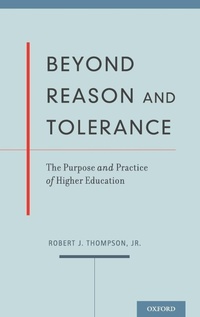
Beyond Reason and Tolerance
The Purpose and Practice of Higher Education
Published on 27. February 2014
Book
Hardback
224 pages
978-0-19-996978-4 (ISBN)
Description
The major challenges facing higher education are often framed in terms of preparing students for life-long learning. Society's 21st century needs require civic-minded individuals who have the intellectual and personal capabilities to constructively engage political, ethnic, and religious differences, work effectively, and live together with many different kinds of people in a more global society. In this volume, Robert J. Thompson aims to influence the current conversation about the purposes and practices of higher education. Beyond Reason and Tolerance adopts a developmental science basis to inform the transformations in undergraduate educational practices that are necessary to empower students to act globally and constructively engage difference. It synthesizes current scholarship regarding the nature and development of three core capacities deemed essential: A personal epistemology that reflects a sophisticated understanding of knowledge, beliefs, and ways of thinking; empathy and the capacity to understand the mental states of others; and an integrated identity that includes values, commitments, and a sense of agency for civic and social responsibility.
Beyond Reason and Tolerance argues that to foster the development of these capabilities, colleges and universities must recommit to providing a formative liberal education and adopt a developmental model of undergraduate education as a process of intellectual and personal growth, involving empathy as well as reasoning, values as well as knowledge, and identity as well as competencies. Thompson focuses on emerging adulthood as an especially dynamic time of reorganization and development of the brain that both influences, and is influenced by, the undergraduate experience. Advances in our understanding of human development and learning are synthesized with regard to the direct implications for undergraduate education practices.
Beyond Reason and Tolerance argues that to foster the development of these capabilities, colleges and universities must recommit to providing a formative liberal education and adopt a developmental model of undergraduate education as a process of intellectual and personal growth, involving empathy as well as reasoning, values as well as knowledge, and identity as well as competencies. Thompson focuses on emerging adulthood as an especially dynamic time of reorganization and development of the brain that both influences, and is influenced by, the undergraduate experience. Advances in our understanding of human development and learning are synthesized with regard to the direct implications for undergraduate education practices.
Reviews / Votes
His magnificent description of the value of a liberal arts education weaves an interdisciplinary tapestry that jumps from philosopy to psychology to education without missing a beat. * PsycCRITQUES *More details
Language
English
Place of publication
New York
United States
Target group
College/higher education
Professional and scholarly
Dimensions
Height: 240 mm
Width: 161 mm
Thickness: 17 mm
Weight
502 gr
ISBN-13
978-0-19-996978-4 (9780199969784)
Copyright in bibliographic data and cover images is held by Nielsen Book Services Limited or by the publishers or by their respective licensors: all rights reserved.
Schweitzer Classification
Other editions
Additional editions
E-Book
01/2014
1st Edition
OUP eBook
€56.49
Available for download
Person
Robert J. Thompson is Professor in the Department of Psychology and Neuroscience at Duke University. He was formerly Dean of Trinity College of Arts and Sciences and Vice Provost for Undergraduate Education at Duke.
Content
Preface ; Chapter 1: American Higher Education in the 21st Century ; Chapter 2: Emerging Adulthood: A Developmental Science Perspective ; Chapter 3: Personal Epistemology ; Chapter 4: Empathy ; Chapter 5: Identity and the Process of Self-Authorship ; Chapter 6: Campus Culture: Developing the Capacities to Constructively Engage Difference ; Chapter 7: Providing a Formative Undergraduate Liberal Education ; References