

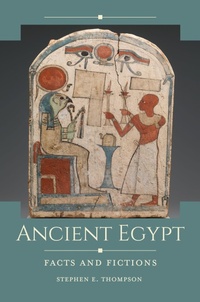
Ancient Egypt
Facts and Fictions
Published on 8. November 2019
Book
Hardback
264 pages
978-1-4408-5493-4 (ISBN)
Description
Comprising a unique collection of primary sources, this book critically examines several topics relating to ancient Egypt that are of high interest to readers but about which misconceptions abound.
With its pyramids, mummies, and sphinxes, ancient Egypt has fascinated us for centuries. It has been the setting of many films and novels, figuring prominently in popular culture. Much of what the average reader believes about this civilization, however, is mistaken. Through a unique collection of primary source documents, this book critically examines several topics related to ancient Egypt and about which misconceptions abound.
Primary sources, many in new translations by the author, are drawn from ancient Egyptian, classical Greek and Roman, Muslim, early Christian, and modern European documents. These sources shed light on popular misconceptions. Such topics include the divinity of the pharaoh, the role of animals in ancient Egyptian religion, the purpose of the Egyptian pyramids, the use of slave labor, the Egyptian hieroglyphic writing system, the role of Cleopatra in the defeat of Marc Antony and the fall of the Roman Republic, and the influence of Egyptian religion on the development of early Christianity. By studying these documents, users will be able to develop their skills interpreting and evaluating primary sources.
With its pyramids, mummies, and sphinxes, ancient Egypt has fascinated us for centuries. It has been the setting of many films and novels, figuring prominently in popular culture. Much of what the average reader believes about this civilization, however, is mistaken. Through a unique collection of primary source documents, this book critically examines several topics related to ancient Egypt and about which misconceptions abound.
Primary sources, many in new translations by the author, are drawn from ancient Egyptian, classical Greek and Roman, Muslim, early Christian, and modern European documents. These sources shed light on popular misconceptions. Such topics include the divinity of the pharaoh, the role of animals in ancient Egyptian religion, the purpose of the Egyptian pyramids, the use of slave labor, the Egyptian hieroglyphic writing system, the role of Cleopatra in the defeat of Marc Antony and the fall of the Roman Republic, and the influence of Egyptian religion on the development of early Christianity. By studying these documents, users will be able to develop their skills interpreting and evaluating primary sources.
Reviews / Votes
This book and the series will provide a great introduction to primary sources and critical thinking for advanced high school and college students. Summing Up: Recommended. General readers through upper-division undergraduates. * Choice *More details
Series
Language
English
Place of publication
United States
Publishing group
Bloomsbury Publishing Plc
Target group
College/higher education
Primary & secondary/elementary & high school
Illustrations
8 bw illus
Dimensions
Height: 240 mm
Width: 161 mm
Thickness: 19 mm
Weight
564 gr
ISBN-13
978-1-4408-5493-4 (9781440854934)
Copyright in bibliographic data and cover images is held by Nielsen Book Services Limited or by the publishers or by their respective licensors: all rights reserved.
Schweitzer Classification
Other editions
Additional editions

E-Book
11/2019
1st Edition
ABC-CLIO
€108.99
Available for download
Person
Stephen E. Thompson,, PhD, is associate director for student life at NSU University School, Davie, Florida. He has taught at Brown University, Boston University, Rhode Island College, Florida Atlantic University, and Brigham Young University.
Content
Preface
Acknowledgments
Introduction
1. Hieroglyphs Were a Secret Code Created to Conceal the Wisdom of Ancient Egypt
2. The Egyptians Worshipped Animals and Gods with Animal Heads
3. Ancient Egyptians Considered the Pharaoh to Be a God
4. The Pyramids Were Built as Storehouses, Work Projects for the Egyptian People, or Repositories of Knowledge
5. Ancient Egyptian Society Was Heavily Dependent on Slave Labor
6. Curses or Booby Traps Protected Egyptian Tombs
7. Cleopatra Was Responsible for Mark Antony's Defeat by Octavian (Augustus Caesar)
8. The Myths of Osiris, Isis, and Horus Were the Basis for the Accounts of Jesus Found in the Christian New Testament
Bibliography
Index
Acknowledgments
Introduction
1. Hieroglyphs Were a Secret Code Created to Conceal the Wisdom of Ancient Egypt
2. The Egyptians Worshipped Animals and Gods with Animal Heads
3. Ancient Egyptians Considered the Pharaoh to Be a God
4. The Pyramids Were Built as Storehouses, Work Projects for the Egyptian People, or Repositories of Knowledge
5. Ancient Egyptian Society Was Heavily Dependent on Slave Labor
6. Curses or Booby Traps Protected Egyptian Tombs
7. Cleopatra Was Responsible for Mark Antony's Defeat by Octavian (Augustus Caesar)
8. The Myths of Osiris, Isis, and Horus Were the Basis for the Accounts of Jesus Found in the Christian New Testament
Bibliography
Index