

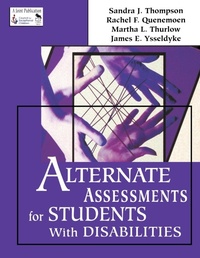
Alternate Assessments for Students With Disabilities
1st Edition
Published on 8. May 2001
Book
Paperback/Softback
168 pages
978-0-7619-7774-2 (ISBN)
Description
A Joint Publication with the Council for Exceptional Children
"The authors clearly explain the "why" of alternate assessment and support this with lots of "how-to" information throughout the book. It is hard to imagine a teacher or administrator who wouldn't gain valuable new skills from reading this book."
Victor Nolet, author
Accessing the General Curriculum
A real-world guide to creating a system of inclusive education . . . measured by inclusive assessments
Students with disabilities need and deserve alternate forms of assessment. They offer greater opportunities for inclusion in general education classrooms, improve the level of education overall, and 'raise the bar' for individual students.
Now a distinguished group of experts in special education have combined current research and a rich variety of case studies to produce a guidebook on alternate assessment-a landmark book for general and special education administrators, teachers, parents, and professionals responsible for development, training, implementation, and continuous improvement of alternate assessments at all levels.
Alternate Assessments for Students With Disabilities will show you:
How to shift to high expectations for all learners
How to carefully assess their progress
How to use the assessment data you gather to improve schooling for them
. . . offering processes and insights based on the real-world experience of states and districts across the country-concrete examples on which professionals can build a solid understanding of alternate assessment.
Thompson and her coauthors offer a "big picture" of high expectations, assessment, and accountability for students with significant disabilities, guiding readers through the process of alternate assessment from beginning to end. Several chapters include examples of worksheets and forms that have worked for some teachers, and in some settings, along with insights into how they can be used to help your students within the context of your own state policies and regulations. Additionally, Alternate Assessments for Students With Disabilities can serve as a resource for planning staff development at the state or district level, and the information can be used by collegial "learning communities" within schools as well.
Given the wide variations in settings and needs, Alternate Assessments for Students With Disabilities is specifically designed to empower you to better understand your own state or district requirements and to get the most out of whatever alternate assessment approach you choose.
All students can learn . . . and Alternate Assessments can be a key to making that a measurable reality in your school.
"The authors clearly explain the "why" of alternate assessment and support this with lots of "how-to" information throughout the book. It is hard to imagine a teacher or administrator who wouldn't gain valuable new skills from reading this book."
Victor Nolet, author
Accessing the General Curriculum
A real-world guide to creating a system of inclusive education . . . measured by inclusive assessments
Students with disabilities need and deserve alternate forms of assessment. They offer greater opportunities for inclusion in general education classrooms, improve the level of education overall, and 'raise the bar' for individual students.
Now a distinguished group of experts in special education have combined current research and a rich variety of case studies to produce a guidebook on alternate assessment-a landmark book for general and special education administrators, teachers, parents, and professionals responsible for development, training, implementation, and continuous improvement of alternate assessments at all levels.
Alternate Assessments for Students With Disabilities will show you:
How to shift to high expectations for all learners
How to carefully assess their progress
How to use the assessment data you gather to improve schooling for them
. . . offering processes and insights based on the real-world experience of states and districts across the country-concrete examples on which professionals can build a solid understanding of alternate assessment.
Thompson and her coauthors offer a "big picture" of high expectations, assessment, and accountability for students with significant disabilities, guiding readers through the process of alternate assessment from beginning to end. Several chapters include examples of worksheets and forms that have worked for some teachers, and in some settings, along with insights into how they can be used to help your students within the context of your own state policies and regulations. Additionally, Alternate Assessments for Students With Disabilities can serve as a resource for planning staff development at the state or district level, and the information can be used by collegial "learning communities" within schools as well.
Given the wide variations in settings and needs, Alternate Assessments for Students With Disabilities is specifically designed to empower you to better understand your own state or district requirements and to get the most out of whatever alternate assessment approach you choose.
All students can learn . . . and Alternate Assessments can be a key to making that a measurable reality in your school.
Reviews / Votes
"The authors clearly explain the "why" of alternate assessment and support this with lots of "how to" information throughout the book. It is hard to imagine there would be a teacher or administrator out there who wouldn't gain valuable new skills from reading this book." -- Victor NoletMore details
Language
English
Place of publication
Thousand Oaks
United States
Target group
Professional and scholarly
Dimensions
Height: 280 mm
Width: 216 mm
Thickness: 9 mm
Weight
445 gr
ISBN-13
978-0-7619-7774-2 (9780761977742)
Copyright in bibliographic data and cover images is held by Nielsen Book Services Limited or by the publishers or by their respective licensors: all rights reserved.
Schweitzer Classification
Other editions
Additional editions
Sandra J. Thompson | Rachel F. Quenemoen | Martha L. Thurlow
Alternate Assessments for Students With Disabilities
Book
05/2001
1st Edition
Corwin Press Inc
€83.14
Article exhausted; check different version
Persons
Sandra Thompson, Ph.D. serves as a Research Associate at the National Center on Educational Outcomes (NCEO) at the University of Minnesota, where she has been responsible for state survey research activities that document the status of outcomes for students with disabilities, current assessment policies and practices, and involvement with IDEA activities. Dr. Thompson has an extensive background in preparing students with disabilities for successful adult lives.
Rachel Quenemoen, M.S., is the National Center on Educational Outcome's (NCEO) Technical Assistance and Dissemination Area Leader, and a specialst in "research into practice" efforts. She has 25 years of experience as an educational sociologist and as a parent of a young person with a disability.
Martha L. Thurlow, Ph.D., is Director of the National Center on Educational Outcomes in the Institute on Community Integration (University Center for Excellence in Developmental Disabilities) at the University of Minnesota. In this position, she addresses the implications of contemporary U.S. policy and practice for students with disabilities and English Language Learners, including national and statewide assessment policies and practices, standards-setting efforts, and graduation requirements. Dr. Thurlow has conducted research for the past 35 years in a variety of areas, including assessment and decision making, learning disabilities, early childhood education, dropout prevention, effective classroom instruction, and integration of students with disabilities in general education settings. She has published extensively on all of these topics, and also recently completed serving as co-Editor with Bob Algozzine of Exceptional Children, the research journal of the Council for Exceptional Children. Dr. Thurlow is a co-author of several books, including Testing Students with Disabilities, Improving Test Performance of Students with Disabilities, Alternate Assessments for Students with Disabilities, and Critical Issues in Special Education. Dr. Thurlow was one of the original developers of the dropout prevention program Check and Connect, which was empirically tested, and replicated in several settings. She is the author of numerous reports, journal articles and chapters on the topic of dropouts and dropout prevention, and also addresses the dropout problem within the current context of federal legislation, high stakes testing, and standards-based education.
Jim Ysseldyke, Ph.D., is Birkmaier Professor in the Department of Educational Psychology, director of the School Psychology Program, and director of the Center for Reading Research at the University of Minnesota. Widely requested as a staff developer and conference speaker, Ysseldyke brings more than 30 years of research and teaching experience to educational professionals around the globe.
As the former director of the federally funded National Center on Educational Outcomes, Ysseldyke conducted research and provided technical support that helped to boost the academic performance of students with disabilities and improve school assessment techniques nationally. Today, he continues to work to improve the education of students with disabilities.
The author of more than 300 publications on special education and school psychology, Ysseldyke is best known for his textbooks on assessment, effective instruction, issues in special education, and other cutting-edge areas of education and school psychology. With A Practical Approach to Special Education for Every Teacher, Ysseldyke seeks to equip educators with practical knowledge and methods that will help them to better engage students in exploring-and meeting-all their potentials.
Rachel Quenemoen, M.S., is the National Center on Educational Outcome's (NCEO) Technical Assistance and Dissemination Area Leader, and a specialst in "research into practice" efforts. She has 25 years of experience as an educational sociologist and as a parent of a young person with a disability.
Martha L. Thurlow, Ph.D., is Director of the National Center on Educational Outcomes in the Institute on Community Integration (University Center for Excellence in Developmental Disabilities) at the University of Minnesota. In this position, she addresses the implications of contemporary U.S. policy and practice for students with disabilities and English Language Learners, including national and statewide assessment policies and practices, standards-setting efforts, and graduation requirements. Dr. Thurlow has conducted research for the past 35 years in a variety of areas, including assessment and decision making, learning disabilities, early childhood education, dropout prevention, effective classroom instruction, and integration of students with disabilities in general education settings. She has published extensively on all of these topics, and also recently completed serving as co-Editor with Bob Algozzine of Exceptional Children, the research journal of the Council for Exceptional Children. Dr. Thurlow is a co-author of several books, including Testing Students with Disabilities, Improving Test Performance of Students with Disabilities, Alternate Assessments for Students with Disabilities, and Critical Issues in Special Education. Dr. Thurlow was one of the original developers of the dropout prevention program Check and Connect, which was empirically tested, and replicated in several settings. She is the author of numerous reports, journal articles and chapters on the topic of dropouts and dropout prevention, and also addresses the dropout problem within the current context of federal legislation, high stakes testing, and standards-based education.
Jim Ysseldyke, Ph.D., is Birkmaier Professor in the Department of Educational Psychology, director of the School Psychology Program, and director of the Center for Reading Research at the University of Minnesota. Widely requested as a staff developer and conference speaker, Ysseldyke brings more than 30 years of research and teaching experience to educational professionals around the globe.
As the former director of the federally funded National Center on Educational Outcomes, Ysseldyke conducted research and provided technical support that helped to boost the academic performance of students with disabilities and improve school assessment techniques nationally. Today, he continues to work to improve the education of students with disabilities.
The author of more than 300 publications on special education and school psychology, Ysseldyke is best known for his textbooks on assessment, effective instruction, issues in special education, and other cutting-edge areas of education and school psychology. With A Practical Approach to Special Education for Every Teacher, Ysseldyke seeks to equip educators with practical knowledge and methods that will help them to better engage students in exploring-and meeting-all their potentials.
Content
Preface
Meet Lara
Audience
Acknowledgments
About the Authors
1. Alternate Assessment
What and Why
2. Inclusive Standards
High Expectations for All Students
3. Alternate Assessment Partners
4. Assessment Participation Decisions
5. Standards-Based IEPs, Transition Plans, and Alternate Assessments
6. The Nuts and Bolts of Alternate Assessment Administration
7. Scoring, Reporting, and Using Alternate Assessment Data
8. Tying It All Together
Resource A
Legal References
Resource B
Resources for Information and Assistance
References
Recommended Reading
Index
Meet Lara
Audience
Acknowledgments
About the Authors
1. Alternate Assessment
What and Why
2. Inclusive Standards
High Expectations for All Students
3. Alternate Assessment Partners
4. Assessment Participation Decisions
5. Standards-Based IEPs, Transition Plans, and Alternate Assessments
6. The Nuts and Bolts of Alternate Assessment Administration
7. Scoring, Reporting, and Using Alternate Assessment Data
8. Tying It All Together
Resource A
Legal References
Resource B
Resources for Information and Assistance
References
Recommended Reading
Index