

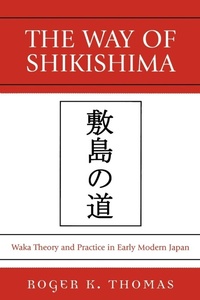
The Way of Shikishima
Waka Theory and Practice in Early Modern Japan
Published on 24. December 2007
Book
Paperback/Softback
244 pages
978-0-7618-3980-4 (ISBN)
Description
Though the haiku is the best known Japanese verse form in the west, its appearance in the early modern period (1600-1868) was preceded by at least a millennium of waka poetry, whose thirty-one syllable version, tanka, had dominated Japanese letters among the aristocracy from the beginning of the tenth century. By the dawn of the seventeenth century, waka appeared to be more bound by convention than ever before, and class privilege in its practice and instruction seemed unassailable. This condition has prompted some modern scholars to dismiss the waka of that period as an anachronistic holdover. The Way of the Shikishima challenges this notion as facile and demonstrates how, from the beginning of the Tokugawa hegemony in the early seventeenth century, waka was in fact closely tied to contemporary social, cultural, and intellectual developments, and how those ties became closer over time. The aristocratic monopoly of the art that prevailed at the beginning of the early modern period gave way to popularizing forces until, by the middle of the nineteenth century and nearly all practitioners of note were commoners.
Reviews / Votes
Provides a firm foundation, in English, for future studies in further detail about specific figures and works in what has, until now, been outside Japan a relatively neglected subfield of early modern literary studies. * The Journal of Japanese Studies * An English-language introduction to the neglected history of Edo waka will always be useful, especially in undergraduate courses, for giving a fuller picture of the literary and intellectual developments of the time. In this respect Thomas's book provides a convenient oveerview of the main trends and representatives of waka and poetic theory. * Monumenta Nipponica * Professor Thomas' book is a long-awaited achievement, and will serve as required reading for students and scholars of Japanese and other non-western cultures for many years. -- Lawrence E. Marceau, Senior Lecturer in Japanese, University of AucklandMore details
Language
English
Place of publication
Lanham, MD
United States
Target group
College/higher education
Professional and scholarly
Dimensions
Height: 229 mm
Width: 152 mm
Thickness: 15 mm
Weight
402 gr
ISBN-13
978-0-7618-3980-4 (9780761839804)
Copyright in bibliographic data and cover images is held by Nielsen Book Services Limited or by the publishers or by their respective licensors: all rights reserved.
Schweitzer Classification
Person
Roger K. Thomas is Professor of Japanese Language and Literature at Illinois State University, where he is also director of the East Asian Studies program. His research is primarily in poetry and poetics of early modern Japan and his translations of modern literature have received noted prizes and reviews.
Content
Part 1 Preface and Acknowledgements
Chapter 2 Introduction
Chapter 3 Bakusho (1600-1683)
Chapter 4 Genroku (1680-1740)
Chapter 5 Mid Eighteenth Century (1740-1770)
Chapter 6 Late Eighteenth Century (1771-1800)
Chapter 7 Early Nineteenth Century (1800-1840)
Chapter 8 Bakumatsu (1840-1868)
Part 9 Appendix: Summary of the Kokka Hachiron Controversy
Part 10 Bibliography
Part 11 Index
Chapter 2 Introduction
Chapter 3 Bakusho (1600-1683)
Chapter 4 Genroku (1680-1740)
Chapter 5 Mid Eighteenth Century (1740-1770)
Chapter 6 Late Eighteenth Century (1771-1800)
Chapter 7 Early Nineteenth Century (1800-1840)
Chapter 8 Bakumatsu (1840-1868)
Part 9 Appendix: Summary of the Kokka Hachiron Controversy
Part 10 Bibliography
Part 11 Index