

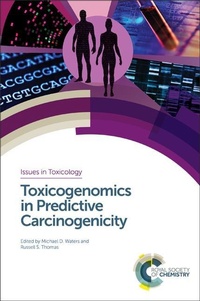
Toxicogenomics in Predictive Carcinogenicity
Published on 26. July 2016
Book
Hardback
524 pages
978-1-78262-162-1 (ISBN)
Description
Research over the past decade has demonstrated that TGx methods of various types can be used to discriminate modes of mutagenesis as a function of dose. TGx can quickly inform safety evaluation regarding potential mechanisms of conventional outcomes and can provide essential dose-response information. This can then be used to ascertain the sequence of key events in a putative mode of action as may apply in quantitative cancer risk assessment. With the increasing complexity of research in mode of action investigations it is important to gain a better understand of approaches to data integration and health risk assessment. Furthermore, it is essential to consider how novel test systems and newer methods and approaches may be used in future to gain a better understanding of mechanisms.
Toxicogenomics in Predictive Carcinogenicity describes toxicogenomics methods in predictive carcinogenicity testing, mode of action and safety evaluation, and cancer risk assessment. It illustrates these methods using case studies that have yielded significant new information on compounds and classes of compounds that have proven difficult to evaluate using conventional methods alone. This book additionally covers current and potential toxicogenomic research using stem cells as well as new bioinformatics methods for drug discovery and environmental toxicology.
This publication is an indispensable tool for postgraduates, academics and industrialists working in biochemistry, genomics, carcinogenesis, pathology, pharmaceuticals, food technology, bioinformatics, risk assessment and environmental toxicology.
Toxicogenomics in Predictive Carcinogenicity describes toxicogenomics methods in predictive carcinogenicity testing, mode of action and safety evaluation, and cancer risk assessment. It illustrates these methods using case studies that have yielded significant new information on compounds and classes of compounds that have proven difficult to evaluate using conventional methods alone. This book additionally covers current and potential toxicogenomic research using stem cells as well as new bioinformatics methods for drug discovery and environmental toxicology.
This publication is an indispensable tool for postgraduates, academics and industrialists working in biochemistry, genomics, carcinogenesis, pathology, pharmaceuticals, food technology, bioinformatics, risk assessment and environmental toxicology.
More details
Series
Language
English
Place of publication
Cambridge
United Kingdom
Target group
Professional and scholarly
College/higher education
Product notice
Unsewn / adhesive bound
Dimensions
Height: 236 mm
Width: 163 mm
Thickness: 33 mm
Weight
907 gr
ISBN-13
978-1-78262-162-1 (9781782621621)
Copyright in bibliographic data and cover images is held by Nielsen Book Services Limited or by the publishers or by their respective licensors: all rights reserved.
Schweitzer Classification
Other editions
Additional editions
Russell S. Thomas | Michael D. Waters
Toxicogenomics in Predictive Carcinogenicity
E-Book
06/2016
1st Edition
Royal Society of Chemistry
€246.99
Available for download
Russell S. Thomas | Michael D. Waters
Toxicogenomics in Predictive Carcinogenicity
E-Book
06/2016
1st Edition
Royal Society of Chemistry
€246.99
Available for download
Persons
Dr Michael D. Waters is currently a Consultant with Integrated Laboratory Systems Inc. He is also an Adjunct Professor of Toxicology at the University of North Carolina at Chapel Hill and of Pharmacology and Toxicology at Duke University. He is Editor of Mutation Research - Reviews in Mutation Research. He has over 35 years of experience as a biochemist, genetic toxicologist, toxicogenomics and information scientist. Over the last 20 years Dr Waters has also worked extensively on database development; designing and conducting genotoxicity assays and chemoprevention studies in in vitro models; and studying genomics, clinical and toxicologic pathology.
Dr Russell S. Thomas is Director of the National Center for Computational Toxicology with the U.S. Environmental Protection Agency. Prior to this he was Director of the Institute for Chemical Safety Sciences at The Hamner Institutes for Health Sciences for over 10 years. Dr. Thomas also maintains an adjunct faculty appointment in the Division of Pharmacogenomics and Individualized Therapy at the University of North Carolina at Chapel Hill. Dr. Thomas has additionally been active in molecular biology and genomics research at the McArdle Cancer Research Laboratory at the University of Wisconsin.
Dr Russell S. Thomas is Director of the National Center for Computational Toxicology with the U.S. Environmental Protection Agency. Prior to this he was Director of the Institute for Chemical Safety Sciences at The Hamner Institutes for Health Sciences for over 10 years. Dr. Thomas also maintains an adjunct faculty appointment in the Division of Pharmacogenomics and Individualized Therapy at the University of North Carolina at Chapel Hill. Dr. Thomas has additionally been active in molecular biology and genomics research at the McArdle Cancer Research Laboratory at the University of Wisconsin.
Content
Introduction to Predictive Toxicogenomics for Carcinogenicity;
Genomic Biomarkers in Cell-based Drug Screening;
Toxicogenomics In Vitro: Gene Expression Signatures for Differentiating Genotoxic Mechanisms;
In Vivo Signatures of Genotoxic and Non-Genotoxic Chemicals;
Transcriptomic Dose-Response Analysis for Mode of Action and Risk Assessment;
Using transcriptomics to evaluate thresholds in genotoxicity dose-response;
Dissecting Modes of Action of Non-Genotoxic Carcinogens;
Human Embryonic Stem Cells as Biological Models to Examine the Impact of Xenobiotics on the Genome and Epigenome;
Novel Data Streams in the Assessment of Mutagenicity and Carcinogenicity: Implications for Cancer Hazard Assessment;
Conazoles and Cancer, a Review;
Application of Transcriptomics in Exposed Human Populations: Benzene as an Example;
Toxicogenomics Case Study: Furan;
The Parallelogram Approach to Assess Human Relevance of Toxicogenomics Derived Toxicity Pathways in Human Health Risk Assessment;
Bioinformatics of Genomics in the Assessment of Cancer;
Genomic Biomarkers in Cell-based Drug Screening;
Toxicogenomics In Vitro: Gene Expression Signatures for Differentiating Genotoxic Mechanisms;
In Vivo Signatures of Genotoxic and Non-Genotoxic Chemicals;
Transcriptomic Dose-Response Analysis for Mode of Action and Risk Assessment;
Using transcriptomics to evaluate thresholds in genotoxicity dose-response;
Dissecting Modes of Action of Non-Genotoxic Carcinogens;
Human Embryonic Stem Cells as Biological Models to Examine the Impact of Xenobiotics on the Genome and Epigenome;
Novel Data Streams in the Assessment of Mutagenicity and Carcinogenicity: Implications for Cancer Hazard Assessment;
Conazoles and Cancer, a Review;
Application of Transcriptomics in Exposed Human Populations: Benzene as an Example;
Toxicogenomics Case Study: Furan;
The Parallelogram Approach to Assess Human Relevance of Toxicogenomics Derived Toxicity Pathways in Human Health Risk Assessment;
Bioinformatics of Genomics in the Assessment of Cancer;