

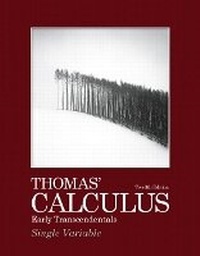
Thomas' Calculus
Early Transcendentals, Single Variable
12th Edition
Published on 24. February 2010
Book
Paperback/Softback
816 pages
978-0-321-62883-1 (ISBN)
Description
This text is designed for the single variable component of a three-semester or four-quarter calculus course (math, engineering, and science majors).
Calculus hasn't changed, but your students have. Today's students have been raised on immediacy and the desire for relevance, and they come to calculus with varied mathematical backgrounds. Thomas' Calculus: Early Transcendentals, Twelfth Edition,
(contains only chapters 1-11) helps your students successfully generalize and apply the key ideas of calculus through clear and precise explanations, clean design, thoughtfully chosen examples, and superior exercise sets. Thomas offers the right mix of basic, conceptual, and challenging exercises, along with meaningful applications. This significant revision features more examples, more mid-level exercises, more figures, and improved conceptual flow.
This is the standalone book,(contains only chapters 1-11) if you want the book/access card order the ISBN below.
0321705408 / 9780321705402 Thomas' Calculus Early Transcendentals, Single Variable(contains only chapters 1-11) with MML/MSL Student Access Code Card
Package consists of:
0321431308 / 9780321431301 MyMathLab/MyStatLab -- Access Card
0321628837 / 9780321628831 Thomas' Calculus Early Transcendentals, Single Variable
0321654064 / 9780321654069 MyMathLab Inside Star Sticker
Calculus hasn't changed, but your students have. Today's students have been raised on immediacy and the desire for relevance, and they come to calculus with varied mathematical backgrounds. Thomas' Calculus: Early Transcendentals, Twelfth Edition,
(contains only chapters 1-11) helps your students successfully generalize and apply the key ideas of calculus through clear and precise explanations, clean design, thoughtfully chosen examples, and superior exercise sets. Thomas offers the right mix of basic, conceptual, and challenging exercises, along with meaningful applications. This significant revision features more examples, more mid-level exercises, more figures, and improved conceptual flow.
This is the standalone book,(contains only chapters 1-11) if you want the book/access card order the ISBN below.
0321705408 / 9780321705402 Thomas' Calculus Early Transcendentals, Single Variable(contains only chapters 1-11) with MML/MSL Student Access Code Card
Package consists of:
0321431308 / 9780321431301 MyMathLab/MyStatLab -- Access Card
0321628837 / 9780321628831 Thomas' Calculus Early Transcendentals, Single Variable
0321654064 / 9780321654069 MyMathLab Inside Star Sticker
More details
Edition
12th edition
Language
English
Place of publication
United States
Publishing group
Pearson Education (US)
Target group
College/higher education
Dimensions
Height: 217 mm
Width: 275 mm
Thickness: 24 mm
Weight
1633 gr
ISBN-13
978-0-321-62883-1 (9780321628831)
Copyright in bibliographic data and cover images is held by Nielsen Book Services Limited or by the publishers or by their respective licensors: all rights reserved.
Schweitzer Classification
Other editions
New editions
George B. Thomas | Maurice D. Weir | Joel R. Hass
Thomas' Calculus
Early Transcendentals, Single Variable
Book
02/2014
13th Edition
Pearson
€129.98
Shipment within 10-20 days

George B. Thomas | Maurice D. Weir | Joel R. Hass
Thomas' Calculus
Early Transcendentals, Single Variable
Book
11/2013
13th Edition
Pearson
€95.31
Article is exhausted; no reprint
Persons
Joel Hass received his PhD from the University of California-Berkeley. He is currently a professor of mathematics at the University of California-Davis. He has coauthored six widely used calculus texts as well as two calculus study guides. He is currently on the editorial board of Geometriae Dedicata and Media-Enhanced Mathematics. He has been a member of the Institute for Advanced Study at Princeton University and of the Mathematical Sciences Research Institute, and he was a Sloan Research Fellow. Hass's current areas of research include the geometry of proteins, three dimensional manifolds, applied math, and computational complexity. In his free time, Hass enjoys kayaking.
Maurice D. Weir holds a DA and MS from Carnegie-Mellon University and received his BS at Whitman College. He is a Professor Emeritus of the Department of Applied Mathematics at the Naval Postgraduate School in Monterey, California. Weir enjoys teaching Mathematical Modeling and Differential Equations. His current areas of research include modeling and simulation as well as mathematics education. Weir has been awarded the Outstanding Civilian Service Medal, the Superior Civilian Service Award, and the Schieffelin Award for Excellence in Teaching. He has coauthored eight books, including the University Calculus series and the twelfth edition of Thomas' Calculus.
George B. Thomas, Jr. (late) of the Massachusetts Institute of Technology, was a professor of mathematics for thirty-eight years; he served as the executive officer of the department for ten years and as graduate registration officer for five years. Thomas held a spot on the board of governors of the Mathematical Association of America and on the executive committee of the mathematics division of the American Society for Engineering Education. His book, Calculus and Analytic Geometry, was first published in 1951 and has since gone through multiple revisions. The text is now in its twelfth edition and continues to guide students through their calculus courses. He also co-authored monographs on mathematics, including the text Probability and Statistics.
Maurice D. Weir holds a DA and MS from Carnegie-Mellon University and received his BS at Whitman College. He is a Professor Emeritus of the Department of Applied Mathematics at the Naval Postgraduate School in Monterey, California. Weir enjoys teaching Mathematical Modeling and Differential Equations. His current areas of research include modeling and simulation as well as mathematics education. Weir has been awarded the Outstanding Civilian Service Medal, the Superior Civilian Service Award, and the Schieffelin Award for Excellence in Teaching. He has coauthored eight books, including the University Calculus series and the twelfth edition of Thomas' Calculus.
George B. Thomas, Jr. (late) of the Massachusetts Institute of Technology, was a professor of mathematics for thirty-eight years; he served as the executive officer of the department for ten years and as graduate registration officer for five years. Thomas held a spot on the board of governors of the Mathematical Association of America and on the executive committee of the mathematics division of the American Society for Engineering Education. His book, Calculus and Analytic Geometry, was first published in 1951 and has since gone through multiple revisions. The text is now in its twelfth edition and continues to guide students through their calculus courses. He also co-authored monographs on mathematics, including the text Probability and Statistics.
Content
1. Functions
1.1 Functions and Their Graphs
1.2 Combining Functions; Shifting and Scaling Graphs
1.3 Trigonometric Functions
1.4 Graphing with Calculators and Computers
1.5 Exponential Functions
1.6 Inverse Functions and Logarithms
2. Limits and Derivatives
2.1 Rates of Change and Tangents to Curves
2.2 Limit of a Function and Limit Laws
2.3 Precise Definition of a Limit
2.4 One-Sided Limits
2.5 Continuity
2.6 Limits Involving Infinity, Asymptotes of Graphs
3. Differentiation
3.1 Tangents and the Derivative at a Point
3.2 The Derivative as a Function
3.3 Rules for Polynomials, Exponentials, Products, and Quotients
3.4 The Derivative as a Rate of Change
3.5 Derivatives of Trigonometric Functions
3.6 The Chain Rule
3.7 Implicit Differentiation
3.8 Derivatives of Inverse Functions and Logarithms
3.9 Inverse Trigonometric Functions
3.10 Related Rates
3.11 Linearization and Differentials
4. Applications of Derivatives
4.1 Extreme Values of Functions
4.2 The Mean Value Theorem
4.3 Monotonic Functions and the First Derivative Test
4.4 Concavity and Curve Sketching
4.5 Indeterminate Forms and L'Hopital's Rule
4.6 Applied Optimization
4.7 Newton's Method
4.8 Antiderivatives
5. Integration
5.1 Area and Estimating with Finite Sums
5.2 Sigma Notation and Limits of Finite Sums
5.3 The Definite Integral
5.4 The Fundamental Theorem of Calculus
5.5 Indefinite Integrals and the Substitution Rule
5.6 Substitution and Area Between Curves
6. Applications of Definite Integrals
6.1 Volumes Using Cross-Sections
6.2 Volumes Using Cylindrical Shells
6.3 Arc Length
6.4 Areas of Surfaces of Revolution
6.5 Work and Fluid Forces
6.6 Moments and Centers of Mass
7. Integrals and Transcendental Functions
7.1 The Logarithm Defined as an Integral
7.2 Exponential Change and Separable Differential Equations
7.3 Hyperbolic Functions
7.4 Relative Rates of Growth
8. Techniques of Integration
8.1 Integration by Parts
8.2 Trigonometric Integrals
8.3 Trigonometric Substitutions
8.4 Integration of Rational Functions by Partial Fractions
8.5 Integral Tables and Computer Algebra Systems
8.6 Numerical Integration
8.7 Improper Integrals
9. First-Order Differential Equations
9.1 Solutions, Slope Fields, and Euler's Method
9.2 First-Order Linear Equations
9.3 Applications
9.4 Graphical Solutions of Autonomous Equations
9.5 Systems of Equations and Phase Planes
10. Infinite Sequences and Series
10.1 Sequences
10.2 Infinite Series
10.3 The Integral Test
10.4 Comparison Tests
10.5 The Ratio and Root Tests
10.6 Alternating Series, Absolute and Conditional Convergence
10.7 Power Series
10.8 Taylor and Maclaurin Series
10.9 Convergence of Taylor Series
10.10 The Binomial Series and Applications of Taylor Series
11. Parametric Equations and Polar Coordinates
11.1 Parametrizations of Plane Curves
11.2 Calculus with Parametric Curves
11.3 Polar Coordinates
11.4 Graphing in Polar Coordinates
11.5 Areas and Lengths in Polar Coordinates
11.6 Conic Sections
11.7 Conics in Polar Coordinates
1.1 Functions and Their Graphs
1.2 Combining Functions; Shifting and Scaling Graphs
1.3 Trigonometric Functions
1.4 Graphing with Calculators and Computers
1.5 Exponential Functions
1.6 Inverse Functions and Logarithms
2. Limits and Derivatives
2.1 Rates of Change and Tangents to Curves
2.2 Limit of a Function and Limit Laws
2.3 Precise Definition of a Limit
2.4 One-Sided Limits
2.5 Continuity
2.6 Limits Involving Infinity, Asymptotes of Graphs
3. Differentiation
3.1 Tangents and the Derivative at a Point
3.2 The Derivative as a Function
3.3 Rules for Polynomials, Exponentials, Products, and Quotients
3.4 The Derivative as a Rate of Change
3.5 Derivatives of Trigonometric Functions
3.6 The Chain Rule
3.7 Implicit Differentiation
3.8 Derivatives of Inverse Functions and Logarithms
3.9 Inverse Trigonometric Functions
3.10 Related Rates
3.11 Linearization and Differentials
4. Applications of Derivatives
4.1 Extreme Values of Functions
4.2 The Mean Value Theorem
4.3 Monotonic Functions and the First Derivative Test
4.4 Concavity and Curve Sketching
4.5 Indeterminate Forms and L'Hopital's Rule
4.6 Applied Optimization
4.7 Newton's Method
4.8 Antiderivatives
5. Integration
5.1 Area and Estimating with Finite Sums
5.2 Sigma Notation and Limits of Finite Sums
5.3 The Definite Integral
5.4 The Fundamental Theorem of Calculus
5.5 Indefinite Integrals and the Substitution Rule
5.6 Substitution and Area Between Curves
6. Applications of Definite Integrals
6.1 Volumes Using Cross-Sections
6.2 Volumes Using Cylindrical Shells
6.3 Arc Length
6.4 Areas of Surfaces of Revolution
6.5 Work and Fluid Forces
6.6 Moments and Centers of Mass
7. Integrals and Transcendental Functions
7.1 The Logarithm Defined as an Integral
7.2 Exponential Change and Separable Differential Equations
7.3 Hyperbolic Functions
7.4 Relative Rates of Growth
8. Techniques of Integration
8.1 Integration by Parts
8.2 Trigonometric Integrals
8.3 Trigonometric Substitutions
8.4 Integration of Rational Functions by Partial Fractions
8.5 Integral Tables and Computer Algebra Systems
8.6 Numerical Integration
8.7 Improper Integrals
9. First-Order Differential Equations
9.1 Solutions, Slope Fields, and Euler's Method
9.2 First-Order Linear Equations
9.3 Applications
9.4 Graphical Solutions of Autonomous Equations
9.5 Systems of Equations and Phase Planes
10. Infinite Sequences and Series
10.1 Sequences
10.2 Infinite Series
10.3 The Integral Test
10.4 Comparison Tests
10.5 The Ratio and Root Tests
10.6 Alternating Series, Absolute and Conditional Convergence
10.7 Power Series
10.8 Taylor and Maclaurin Series
10.9 Convergence of Taylor Series
10.10 The Binomial Series and Applications of Taylor Series
11. Parametric Equations and Polar Coordinates
11.1 Parametrizations of Plane Curves
11.2 Calculus with Parametric Curves
11.3 Polar Coordinates
11.4 Graphing in Polar Coordinates
11.5 Areas and Lengths in Polar Coordinates
11.6 Conic Sections
11.7 Conics in Polar Coordinates