

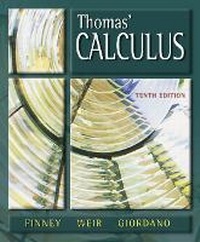
Thomas' Calculus
10th Edition
Published on 3. August 2000
Book
Mixed media product
1256 pages
978-0-201-44141-3 (ISBN)
Description
The tenth edition of this clear, precise calculus text with superior applications sets the standard in calculus. The tenth edition of this proven text was carefully revised to give students the solid base they need to succeed in math, science and engineering programs. Through a comprehensive technology package, this edition now includes more opportunity to incorporate optional, but meaningful technology into the course.
More details
Edition
10th edition
Language
English
Place of publication
United States
Publishing group
Pearson Education (US)
Target group
Professional and scholarly
Dimensions
Height: 260 mm
Width: 225 mm
Thickness: 45 mm
Weight
2672 gr
ISBN-13
978-0-201-44141-3 (9780201441413)
Copyright in bibliographic data and cover images is held by Nielsen Book Services Limited or by the publishers or by their respective licensors: all rights reserved.
Schweitzer Classification
Other editions
New editions
Book
11/2004
11th Edition
Pearson
€125.02
Article is exhausted; no reprint
George B. Thomas | Ross L. Finney | Jan D. Weir
Thomas' Calculus, Updated
Book
07/2002
10th Edition
Pearson
€104.63
Article exhausted; check for reprint
Previous edition

George B. Thomas | Ross L. Finney
Calculus
Book
01/1996
9th Edition
Pearson
€45.79
Article exhausted; check for reprint
Content
(Each chapter ends with "Questions to Guide Your Review", "Practice Exercises", and "Additional Exercises".)
P. Preliminaries.
Lines.
Functions and Graphs.
Exponential Functions.
Inverse Functions and Logarithms.
Trigonometric Functions and Their Inverses.
Parametric Equations.
Modeling Change.
1. Limits and Continuity.
Rates of Change and Limits.
Finding Limits and One-Sided Limits.
Limits Involving Infinity.
Continuity.
Tangent Lines.
2. Derivatives.
The Derivative as a Function.
The Derivative as a Rate of Change.
Derivatives of Products, Quotients, and Negative Powers.
Derivatives of Trigonometric Functions.
The Chain Rule.
Implicit Differentiation.
Related Rates.
3. Applications of Derivatives.
Extreme Values of Functions.
The Mean Value Theorem and Differential Equations.
The Shape of a Graph.
Graphical Solutions of Autonomous Differential Equations.
Modeling and Optimization.
Linearization and Differentials.
Newton's Method.
4. Integration.
Indefinite Integrals, Differential Equations, and Modeling.
Integral Rules; Integration by Substitution.
Estimating with Finite Sums.
Riemann Sums and Definite Integrals.
The Mean Value and Fundamental Theorems.
Substitution in Definite Integrals.
Numerical Integration.
5. Applications of Integrals.
Volumes by Slicing and Rotation About an Axis.
Modeling Volume Using Cylindrical Shells.
Lengths of Plane Curves.
Springs, Pumping and Lifting.
Fluid Forces.
Moments and Centers of Mass.
6. Transcendental Functions and Differential Equations.
Logarithms.
Exponential Functions.
Derivatives of Inverse Trigonometric Functions; Integrals.
First-Order Separable Differential Equations.
Linear First-Order Differential Equations.
Euler's Method; Population Models.
Hyperbolic Functions.
7. Integration Techniques, L'Hopital's Rule, and Improper Integrals.
Basic Integration Formulas.
Integration by Parts.
Partial Fractions.
Trigonometric Substitutions.
Integral Tables, Computer Algebra Systems, and Monte Carlo Integration.
L'Hopital's Rule.
Improper Integrals.
8. Infinite Series.
Limits of Sequences of Numbers.
Subsequences, Bounded Sequences, and Picard's Method.
Infinite Series.
Series of Nonnegative Terms.
Alternating Series, Absolute and Conditional Convergence.
Power Series.
Taylor and Maclaurin Series.
Applications of Power Series.
Fourier Series.
Fourier Cosine and Sine Series.
9. Vectors in the Plane and Polar Functions.
Vectors in the Plane.
Dot Products.
Vector-Valued Functions.
Modeling Projectile Motion.
Polar Coordinates and Graphs.
Calculus of Polar Curves.
10. Vectors and Motion in Space.
Cartesian (Rectangular) Coordinates and Vectors in Space.
Dot and Cross Products.
Lines and Planes in Space.
Cylinders and Quadric Surfaces.
Vector-Valued Functions and Space Curves.
Arc Length and the Unit Tangent Vector T.
The TNB Frame; Tangential and Normal Components of Acceleration.
Planetary Motion and Satellites.
11. Multivariable Functions and Their Derivatives.
Functions of Several Variables.
Limits and Continuity in Higher Dimensions.
Partial Derivatives.
The Chain Rule.
Directional Derivatives, Gradient Vectors, and Tangent Planes.
Linearization and Differentials.
Extreme Values and Saddle Points.
Lagrange Multipliers.
Partial Derivatives with Constrained Variables.
Taylor's Formula for Two Variables.
12. Multiple Integrals.
Double Integrals.
Areas, Moments, and Centers of Mass.
Double Integrals in Polar Form.
Triple Integrals in Rectangular Coordinates.
Masses and Moments in Three Dimensions.
Triple Integrals in Cylindrical and Spherical Coordinates.
Substitutions in Multiple Integrals.
13. Integration in Vector Fields.
Line Integrals.
Vector Fields, Work, Circulation, and Flux.
Path Independence, Potential Functions, and Conservative Fields.
Green's Theorem in the Plane.
Surface Area and Surface Integrals.
Parametrized Surfaces.
Stokes' Theorem.
Divergence Theorem and a Unified Theory.
Appendices.
Mathematical Induction.
Proofs of Limit Theorems in Section 1.2.
Proof of the Chain Rule.
Complex Numbers.
Simpson's One-Third Rule.
Cauchy's Mean Value Theorem and the Stronger Form of L'Hopital's Rule.
Limits that Arise Frequently.
Proof of Taylor's Theorem.
The Distributive Law for Vector Cross Products.
Determinants and Cramer's Rule.
The Mixed Derivative Theorem and the Increment Theorem.
The Area of a Parallelogram's Projection on a Plane.
P. Preliminaries.
Lines.
Functions and Graphs.
Exponential Functions.
Inverse Functions and Logarithms.
Trigonometric Functions and Their Inverses.
Parametric Equations.
Modeling Change.
1. Limits and Continuity.
Rates of Change and Limits.
Finding Limits and One-Sided Limits.
Limits Involving Infinity.
Continuity.
Tangent Lines.
2. Derivatives.
The Derivative as a Function.
The Derivative as a Rate of Change.
Derivatives of Products, Quotients, and Negative Powers.
Derivatives of Trigonometric Functions.
The Chain Rule.
Implicit Differentiation.
Related Rates.
3. Applications of Derivatives.
Extreme Values of Functions.
The Mean Value Theorem and Differential Equations.
The Shape of a Graph.
Graphical Solutions of Autonomous Differential Equations.
Modeling and Optimization.
Linearization and Differentials.
Newton's Method.
4. Integration.
Indefinite Integrals, Differential Equations, and Modeling.
Integral Rules; Integration by Substitution.
Estimating with Finite Sums.
Riemann Sums and Definite Integrals.
The Mean Value and Fundamental Theorems.
Substitution in Definite Integrals.
Numerical Integration.
5. Applications of Integrals.
Volumes by Slicing and Rotation About an Axis.
Modeling Volume Using Cylindrical Shells.
Lengths of Plane Curves.
Springs, Pumping and Lifting.
Fluid Forces.
Moments and Centers of Mass.
6. Transcendental Functions and Differential Equations.
Logarithms.
Exponential Functions.
Derivatives of Inverse Trigonometric Functions; Integrals.
First-Order Separable Differential Equations.
Linear First-Order Differential Equations.
Euler's Method; Population Models.
Hyperbolic Functions.
7. Integration Techniques, L'Hopital's Rule, and Improper Integrals.
Basic Integration Formulas.
Integration by Parts.
Partial Fractions.
Trigonometric Substitutions.
Integral Tables, Computer Algebra Systems, and Monte Carlo Integration.
L'Hopital's Rule.
Improper Integrals.
8. Infinite Series.
Limits of Sequences of Numbers.
Subsequences, Bounded Sequences, and Picard's Method.
Infinite Series.
Series of Nonnegative Terms.
Alternating Series, Absolute and Conditional Convergence.
Power Series.
Taylor and Maclaurin Series.
Applications of Power Series.
Fourier Series.
Fourier Cosine and Sine Series.
9. Vectors in the Plane and Polar Functions.
Vectors in the Plane.
Dot Products.
Vector-Valued Functions.
Modeling Projectile Motion.
Polar Coordinates and Graphs.
Calculus of Polar Curves.
10. Vectors and Motion in Space.
Cartesian (Rectangular) Coordinates and Vectors in Space.
Dot and Cross Products.
Lines and Planes in Space.
Cylinders and Quadric Surfaces.
Vector-Valued Functions and Space Curves.
Arc Length and the Unit Tangent Vector T.
The TNB Frame; Tangential and Normal Components of Acceleration.
Planetary Motion and Satellites.
11. Multivariable Functions and Their Derivatives.
Functions of Several Variables.
Limits and Continuity in Higher Dimensions.
Partial Derivatives.
The Chain Rule.
Directional Derivatives, Gradient Vectors, and Tangent Planes.
Linearization and Differentials.
Extreme Values and Saddle Points.
Lagrange Multipliers.
Partial Derivatives with Constrained Variables.
Taylor's Formula for Two Variables.
12. Multiple Integrals.
Double Integrals.
Areas, Moments, and Centers of Mass.
Double Integrals in Polar Form.
Triple Integrals in Rectangular Coordinates.
Masses and Moments in Three Dimensions.
Triple Integrals in Cylindrical and Spherical Coordinates.
Substitutions in Multiple Integrals.
13. Integration in Vector Fields.
Line Integrals.
Vector Fields, Work, Circulation, and Flux.
Path Independence, Potential Functions, and Conservative Fields.
Green's Theorem in the Plane.
Surface Area and Surface Integrals.
Parametrized Surfaces.
Stokes' Theorem.
Divergence Theorem and a Unified Theory.
Appendices.
Mathematical Induction.
Proofs of Limit Theorems in Section 1.2.
Proof of the Chain Rule.
Complex Numbers.
Simpson's One-Third Rule.
Cauchy's Mean Value Theorem and the Stronger Form of L'Hopital's Rule.
Limits that Arise Frequently.
Proof of Taylor's Theorem.
The Distributive Law for Vector Cross Products.
Determinants and Cramer's Rule.
The Mixed Derivative Theorem and the Increment Theorem.
The Area of a Parallelogram's Projection on a Plane.