

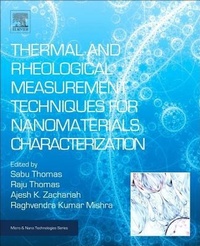
Thermal and Rheological Measurement Techniques for Nanomaterials Characterization: Volume 3
Volume 3
Published on 26. May 2017
Book
Hardback
292 pages
978-0-323-46139-9 (ISBN)
Description
Thermal and Rheological Measurement Techniques for Nanomaterials Characterization, Second Edition covers thermal and rheological measurement techniques, including their principle working methods, sample preparation and interpretation of results.
This important reference is an ideal source for materials scientists and industrial engineers who are working with nanomaterials and need to know how to determine their properties and behaviors.
This important reference is an ideal source for materials scientists and industrial engineers who are working with nanomaterials and need to know how to determine their properties and behaviors.
More details
Series
Language
English
Place of publication
Philadelphia
United States
Target group
Professional and scholarly
Product notice
sewn/stitched
Cloth over boards
Illustrations
Approx. 180 illustrations (32 in full color)
Dimensions
Height: 195 mm
Width: 241 mm
Thickness: 22 mm
Weight
750 gr
ISBN-13
978-0-323-46139-9 (9780323461399)
Copyright in bibliographic data and cover images is held by Nielsen Book Services Limited or by the publishers or by their respective licensors: all rights reserved.
Schweitzer Classification
Other editions
Additional editions
Sabu Thomas | Raju Thomas | Ajesh K. Zachariah
Thermal and Rheological Measurement Techniques for Nanomaterials Characterization
E-Book
05/2017
Elsevier
€185.00
Available for download
Persons
Prof. Sabu Thomas is a globally renowned scientist and one of the leading researchers in polymer science and nanotechnology. He currently serves as Professor of Polymer Science & Engineering and was the former Vice Chancellor of Mahatma Gandhi University, Kerala, India. Prof. Thomas is internationally recognized for his pioneering work on polymer blends, nanocomposites, green materials, and sustainable polymers. Prof (Dr). Raju Thomas is currently Vice Chancellor of Middle East University FZE, P.O. BOX 37173, Al Hamara, Ras Al Khaimah, and United Arab Emirates. Dr. Thomas started Professorship from Research and Postgraduate Department of Chemistry, Mar Thoma College, Tiruvalla-3, Kerala, India. Dr. Thomas procured Ph.D degree under the supervision of Prof. (Dr). Sabu Thomas, Director of International and Interuniversity Centre for Nanoscience and Nanotechnology, Mahatma Gandhi University, Kottayam, Kerala, India. He has extensive research experience in Nanoscience and Nanotechnology. He has twelve years of research experience in the Organic Chemistry and Polymer Chemistry laboratories of the School of Chemical Sciences, Mahatma Gandhi University, Kottayam, Kerala, India. He has also worked in the laboratory of Applied Rheology and Polymer processing of Katholieke University, Leuven, Belgium and in the laboratory at Leibniz Institute of Polymer Research Dresden, Germany. He has widely studied the kinetics of curing, morphology developments and structural characteristics of in-situ cured nanocomposites based on epoxy resin and reactive rubbers. His research is reflected in his six published research articles in international journals and additional articles which are currently under review. In addition, many articles are published in popular journals. He has co-authored many chapters and co-editor of a book entitled "Micro and Nanostructured Epoxy/Rubber Blends? which was recently published by Wiley and Sons. He has attended many national and international seminars/ conferences and presented many research papers. He is an approved research guide in Chemistry of Mahatma Gandhi University, Kottayam, India and has availed projects from University Grants Commission (UGC), Department of Science and Technology- Science and Engineering Research Board (DST-SERB) and Kerala Science Council for Science, Technology and Environment (KSCSTE). Prof. Ajesh K. Zachariah is currently working as Assistant Professor in the Department of Chemistry, Mar Thoma College, Tiruvalla. He had done Doctoral Research in Polymer Chemistry at School of Chemical Sciences, Mahatma Gandhi University, Kottayam, Kerala, India. He has ten years' research experience in nanomaterials and characterization. Expert in sophisticated analytical techniques such as Atomic Force Microscopy (AFM), X ray diffraction Technique (XRD), Gas Permeability Tester, Dynamic Mechanical Analyser (DMA), Rubber Process Analyser (RPA)and Oscillating Disc Rheometer (ODR). Published nine internationally cited articles, two international books and applied one Indian patent. He presented articles in different national and international conferences. He bagged Young Technological Innovation (GYTI) Award 2013, the meritorious research scholar award from UGC, India in 2009 and young researcher award in Nanosat-2010. His research areas are nanomaterial, naocomposites, elastomer-elastomer blend systems, sensors, membranes, computational chemistry and environmental chemistry. Raghvendra Kumar Mishra is a Materials Scientist in the Chemical Engineering Department at IIT Delhi, India, and he has previously held research positions at Cranfield University (United Kingdom), Madrid Institute of Advanced Studies (Spain), and Mahatma Gandhi University (India). His research interests focus on nanomaterials and polymer composites, including new applications of nanomaterials, developing nanomaterials-based systems for diverse functionalities, creating biopolymer-based composites, and utilizing advanced fabrication techniques such as electrospinning and 3D printing.
Content
1. Instrumental techniques for the characterization of nanoparticles
2. Dynamic Light Scattering (DLS) Analysis of Nanomaterials
3. Size-exclusion chromatography in Nanoscience and Nanotechnology
4. Thermogravimetry Analysis for Characterization of Nanomaterials
5. Differential Scanning Calorimetry in Nanosciences and Nanotechnology
6. Dynamic Mechanical Thermal Analysis of Polymer Nanocomposites
7. Thermomechanical?Analysis of Nanomaterials and Nanocomposites
8. Contact Angle Measurement Techniques in Nanosciences and Nanotechnology
9. Surface area analysis of Nanomaterials
10. Small angle Light and X-ray scattering in Nanosciences and Nanotechnology
2. Dynamic Light Scattering (DLS) Analysis of Nanomaterials
3. Size-exclusion chromatography in Nanoscience and Nanotechnology
4. Thermogravimetry Analysis for Characterization of Nanomaterials
5. Differential Scanning Calorimetry in Nanosciences and Nanotechnology
6. Dynamic Mechanical Thermal Analysis of Polymer Nanocomposites
7. Thermomechanical?Analysis of Nanomaterials and Nanocomposites
8. Contact Angle Measurement Techniques in Nanosciences and Nanotechnology
9. Surface area analysis of Nanomaterials
10. Small angle Light and X-ray scattering in Nanosciences and Nanotechnology