

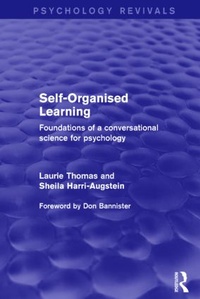
Self-Organised Learning
Foundations of a Conversational Science for Psychology
1st Edition
Published on 17. December 2013
Book
Hardback
426 pages
978-1-138-01653-8 (ISBN)
Description
From its foundation in the 1950s by George Kelly, Personal Construct Psychology continued to grow, both as a movement among psychologists and then in industry, education, government and commerce. Originally published in 1985 this title offers a compendium of elaborations and new conversational uses for Kelly's repertory grid technique. The authors have dramatically transformed the grid from a static measuring instrument to a dynamic tool for a personal exploration of the learning process itself. This grid-based Reflective Learning Technology enables individuals, pairs, groups and organisations to develop their learning in environments of work, family, education and society.
As the originators and best-known practitioners of interactive grids, the authors give the reader an A-Z of these techniques. Case studies include management training, quality control, staff appraisal, job selection, team building, manufacturing, marketing and production as well as learning at a distance, learning to learn in schools, youth training, reading to learn and other learning skills, staff development, social work, counselling and therapy. Their development of a theory of learning conversation and conversational grid software opens up an imaginative, exciting and more humane approach to the use of microcomputers in all forms of education, while at the same time demonstrating the essentially autonomous nature of human learning. Available again after many years out of print, this book is of even greater value today than when first published.
As the originators and best-known practitioners of interactive grids, the authors give the reader an A-Z of these techniques. Case studies include management training, quality control, staff appraisal, job selection, team building, manufacturing, marketing and production as well as learning at a distance, learning to learn in schools, youth training, reading to learn and other learning skills, staff development, social work, counselling and therapy. Their development of a theory of learning conversation and conversational grid software opens up an imaginative, exciting and more humane approach to the use of microcomputers in all forms of education, while at the same time demonstrating the essentially autonomous nature of human learning. Available again after many years out of print, this book is of even greater value today than when first published.
More details
Series
Language
English
Place of publication
London
United Kingdom
Publishing group
Taylor & Francis Ltd
Target group
College/higher education
Professional and scholarly
Dimensions
Height: 234 mm
Width: 156 mm
Weight
950 gr
ISBN-13
978-1-138-01653-8 (9781138016538)
Copyright in bibliographic data and cover images is held by Nielsen Book Services Limited or by the publishers or by their respective licensors: all rights reserved.
Schweitzer Classification
Other editions
Additional editions
Laurie Thomas | Sheila Harri-Augstein
Self-Organised Learning
Foundations of a Conversational Science for Psychology
Book
06/2015
1st Edition
Routledge
€79.41
Shipment within 10-20 days
Persons
Laurie F. Thomas and E. Sheila Harri-Augstein, Centre for the Study of Human Learning, Brunei University.
Content
Foreword by Don Bannister. General Introduction: The Self-Organised Learner and the Repertory Grid 1. The Personal Nature of Self-Organised Learning 2. Introducing the Repertory Grid: Elements and Constructs 3.The Construction of Personal Meaning 4. FOCUSing: The Emergent Pattern 5. Talkback through a FOCUSed Grid 6. Grid Conversations for Achieving Self-Awareness 7. The Space within which Personal Meaning may be Represented 8. A PCP Approach to Perception 9. The Critical Self: Conversational Self-Assessment 10. Grid Conversations for the Sharing of Meaning 11. Groups and Institutions as Personal Learning Systems 12. The Theory and Practice of Conversational Science: Tools for the T-C Practitioner. Grid Tricks: An Accessing System to the CSHL Reflective Learning Technology. Appendix A: Applications of the Repertory Grid. Appendix B: The Centre for the Study of Human Learning. Glossary: The Personal Structure of Meaning of the Authors. Bibliography. Index.