

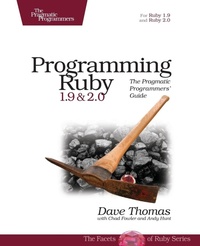
Programming Ruby 1.9 & 2.0 4ed
The Pragmatic Programmers' Guide
4th Edition
Published on 19. September 2013
Book
Paperback/Softback
888 pages
978-1-937785-49-9 (ISBN)
Description
Ruby is the fastest growing and most exciting dynamic language out there. If you need to get working programs delivered fast, you should add Ruby to your toolbox.
This book is the only complete reference for both Ruby 1.9 and Ruby 2.0, the very latest version of Ruby.
2013 marks the 20th anniversary of the Ruby language. We're proud that throughout its history, we've continued to cover the latest version of Ruby.
Would you like to go from first idea to working code much, much faster? Do you currently spend more time satisfying the compiler instead of your clients or end users? Are you frustrated with demanding languages that seem to get in your way, instead of getting the work done? Are you using Rails, and want to dig deeper into the underlying Ruby language? If so, then we've got a language and book for you!
Ruby is a fully object-oriented language, much like the classic object-oriented language, Smalltalk. Like Smalltalk, it is dynamically typed (as opposed to Java or C++), but unlike Smalltalk, Ruby features the same conveniences found in modern scripting languages such as Perl and Python.
The combination of the power of a pure object-oriented language with the convenience of a scripting language makes Ruby a favorite tool of intelligent, forward-thinking programmers.
The Pickaxe contains four major sections:
An acclaimed tutorial on using Ruby. The definitive reference to the language. Complete documentation of all built-in classes, modules, and methods. Complete descriptions of all 97 standard libraries.
This is the reference manual for Ruby, including a description of all the standard library modules, a complete reference to all built-in classes and modules (including all the new and changed methods introduced by Ruby 1.9, 1.9.2, 1.9.3, and 2.0). It also includes all the new and changed syntax and semantics introduced since Ruby 1.8. Learn about the new parameter passing rules, local variable scoping in blocks, fibers, and the new block declaration syntax, among other exciting new features.
About Ruby 2.0
Ruby 2.0 is a minor update to Ruby 1.9, unlike the more major updates from Ruby 1.8 to Ruby 1.9.
The major language changes in Ruby 2.0 are the addition of keyword arguments and the change to use UTF-8 as the default source file encoding.
There are a number of additions to the standard library, including:
@Enumerator::Lazy@, which adds support for lazy access to potentially infinite lists. Refinements allow you to encapsulate changes to third-party classes, and scope their application to individual source files, preventing your changes from polluting the global application.
You'll also find that Ruby 2 is faster, and has memory management improvements that make it more server-friendly.
All told, there are over 110 sections of the book that have been flagged and cross-linked to indicate 2.0 content.
What You Need
This book assumes you have a basic understanding of object-oriented programming.
In general, Ruby programmers tend to favor the the command line for running their code, and they tend to use text editors rather than IDEs.
* Ruby runs on Windows, Linux, and Macs.
This book is the only complete reference for both Ruby 1.9 and Ruby 2.0, the very latest version of Ruby.
2013 marks the 20th anniversary of the Ruby language. We're proud that throughout its history, we've continued to cover the latest version of Ruby.
Would you like to go from first idea to working code much, much faster? Do you currently spend more time satisfying the compiler instead of your clients or end users? Are you frustrated with demanding languages that seem to get in your way, instead of getting the work done? Are you using Rails, and want to dig deeper into the underlying Ruby language? If so, then we've got a language and book for you!
Ruby is a fully object-oriented language, much like the classic object-oriented language, Smalltalk. Like Smalltalk, it is dynamically typed (as opposed to Java or C++), but unlike Smalltalk, Ruby features the same conveniences found in modern scripting languages such as Perl and Python.
The combination of the power of a pure object-oriented language with the convenience of a scripting language makes Ruby a favorite tool of intelligent, forward-thinking programmers.
The Pickaxe contains four major sections:
An acclaimed tutorial on using Ruby. The definitive reference to the language. Complete documentation of all built-in classes, modules, and methods. Complete descriptions of all 97 standard libraries.
This is the reference manual for Ruby, including a description of all the standard library modules, a complete reference to all built-in classes and modules (including all the new and changed methods introduced by Ruby 1.9, 1.9.2, 1.9.3, and 2.0). It also includes all the new and changed syntax and semantics introduced since Ruby 1.8. Learn about the new parameter passing rules, local variable scoping in blocks, fibers, and the new block declaration syntax, among other exciting new features.
About Ruby 2.0
Ruby 2.0 is a minor update to Ruby 1.9, unlike the more major updates from Ruby 1.8 to Ruby 1.9.
The major language changes in Ruby 2.0 are the addition of keyword arguments and the change to use UTF-8 as the default source file encoding.
There are a number of additions to the standard library, including:
@Enumerator::Lazy@, which adds support for lazy access to potentially infinite lists. Refinements allow you to encapsulate changes to third-party classes, and scope their application to individual source files, preventing your changes from polluting the global application.
You'll also find that Ruby 2 is faster, and has memory management improvements that make it more server-friendly.
All told, there are over 110 sections of the book that have been flagged and cross-linked to indicate 2.0 content.
What You Need
This book assumes you have a basic understanding of object-oriented programming.
In general, Ruby programmers tend to favor the the command line for running their code, and they tend to use text editors rather than IDEs.
* Ruby runs on Windows, Linux, and Macs.
More details
Edition
4th edition
Language
English
Place of publication
Raleigh
United States
Product notice
Paperback (trade)
Unsewn / adhesive bound
Dimensions
Height: 233 mm
Width: 194 mm
Thickness: 53 mm
Weight
1534 gr
ISBN-13
978-1-937785-49-9 (9781937785499)
Copyright in bibliographic data and cover images is held by Nielsen Book Services Limited or by the publishers or by their respective licensors: all rights reserved.
Schweitzer Classification
Other editions
Previous edition

Book
06/2009
3rd Edition
The Pragmatic Programmers
€67.75
Article exhausted; check for reprint
Persons
Dave Thomas is a cornerstone of the Ruby community, and is personally responsible for many of its innovative directions and initiatives. He and original co-author Andy Hunt are founders of the Pragmatic Programmers and the Pragmatic Bookshelf.