

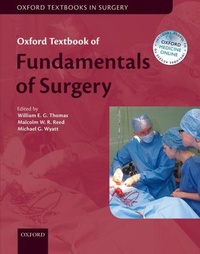
Oxford Textbook of Fundamentals of Surgery
Published on 28. July 2016
Book
Hardback
848 pages
978-0-19-966554-9 (ISBN)
Description
The Oxford Textbook of Fundamentals of Surgery provides a solid foundation of the knowledge and basic science needed to hone all of the core surgical skills used in surgical settings.
Presented in a clear and accessible way, the Oxford Textbook of Fundamentals of Surgery addresses the cross-specialty aspects of surgery applicable to all trainees. With an emphasis on practical application and international best practice, it will support you to confidently deliver the highest possible surgical outcomes.
This authoritative learning and reference tool is richly illustrated throughout, with step by step guides for skills such as stitching and tying knots. The topics discussed range from anatomy to radiology, and cover the basic surgical skills needed to manage wounds and haemostasis. Evidence-based approaches to the management of a range of surgical situations, such as major trauma, transplantation, and the dying patient, will help you to overcome tough clinical challenges and improve patient
outcomes.
The Oxford Textbook of Fundamentals of Surgery comes with a year's access to the online version on Oxford Medicine Online. By activating your unique access code, you can find answers quickly by searching the full text, as well as annotate, bookmark, and download important information.
Presented in a clear and accessible way, the Oxford Textbook of Fundamentals of Surgery addresses the cross-specialty aspects of surgery applicable to all trainees. With an emphasis on practical application and international best practice, it will support you to confidently deliver the highest possible surgical outcomes.
This authoritative learning and reference tool is richly illustrated throughout, with step by step guides for skills such as stitching and tying knots. The topics discussed range from anatomy to radiology, and cover the basic surgical skills needed to manage wounds and haemostasis. Evidence-based approaches to the management of a range of surgical situations, such as major trauma, transplantation, and the dying patient, will help you to overcome tough clinical challenges and improve patient
outcomes.
The Oxford Textbook of Fundamentals of Surgery comes with a year's access to the online version on Oxford Medicine Online. By activating your unique access code, you can find answers quickly by searching the full text, as well as annotate, bookmark, and download important information.
More details
Other editions
Additional editions
William E. G. Thomas | Malcolm W. R. Reed | Michael G. Wyatt
Oxford Textbook of Fundamentals of Surgery
Book
04/2018
Oxford University Press
€111.50
Shipment within 15-20 days
William E. G. Thomas | Malcolm W. R. Reed | Michael G. Wyatt
Oxford Textbook of Fundamentals of Surgery
E-Book
09/2016
1st Edition
OUP eBook
€98.99
Available for download
William E. G. Thomas | Malcolm W. R. Reed | Michael G. Wyatt
Oxford Textbook of Fundamentals of Surgery
E-Book
07/2016
1st Edition
OUP eBook
€95.49
Available for download
Persons
Mr William E. G. Thomas is Consultant Surgeon Emeritus and former Clinical Director of Surgery at Sheffield Teaching Hospitals Trust having been appointed in 1986. Mr Thomas have also held the posts of Honorary Senior Clinical Lecturer in Surgery, University of Sheffield and past Member of Council and Senior Vice President, of the Royal College of Surgeons of England and past Dean of the Academy of Education of the International Society of Surgery. Mr Thomas was a
member of the Founding Council of the Faculty of Medical Leadership and Management, and Founder and Executive Board Member of the International Collaboration for Essential Surgery (ICES).
Mr Malcolm Reed is a Professor of Surgical Oncology and an Honorary Consultant at Royal Hallamshire Hospital, Sheffield. He then underwent surgical training in Birmingham, Derby and Bristol before moving to the University of Louisville in the United States to undertake a research MD. He returned to Sheffield and undertook higher surgical training before becoming appointed a Senior Lecturer and Honorary Consultant Surgeon at the Royal Hallamshire Hospital in 1992. He was then appointed to the
Foundation Chair in Surgical Oncology at the University of Sheffield in 2000. Subsequent roles included Head of Academic Surgery and Head of the University Department of Oncology. He was appointed Dean of Brighton and Sussex Medical School in 2014 and is currently a member of the Medical Schools
Council and an external examiner for the final year medical school exams at the University of Leeds. He has previous held external examinerships at UCL, the University of Nottingham and the University of Kuwait.
Mr Michael Wyatt is an NHS Consultant with a major interest in treating complex thoracic and abdominal aortic disease, using both open and stent graft technologies. Having qualified from Newcastle University, he trained in surgery in Bristol, Plymouth, Exeter and London. Mr Wyatt presents and publishes widely on all aspects of vascular disease, and is the President-Elect of the Vascular Society of Great Britain and Ireland (President, 2015-6). His other external responsibilities are as
Treasurer of the British Journal of Surgery Society, Clinical Editor of Surgery, Vice Chair of the Ethics Committee, Chair of the General Surgical Training Committee, Vice Chair of the Vascular Surgery Clinical Reference Group and Chairman of the Society of International Vascular Surgeons. He runs a busy
tertiary referral vascular practice at the Freeman Hospital, where he receives referrals from all over the country.
member of the Founding Council of the Faculty of Medical Leadership and Management, and Founder and Executive Board Member of the International Collaboration for Essential Surgery (ICES).
Mr Malcolm Reed is a Professor of Surgical Oncology and an Honorary Consultant at Royal Hallamshire Hospital, Sheffield. He then underwent surgical training in Birmingham, Derby and Bristol before moving to the University of Louisville in the United States to undertake a research MD. He returned to Sheffield and undertook higher surgical training before becoming appointed a Senior Lecturer and Honorary Consultant Surgeon at the Royal Hallamshire Hospital in 1992. He was then appointed to the
Foundation Chair in Surgical Oncology at the University of Sheffield in 2000. Subsequent roles included Head of Academic Surgery and Head of the University Department of Oncology. He was appointed Dean of Brighton and Sussex Medical School in 2014 and is currently a member of the Medical Schools
Council and an external examiner for the final year medical school exams at the University of Leeds. He has previous held external examinerships at UCL, the University of Nottingham and the University of Kuwait.
Mr Michael Wyatt is an NHS Consultant with a major interest in treating complex thoracic and abdominal aortic disease, using both open and stent graft technologies. Having qualified from Newcastle University, he trained in surgery in Bristol, Plymouth, Exeter and London. Mr Wyatt presents and publishes widely on all aspects of vascular disease, and is the President-Elect of the Vascular Society of Great Britain and Ireland (President, 2015-6). His other external responsibilities are as
Treasurer of the British Journal of Surgery Society, Clinical Editor of Surgery, Vice Chair of the Ethics Committee, Chair of the General Surgical Training Committee, Vice Chair of the Vascular Surgery Clinical Reference Group and Chairman of the Society of International Vascular Surgeons. He runs a busy
tertiary referral vascular practice at the Freeman Hospital, where he receives referrals from all over the country.
Editor
Consultant Surgeon and Clinical Director of SurgeryConsultant Surgeon and Clinical Director of Surgery, Royal Hallamshire Hospital, Sheffield, UK
Consultant in General SurgeryConsultant in General Surgery, Royal Hallamshire Hospital, Sheffield, UK
Consultant in Vascular SurgeryConsultant in Vascular Surgery, Freeman Hospital, Newcastle upon Tyne, UK
Content
1. BASIC SCIENCE; 1.1 APPLIED SURGICAL ANATOMY; 1.2 APPLIED SURGICAL PHYSIOLOGY; 1.3 APPLIED SURGICAL PHARMACOLOGY; 1.4 APPLIED SURGICAL PATHOLOGY; 1.5 APPLIED SURGICAL MICROBIOLOGY; 1.6 APPLIED SURGICAL RADIOLOGY; 2. COMMON SURGICAL CONDITIONS; 2.1 ASSESSING THE ACUTE ABDOMEN; 2.2 ABDOMINAL WALL AND HERNIAS; 2.3 UPPER GASTRO-OESOPHAGEAL SURGERY; 2.4 HEPATO-PANCREATO-BILIARY DISORDERS; 2.5 COLORECTAL; 2.6 BREAST SURGERY; 2.7 VASCULAR SURGERY; 2.8 CARDIAC AND PULMONARY SURGERY; 2.9 GENITOURINARY SURGERY; 2.10 ORTHOPAEDIC SURGERY; 2.11 SKIN AND SOFT TISSUE MASSES; 2.12 HEAD AND NECK SURGERY; 2.13 NEUROSURGERY; 2.14 ENDOCRINE SURGERY; 2.15 SURGICAL ONCOLOGY; 3 BASIC SURGICAL SKILLS; 3.1 PRINCIPLES OF SAFE SURGERY; 3.2 ANAESTHETIC TECHNIQUES; 3.3 BASIC SURGICAL TECHNIQUES; 3.4 SURGICAL WOUNDS; 3.5 SURGICAL HAEMOSTASIS; 3.6 ANATOMOSES AND DRAINS; 3.7 PRINCIPLES OF SURGICAL ENDOSCOPY AND MINIMAL ACCESS SURGERY; 3.8 SIMULATION AND ASSESSMENT; 4. ASSESSMENT AND MANAGEMENT OF THE SURGICAL PATIENT; 4.1 HISTORY TAKING AND INFORMATION GATHERING; 4.2 PHYSICAL EXAMINATION; 4.3 INFORMATION SHARING; 4.4 SURGICAL CONSENT; 5. PERI-OPERATIVE MANAGEMENT; 5.1 PRE-OPERATIVE ASSESSMENT; 5.2 INTRA-OPERATIVE CARE; 5.3 POST-OPERATIVE CARE; 5.4 NUTRITIONAL MANAGEMENT; 5.5 ENHANCED RECOVERY; 5.6 PRINCIPLES OF TRANSFUSION AND HAEMOSTASIS; 5.7 VENOUS THROMBOEMBOLISM: DEEP VEIN THROMBOSIS AND PULMONARY EMBOLISM; 5.8 METABOLIC AND ENDOCRINE DISORDERS IN THE PERI-OPERATIVE PERIOD; 6. ASSESSMENT AND MANAGEMENT OF PATIENTS WITH MAJOR TRAUMA; 6.1 ASSESSMENT OF THE MULTIPLY INJURED PATIENT; 6.2 PRINCIPLES OF MANAGEMENT OF SOFT TISSUE INJURIES; 6.3 THE ACUTE MANAGEMENT OF MAJOR/MULTIPLE FRACTURES AND DISLOCATIONS; 6.4 PRINCIPLES OF SPECIFIC INJURIES; 7. SURGICAL CARE OF THE PAEDIATRIC PATIENT; 7.1 PRINCIPLES OF PAEDIATRIC; 7.2 PRINCIPLES OF CHILD PROTECTION AND GOVERNANCE; 7.3 COMMON PAEDIATRIC SURGICAL CONDITIONS; 8. MANAGEMENT OF THE DYING PATIENT; 8.1 MANAGEMENT OF THE DYING PATIENT IN CONSULTATION WITH THE PALLIATIVE CARE TEAM; 8.2 TERMINAL CARE OF THE DYING PATIENT, SUPPORTING THEIR FAMILY, AND ETHICAL CONSIDERATIONS; 9. PRINCIPLES OF ORGAN AND TISSUE TRANSPLANTATION; 9.1 ORGAN DONATION; 9.2 PRINCIPLES OF THE TRANSPLANT IMMUNOLOGY; 9.3 KIDNEY TRANSPLANTATION; 9.4 PANCREAS TRANSPLANTATION; 9.5 LIVER TRANSPLANTATION; 10. EVIDENCE BASED SURGERY, RESEARCH, AND AUDIT; 10.1 RESEARCH IN SURGERY; 10.2 QUALITY IMPROVEMENT; 10.3 STATISTICS FOR SURGEONS; INDEX