

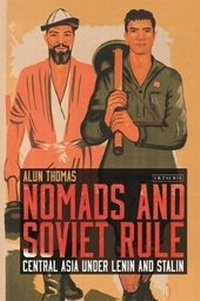
Nomads and Soviet Rule
Central Asia under Lenin and Stalin
Published on 14. June 2018
Book
Hardback
272 pages
978-1-78831-155-7 (ISBN)
Description
The nomads of Central Asia were already well accustomed to life under the power of a distant capital when the Bolsheviks fomented revolution on the streets of Petrograd. Yet after the fall of the Tsar, the nature, ambition and potency of that power would change dramatically, ultimately resulting in the near eradication of Central Asian nomadism.
Based on extensive primary source work in Almaty, Bishkek and Moscow, Nomads and Soviet Rule charts the development of this volatile and brutal relationship and challenges the often repeated view that events followed a linear path of gradually escalating violence. Rather than the sedentarisation campaign being an inevitability born of deep-rooted Marxist hatred of the nomadic lifestyle, Thomas demonstrates the Soviet state's treatment of nomads to be far more complex and pragmatic. He shows how Soviet policy was informed by both an anti-colonial spirit and an imperialist impulse, by nationalism as well as communism, and above all by a lethal self-confidence in the Communist Party's ability to transform the lives of nomads and harness the agricultural potential of their landscape. This is the first book to look closely at the period between the revolution and the collectivisation drive, and offers fresh insight into a little-known aspect of early Soviet history. In doing so, the book offers a path to refining conceptions of the broader history and dynamics of the Soviet project in this key period.
Based on extensive primary source work in Almaty, Bishkek and Moscow, Nomads and Soviet Rule charts the development of this volatile and brutal relationship and challenges the often repeated view that events followed a linear path of gradually escalating violence. Rather than the sedentarisation campaign being an inevitability born of deep-rooted Marxist hatred of the nomadic lifestyle, Thomas demonstrates the Soviet state's treatment of nomads to be far more complex and pragmatic. He shows how Soviet policy was informed by both an anti-colonial spirit and an imperialist impulse, by nationalism as well as communism, and above all by a lethal self-confidence in the Communist Party's ability to transform the lives of nomads and harness the agricultural potential of their landscape. This is the first book to look closely at the period between the revolution and the collectivisation drive, and offers fresh insight into a little-known aspect of early Soviet history. In doing so, the book offers a path to refining conceptions of the broader history and dynamics of the Soviet project in this key period.
Reviews / Votes
An impressive array of materials from the archives ... Dense with details ... Summing Up: Recommended. * V. Clement, Marine Corps University, CHOICE * The willingness of the author to analyze the sovietization of Central Asia through the category of nomadism brings an enriching perspective to many questions and allows reader to explore the diversity of discourses of the 1920s. * Connexe (Bloomsbury Translation) * Thomas' study makes an insightful addition to the field and should take an honourable place on the shelves of students and scholars of Central Asian history alike. * Nomadic Peoples *More details
Series
Language
English
Place of publication
United Kingdom
Publishing group
Bloomsbury Publishing PLC
Target group
College/higher education
Illustrations
2 maps
Dimensions
Height: 216 mm
Width: 138 mm
Weight
456 gr
ISBN-13
978-1-78831-155-7 (9781788311557)
Copyright in bibliographic data and cover images is held by Nielsen Book Services Limited or by the publishers or by their respective licensors: all rights reserved.
Schweitzer Classification
Other editions
Additional editions
E-Book
06/2018
1st Edition
I.B. Tauris
€38.49
Available for download
Person
Alun Thomas is Lecturer in Modern History at Staffordshire University. He received his PhD from the University of Sheffield and has written in peer-reviewed journals and delivered papers internationally on the complex relationship between the nomadic communities of Central Asia and the nascent Soviet state.
Content
Chapter One: Introduction
Chapter Two: Perceptions of Nomadism
Chapter Three: The Politics of Land Use
Chapter Four: Territory and Jurisdiction
Chapter Five: Taxing Nomads
Chapter Six: Social Policies in the Nomadic Aul (Community)
Chapter Seven: Sedentarisation
Chapter Eight: Conclusion
Chapter Two: Perceptions of Nomadism
Chapter Three: The Politics of Land Use
Chapter Four: Territory and Jurisdiction
Chapter Five: Taxing Nomads
Chapter Six: Social Policies in the Nomadic Aul (Community)
Chapter Seven: Sedentarisation
Chapter Eight: Conclusion