

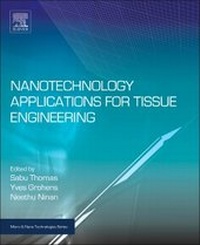
Nanotechnology Applications for Tissue Engineering
Published on 8. January 2015
Book
Hardback
336 pages
978-0-323-32889-0 (ISBN)
Description
Tissue engineering involves seeding of cells on bio-mimicked scaffolds providing adhesive surfaces. Researchers though face a range of problems in generating tissue which can be circumvented by employing nanotechnology. It provides substrates for cell adhesion and proliferation and agents for cell growth and can be used to create nanostructures and nanoparticles to aid the engineering of different types of tissue.Written by renowned scientists from academia and industry, this book covers the recent developments, trends and innovations in the application of nanotechnologies in tissue engineering and regenerative medicine. It provides information on methodologies for designing and using biomaterials to regenerate tissue, on novel nano-textured surface features of materials (nano-structured polymers and metals e.g.) as well as on theranostics, immunology and nano-toxicology aspects. In the book also explained are fabrication techniques for production of scaffolds to a series of tissue-specific applications of scaffolds in tissue engineering for specific biomaterials and several types of tissue (such as skin bone, cartilage, vascular, cardiac, bladder and brain tissue). Furthermore, developments in nano drug delivery, gene therapy and cancer nanotechonology are described.The book helps readers to gain a working knowledge about the nanotechnology aspects of tissue engineering and will be of great use to those involved in building specific tissue substitutes in reaching their objective in a more efficient way. It is aimed for R&D and academic scientists, lab engineers, lecturers and PhD students engaged in the fields of tissue engineering or more generally regenerative medicine, nanomedicine, medical devices, nanofabrication, biofabrication, nano- and biomaterials and biomedical engineering.
More details
Series
Language
English
Place of publication
Norwich
United States
Target group
Professional and scholarly
Scientists, engineers, lecturers and PhD students engaged in the fields of tissue engineering, regenerative medicine, nanomedicine, nanofabrication, biofabrication and biomedical engineering. Physicians and medicine students/researchers
Dimensions
Height: 235 mm
Width: 191 mm
Weight
780 gr
ISBN-13
978-0-323-32889-0 (9780323328890)
Copyright in bibliographic data and cover images is held by Nielsen Book Services Limited or by the publishers or by their respective licensors: all rights reserved.
Schweitzer Classification
Other editions
Additional editions

Sabu Thomas | Yves Grohens | Neethu Ninan
Nanotechnology Applications for Tissue Engineering
E-Book
01/2015
William Andrew
€107.00
Available for download
Persons
Prof. Sabu Thomas is a globally renowned scientist and one of the leading researchers in polymer science and nanotechnology. He currently serves as Professor of Polymer Science & Engineering and was the former Vice Chancellor of Mahatma Gandhi University, Kerala, India. Prof. Thomas is internationally recognized for his pioneering work on polymer blends, nanocomposites, green materials, and sustainable polymers. Professor Yves Grohens is the Director of the LIMATB (Material Engineering) Laboratory of Universite de Bretagne Sud, France. His master's and PhD degrees were from Besancon University, France. After finishing his studies, he worked as assistant professor and later professor in various reputed universities in France. He is an invited professor to many universities in different parts of the world as well. His areas of interest include physicochemical studies of polymer surfaces and interfaces, phase transitions in thin films confinement, nano and bio composites design and characterization, and biodegradation of polymers and biomaterials. He has written several book chapters, monographs, and scientific reviews and has published 130 international publications. He is the chairman and member of advisory committees of many international conferences. Dr.Neethu Ninan was awarded PhD in Materials Engineering from Universite de Bretagne Sud, Lorient, France. She received Masters in Engineering in 'Nanotechnology in Medical Science' from Amrita Centre for Nanosciences, Kochi, India. She did her Bachelors of Engineering in 'Biotechnology and Biochemical Engineering'. She worked in collaboration with Universiti Technologi Mara (Malaysia), Mahatma Gandhi University (India) and Chonnam National University (South Korea). She is the editor of four books. She has written several articles, book chapters, and reviews in international journals. Her keen research areas are nanotechnology, composites, tissue engineering, drug delivery and zeolites.
Content
1. Nanomedicine and Tissue Engineering
2. Design of biomaterials using nanotechnlogy
3. Electrospinning of polymers for tissue engineering.
4. Biomimetic nanofibers for muskuloskeletal tissue engineering
5. Hydrogels - Promising candidates for tissue engineering
6. 3D scaffolding for pancreatic islet replacement
7. Scaffolds with antibacterial properties
8. Dermal tissue engineering: Current trends
9. Chitosan and its application as tissue engineering scaffolds
10. Cell encapsulation in self-assembled hydrogel matrix
11. Nanotechnology enabled drug delivery for cancer therapy
12. Nanomedicine in Theranostics
13. Upconversion nanoparticles
14. Gold nanoparticles for cancer drug delivery
15. Role of nanogenotoxicology studies in safety evaluation of nanomaterials
16. Toxicology considerations in nanomedicine
17. Future of nanotechnology in tissue engineering
2. Design of biomaterials using nanotechnlogy
3. Electrospinning of polymers for tissue engineering.
4. Biomimetic nanofibers for muskuloskeletal tissue engineering
5. Hydrogels - Promising candidates for tissue engineering
6. 3D scaffolding for pancreatic islet replacement
7. Scaffolds with antibacterial properties
8. Dermal tissue engineering: Current trends
9. Chitosan and its application as tissue engineering scaffolds
10. Cell encapsulation in self-assembled hydrogel matrix
11. Nanotechnology enabled drug delivery for cancer therapy
12. Nanomedicine in Theranostics
13. Upconversion nanoparticles
14. Gold nanoparticles for cancer drug delivery
15. Role of nanogenotoxicology studies in safety evaluation of nanomaterials
16. Toxicology considerations in nanomedicine
17. Future of nanotechnology in tissue engineering