

Micro- and Nanotechnology Enabled Applications for Portable Miniaturized Analytical Systems
Published on 19. October 2021
Book
Paperback/Softback
438 pages
978-0-12-823727-4 (ISBN)
Description
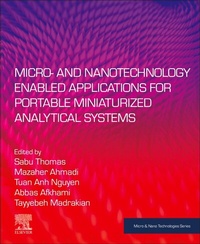
Micro- and Nanotechnology Enabled Applications for Portable Miniaturized Analytical Systems outlines the basic principles of miniaturized analytical devices, such as spectrometric, separation, imaging and electrochemical miniaturized instruments. Concepts such as smartphone-enabled miniaturized detection systems and micro/nanomachines are also reviewed. Subsequent chapters explore the emerging application of these mobile devices for miniaturized analysis in various fields, including medicine and biomedicine, environmental chemistry, food chemistry, and forensic chemistry. This is an important reference source for materials scientists and engineers wanting to understand how miniaturization techniques are being used to create a range of efficient, sustainable electronic and optical devices.
Miniaturization describes the concept of manufacturing increasingly smaller mechanical, optical, and electronic products and devices. These smaller instruments can be used to produce micro- and nanoscale components required for analytical procedures. A variety of micro/nanoscale materials have been synthesized and used in analytical procedures, such as sensing materials, sorbents, adsorbents, catalysts, and reactors. The miniaturization of analytical instruments can be applied to the different steps of analytical procedures, such as sample preparation, analytical separation, and detection, reducing the total cost of manufacturing the instruments and the needed reagents and organic solvents.
Miniaturization describes the concept of manufacturing increasingly smaller mechanical, optical, and electronic products and devices. These smaller instruments can be used to produce micro- and nanoscale components required for analytical procedures. A variety of micro/nanoscale materials have been synthesized and used in analytical procedures, such as sensing materials, sorbents, adsorbents, catalysts, and reactors. The miniaturization of analytical instruments can be applied to the different steps of analytical procedures, such as sample preparation, analytical separation, and detection, reducing the total cost of manufacturing the instruments and the needed reagents and organic solvents.
More details
Series
Language
English
Place of publication
United States
Target group
Professional and scholarly
Dimensions
Height: 235 mm
Width: 191 mm
Weight
880 gr
ISBN-13
978-0-12-823727-4 (9780128237274)
Copyright in bibliographic data and cover images is held by Nielsen Book Services Limited or by the publishers or by their respective licensors: all rights reserved.
Schweitzer Classification
Other editions
Additional editions
Sabu Thomas | Mazaher Ahmadi | Abbas Afkhami
Micro- and Nanotechnology Enabled Applications for Portable Miniaturized Analytical Systems
E-Book
10/2021
Elsevier
€210.00
Available for download
Persons
Prof. Sabu Thomas is a globally renowned scientist and one of the leading researchers in polymer science and nanotechnology. He currently serves as Professor of Polymer Science & Engineering and was the former Vice Chancellor of Mahatma Gandhi University, Kerala, India. Prof. Thomas is internationally recognized for his pioneering work on polymer blends, nanocomposites, green materials, and sustainable polymers. In addition to serving as an adjunct faculty member at Shiraz University of Medical Sciences, Shiraz, Iran, Dr. Ahmadi is an Associate Professor at Bu-Ali Sina University. He is the CEO of an analytical chemistry company and an advisor at D-8 International University. He holds approximately 6 patents and is consistently among Stanford University's Top 2% Scientists worldwide. Prof. Abbas Afkhami is a senior faculty member in the Department of Analytical Chemistry at Bu-Ali Sina University, with more than 30 years of academic experience. He has held prominent academic positions such as Chancellor of D-8 International University and Dean of the Faculty of Science. Currently, he serves on multiple journal editorial boards and is the Editor-in-Chief of Analytical and Bioanalytical Chemistry Research. Since 2008, his name has been consistently listed among the ISI Highly Cited Researchers.
Prof. Madrakian is a skilled researcher in the domains of analytical bioassays, nanomaterials, and electrochemical sensors. She is ranked among the top 2% of the world's most cited scientists and has continuously appeared on the ISI Highly Cited Researchers list. She also serves as an editor for multiple journals, including Frontiers in Bioengineering and Biotechnology and Nanochemistry Research.
Tuan Anh Nguyen is a Senior Principal Research Scientist at the Institute for Tropical Technology, Vietnam Academy of Science and Technology, Hanoi, Vietnam. He received a BS in physics from Hanoi University in 1992, a BS in economics from Hanoi National Economics University in 1997, and a PhD in chemistry from the Paris Diderot University, France, in 2003. He was a Visiting Scientist at Seoul National University, South Korea, in 2004, and the University of Wollongong, Australia, in 2005. He then worked as a Postdoctoral Research Associate and Research Scientist at Montana State University, United States in 2006-09. In 2012 he was appointed as the Head of the Microanalysis Department at the Institute for Tropical Technology. His research areas of interest include smart sensors, smart networks, smart hospitals, smart cities, complexiverse, and digital twins. He has edited more than 74 books for Elsevier, 12 books for CRC Press, 1 book for Springer, 1 book for RSC, and 2 books for IGI Global. He is the Editor-in-Chief of Kenkyu Journal of Nanotechnology & Nanoscience.
Prof. Madrakian is a skilled researcher in the domains of analytical bioassays, nanomaterials, and electrochemical sensors. She is ranked among the top 2% of the world's most cited scientists and has continuously appeared on the ISI Highly Cited Researchers list. She also serves as an editor for multiple journals, including Frontiers in Bioengineering and Biotechnology and Nanochemistry Research.
Tuan Anh Nguyen is a Senior Principal Research Scientist at the Institute for Tropical Technology, Vietnam Academy of Science and Technology, Hanoi, Vietnam. He received a BS in physics from Hanoi University in 1992, a BS in economics from Hanoi National Economics University in 1997, and a PhD in chemistry from the Paris Diderot University, France, in 2003. He was a Visiting Scientist at Seoul National University, South Korea, in 2004, and the University of Wollongong, Australia, in 2005. He then worked as a Postdoctoral Research Associate and Research Scientist at Montana State University, United States in 2006-09. In 2012 he was appointed as the Head of the Microanalysis Department at the Institute for Tropical Technology. His research areas of interest include smart sensors, smart networks, smart hospitals, smart cities, complexiverse, and digital twins. He has edited more than 74 books for Elsevier, 12 books for CRC Press, 1 book for Springer, 1 book for RSC, and 2 books for IGI Global. He is the Editor-in-Chief of Kenkyu Journal of Nanotechnology & Nanoscience.
Editor
Assistant Professor, Bu-Ali Sina University, Hamedan, Islamic Republic of Iran
Full Professor, Bu-Ali Sina University, Hamedan, Islamic Republic of Iran
Full Professor, Bu-Ali Sina University, Hamedan, Islamic Republic of Iran
Senior Principal Research Scientist, Institute for Tropical Technology, Vietnam Academy of Science and Technology, Hanoi, Vietnam
Content
PART 1: FUNDAMENTALS
1. Miniaturization: An Introduction to Miniaturized Analytical Devices
2. Nanosensors and Nanodevices for Miniaturized Analysis
3. Spectrometric Miniaturized Instruments
4. Separation Miniaturized Instruments
5. Imaging Miniaturized Instruments
6. Electrochemical Miniaturized Instruments
7. Biosensing and Target Isolation
8. Biomotor-Driven Sensing
9. Motion-Based Signal Transduction
10. Flow Injection/Sequential Injection devices
11. Lab-on-a-Chip Miniaturized Analytical Devices
12. Smartphone Enabled Miniaturized Analytical Devices
PART 2: APPLICATIONS OF MOBILE DEVICES IN MINIATURIZED ANALYSIS
13. Introduction to the Mobile Devices for Miniaturized Analysis
14. Health Care Applications
15. Biomedical Applications
16. Environmental Applications
17. Quality Control Applications
18. Security/Defense Applications
19. Future Perspectives
1. Miniaturization: An Introduction to Miniaturized Analytical Devices
2. Nanosensors and Nanodevices for Miniaturized Analysis
3. Spectrometric Miniaturized Instruments
4. Separation Miniaturized Instruments
5. Imaging Miniaturized Instruments
6. Electrochemical Miniaturized Instruments
7. Biosensing and Target Isolation
8. Biomotor-Driven Sensing
9. Motion-Based Signal Transduction
10. Flow Injection/Sequential Injection devices
11. Lab-on-a-Chip Miniaturized Analytical Devices
12. Smartphone Enabled Miniaturized Analytical Devices
PART 2: APPLICATIONS OF MOBILE DEVICES IN MINIATURIZED ANALYSIS
13. Introduction to the Mobile Devices for Miniaturized Analysis
14. Health Care Applications
15. Biomedical Applications
16. Environmental Applications
17. Quality Control Applications
18. Security/Defense Applications
19. Future Perspectives