

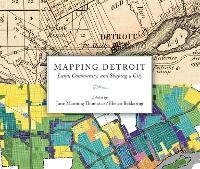
Mapping Detroit
Land, Community, and Shaping a City
Published on 30. March 2015
Book
Paperback/Softback
252 pages
978-0-8143-4026-4 (ISBN)
Description
One of Detroit's most defining modern characteristics-and most pressing dilemmas-is its huge amount of neglected and vacant land. In Mapping Detroit: Land, Community, and Shaping a City, editors June Manning Thomas and Henco Bekkering use chapters based on a variety of maps to shed light on how Detroit moved from frontier fort to thriving industrial metropolis to today's high-vacancy city. With contributors ranging from a map archivist and a historian to architects, urban designers, and urban planners, Mapping Detroit brings a unique perspective to the historical causes, contemporary effects, and potential future of Detroit's transformed landscape.
To show how Detroit arrived in its present condition, contributors in part 1, Evolving Detroit: Past to Present, trace the city's beginnings as an agricultural, military, and trade outpost and map both its depopulation and attempts at redevelopment. In part 2, Portions of the City, contributors delve into particular land-related systems and neighborhood characteristics that encouraged modern social and economic changes. Part 2 continues by offering case studies of two city neighborhoods-the Brightmoor area and Southwest Detroit-that are struggling to adapt to changing landscapes. In part 3, Understanding Contemporary Space and Potential, contributors consider both the city's ecological assets and its sociological fragmentation to add dimension to the current understanding of its emptiness. The volume's epilogue offers a synopsis of the major points of the 2012 Detroit Future City report, the city's own strategic blueprint for future land use.
Mapping Detroit explores not only what happens when a large city loses its main industrial purpose and a major portion of its population but also what future might result from such upheaval. Containing some of the leading voices on Detroit's history and future, Mapping Detroit will be informative reading for anyone interested in urban studies, geography, and recent American history.
To show how Detroit arrived in its present condition, contributors in part 1, Evolving Detroit: Past to Present, trace the city's beginnings as an agricultural, military, and trade outpost and map both its depopulation and attempts at redevelopment. In part 2, Portions of the City, contributors delve into particular land-related systems and neighborhood characteristics that encouraged modern social and economic changes. Part 2 continues by offering case studies of two city neighborhoods-the Brightmoor area and Southwest Detroit-that are struggling to adapt to changing landscapes. In part 3, Understanding Contemporary Space and Potential, contributors consider both the city's ecological assets and its sociological fragmentation to add dimension to the current understanding of its emptiness. The volume's epilogue offers a synopsis of the major points of the 2012 Detroit Future City report, the city's own strategic blueprint for future land use.
Mapping Detroit explores not only what happens when a large city loses its main industrial purpose and a major portion of its population but also what future might result from such upheaval. Containing some of the leading voices on Detroit's history and future, Mapping Detroit will be informative reading for anyone interested in urban studies, geography, and recent American history.
More details
Series
Language
English
Place of publication
Detroit, MI
United States
Target group
Professional and scholarly
Illustrations
130 illustrations
Dimensions
Height: 211 mm
Width: 262 mm
Thickness: 13 mm
ISBN-13
978-0-8143-4026-4 (9780814340264)
Copyright in bibliographic data and cover images is held by Nielsen Book Services Limited or by the publishers or by their respective licensors: all rights reserved.
Schweitzer Classification
Other editions
Additional editions

E-Book
03/2015
1st Edition
Wayne State University Press
€36.99
Available for download
Persons
June Manning Thomas is Centennial Professor in the A. Alfred Taubman College of Architecture and Urban Planning, University of Michigan, USA. She is the author of several books including Redevelopment and Race: Planning a Finer City in Postwar Detroit (Wayne State University Press, 2013) and co-editor with Margaret Dewar of The City after Abandonment.
Henco Bekkering has been a practitioner in urban design and planning in the Netherlands for more than thirty years and is a professor emeritus of urban design at the School of Architecture, Delft University of Technology. He has been a visiting professor at Taubman College, University of Michigan, USA, and at the School of Architecture at Tsinghua University in Beijing, China.
Henco Bekkering has been a practitioner in urban design and planning in the Netherlands for more than thirty years and is a professor emeritus of urban design at the School of Architecture, Delft University of Technology. He has been a visiting professor at Taubman College, University of Michigan, USA, and at the School of Architecture at Tsinghua University in Beijing, China.