

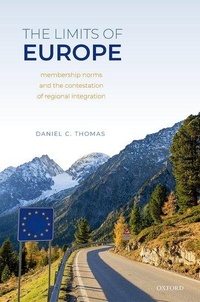
The Limits of Europe
Membership Norms and the Contestation of Regional Integration
Published on 25. November 2021
Book
Hardback
286 pages
978-0-19-920671-1 (ISBN)
Description
Where does Europe begin and end? How have the European Union and its precursors decided which countries are eligible to join the community and which are not? Few issues are more hotly debated, more important for the course of European integration, or more consequential for individuals in and around the EU.
As this book demonstrates, the limits of Europe are determined by the values shared at particular moments in time by the leaders of the community's member states, regardless of their particular policy preferences. These membership norms shape the community's decisions on enlargement by empowering certain political forces and disempowering others. And contrary to conventional wisdom, these norms have changed considerably over time.
The Limits of Europe: Membership Norms and the Contestation of Regional Integration uses a novel combination of normative genealogy, statistical analysis and detailed tracing of EU decision-making on Greece, Spain, Turkey and Ukraine to demonstrate that changing membership norms have had a stronger impact on the community's enlargement since the 1950s than treaty rules, the location of the states seeking membership, or even the commercial or security interests of member states.
As this book demonstrates, the limits of Europe are determined by the values shared at particular moments in time by the leaders of the community's member states, regardless of their particular policy preferences. These membership norms shape the community's decisions on enlargement by empowering certain political forces and disempowering others. And contrary to conventional wisdom, these norms have changed considerably over time.
The Limits of Europe: Membership Norms and the Contestation of Regional Integration uses a novel combination of normative genealogy, statistical analysis and detailed tracing of EU decision-making on Greece, Spain, Turkey and Ukraine to demonstrate that changing membership norms have had a stronger impact on the community's enlargement since the 1950s than treaty rules, the location of the states seeking membership, or even the commercial or security interests of member states.
More details
Language
English
Place of publication
Oxford
United Kingdom
Target group
Professional and scholarly
Product notice
sewn/stitched
Cloth over boards
Dimensions
Height: 231 mm
Width: 157 mm
Thickness: 25 mm
Weight
590 gr
ISBN-13
978-0-19-920671-1 (9780199206711)
Copyright in bibliographic data and cover images is held by Nielsen Book Services Limited or by the publishers or by their respective licensors: all rights reserved.
Schweitzer Classification
Other editions
Additional editions

E-Book
11/2021
1st Edition
OUP eBook
€62.99
Available for download

E-Book
11/2021
1st Edition
OUP eBook
€62.99
Available for download
Person
Daniel C. Thomas is Professor of International Relations at Leiden University. He earned a PhD in Government at Cornell University and taught previously at universities in the US and Ireland. He also worked on human rights and international criminal justice at the European Commission's Directorate General for External Relations (precursor to the European External Action Service).
Content
Questions and Arguments
1: The Question of Membership
2: Explaining Membership Eligibility
Membership Outcomes
3: The Evolution of EU Membership Norms
4: with Patrick D. Statsch: Membership Eligibility in Statistical and Comparative Perspective
Membership Processes
5: Membership Eligibility in a Europe of Non-Communist States, 1957-1961
6: Membership Eligibility in a Europe of Parliamentary Democracies, 1962-1969
7: Membership Eligibility in a Europe of Liberal Democracies, 1970-2005
8: Membership Eligibility in a Divided Europe, 2006-present
Conclusions and Implications
9: Rethinking Europe, rethinking regions
with Patrick D. Statsch: Appendix: Imputing missing Freedom House data from V-Dem data
1: The Question of Membership
2: Explaining Membership Eligibility
Membership Outcomes
3: The Evolution of EU Membership Norms
4: with Patrick D. Statsch: Membership Eligibility in Statistical and Comparative Perspective
Membership Processes
5: Membership Eligibility in a Europe of Non-Communist States, 1957-1961
6: Membership Eligibility in a Europe of Parliamentary Democracies, 1962-1969
7: Membership Eligibility in a Europe of Liberal Democracies, 1970-2005
8: Membership Eligibility in a Divided Europe, 2006-present
Conclusions and Implications
9: Rethinking Europe, rethinking regions
with Patrick D. Statsch: Appendix: Imputing missing Freedom House data from V-Dem data