

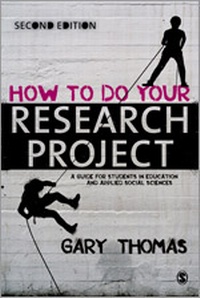
How to Do Your Research Project
A Guide for Students in Education and Applied Social Sciences
2nd Edition
Published on 24. June 2013
Book
Paperback/Softback
328 pages
978-1-4462-5887-3 (ISBN)
Description
Direct, informative and accessible the new edition of Gary Thomas's bestselling title is essential reading for anyone doing a research project.
Packed full of relevant advice and real world examples the book guides you through the complete research process. Using refreshingly jargon-free language and anecdotal evidence it is a witty, easy to follow introduction that will answer your questions, set out best practice and walk you through every stage of your project step-by-step.
It covers:
- How to choose your research question
- Project management and study skills
- Doing an effective literature review
- Methodology, theory and research design
- Design frames
- Ethics and access
- Tools for data collection
- Effective data analysis
- Discussing findings, concluding and writing up
The expanded, insightfully redesigned second edition has a fully integrated companion website including student worksheets, annotated examples and links to SAGE Journals.
Gary Thomas also has an exciting new video in which he explains what's new to this Second Edition.
This popular book is ideal for anyone undertaking a research project in the applied social sciences.
Available with Perusall-an eBook that makes it easier to prepare for class
Perusall is an award-winning eBook platform featuring social annotation tools that allow students and instructors to collaboratively mark up and discuss their SAGE textbook. Backed by research and supported by technological innovations developed at Harvard University, this process of learning through collaborative annotation keeps your students engaged and makes teaching easier and more effective. Learn more.
Packed full of relevant advice and real world examples the book guides you through the complete research process. Using refreshingly jargon-free language and anecdotal evidence it is a witty, easy to follow introduction that will answer your questions, set out best practice and walk you through every stage of your project step-by-step.
It covers:
- How to choose your research question
- Project management and study skills
- Doing an effective literature review
- Methodology, theory and research design
- Design frames
- Ethics and access
- Tools for data collection
- Effective data analysis
- Discussing findings, concluding and writing up
The expanded, insightfully redesigned second edition has a fully integrated companion website including student worksheets, annotated examples and links to SAGE Journals.
Gary Thomas also has an exciting new video in which he explains what's new to this Second Edition.
This popular book is ideal for anyone undertaking a research project in the applied social sciences.
Available with Perusall-an eBook that makes it easier to prepare for class
Perusall is an award-winning eBook platform featuring social annotation tools that allow students and instructors to collaboratively mark up and discuss their SAGE textbook. Backed by research and supported by technological innovations developed at Harvard University, this process of learning through collaborative annotation keeps your students engaged and makes teaching easier and more effective. Learn more.
Reviews / Votes
This is an excellent guide to research project work in the social sciences. Its practical advice is offered in clear and accessible ways, and is underpinned by sound research principles. Although the book won't actually write your thesis, those who base their efforts on it should do very well!Professor Andrew Pollard
Institute of Education, University of London and Graduate School of Education, University of Bristol I think this edition is clear concise and helpful. It was a must have for me when writing my dissertation and I still refer often to it now. The student finds detailed information with useful examples and direction inside. A great guide to creating sound research projects. -- Maria Burns How to Do Your Research Project has been my research 'bible'! I used it a lot in initial stages, and now in my writing up, I am coming back to it, especially for some sane advice around analysing quantitative data. The writing style is very clear, and having exhausted many of the research texts around advanced research methods, I keep coming back to this book as it makes the most sense. -- Sarah Edwards As learning by doing is very important especially in writing, students need a manual, written without heavy jargon and with lots of examples. Thomas gets you straight to the point by including a smart design, very clear and informative examples, anecdotes and a small dose of humour in his book How to Do Your Research Project. This book will be of great use to students and tutors. As such, it deserves a high place in academic reading lists. -- Engin Deniz Eris * Psychology Learning and Teaching *
More details
Edition
2nd Revised edition
Language
English
Place of publication
London
United Kingdom
Target group
College/higher education
Edition type
Revised edition
Dimensions
Height: 242 mm
Width: 170 mm
Weight
567 gr
ISBN-13
978-1-4462-5887-3 (9781446258873)
Copyright in bibliographic data and cover images is held by Nielsen Book Services Limited or by the publishers or by their respective licensors: all rights reserved.
Schweitzer Classification
Other editions
New editions
Book
11/2022
4th Edition
SAGE Publications Ltd
€45.00
Article exhausted; check for reprint
Book
06/2017
3rd Edition
SAGE Publications Ltd
€58.37
Article exhausted; check for reprint
Previous edition
Gary Thomas
How to do Your Research Project
A Guide for Students in Education and Applied Social Sciences
Book
05/2009
1st Edition
SAGE Publications Ltd
€45.99
Article exhausted; check for reprint
Person
Gary Thomas is an emeritus professor of education at the University of Birmingham. His teaching and research have focused on inclusion, special education, and research methodology in education, with a particular focus on case study. He has conducted research funded by the AHRC, the ESRC, the Nuffield Foundation, the Leverhulme Trust, the Department for Education, Barnardos, local authorities, and a range of other organisations. He has coedited the British Educational Research Journal and is currently an executive editor of Educational Review. He is author of many books, most recently Education: A Very Short Introduction published by Oxford University Press.
Content
Your Introduction: Starting Points
Preparation: Project Management, Ethics and Getting Clearance
The Literature Review
Decide on Your Question - Again
Methodology Part 1: Deciding on an Approach
Methodology Part 2: The Design Frame
The Right Tools for the Job: Data Gathering
How to Analyse the Information You Gather
Concluding and Writing Up
Preparation: Project Management, Ethics and Getting Clearance
The Literature Review
Decide on Your Question - Again
Methodology Part 1: Deciding on an Approach
Methodology Part 2: The Design Frame
The Right Tools for the Job: Data Gathering
How to Analyse the Information You Gather
Concluding and Writing Up