

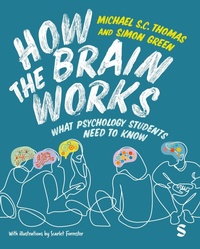
How the Brain Works
What Psychology Students Need to Know
1st Edition
Published on 30. October 2023
Book
Paperback/Softback
296 pages
978-1-5297-4194-0 (ISBN)
Description
Delve into the intricacies of the human mind with this engaging and insightful guide to how the brain works.
Written in a playful style and beautifully illustrated, this book is designed to support you as you embark on the beginning of your psychology degree. It provides an accessible guide to how the brain's structures and functions determine how the mind works, and how this fits into the bigger picture of our evolution and biology as a species.
From focus boxes that delve into specific topics to entertaining puzzles that bring the subject to life, this book will captivate your imagination while building your understanding of biological and cognitive psychology.
This is an essential read for undergraduate psychology students.
Michael S.C. Thomas is Professor of Cognitive Neuroscience at Birkbeck, University of London.
Simon Green is a Chartered Psychologist and retired Senior Lecturer in Psychology at Birkbeck, University of London.
Written in a playful style and beautifully illustrated, this book is designed to support you as you embark on the beginning of your psychology degree. It provides an accessible guide to how the brain's structures and functions determine how the mind works, and how this fits into the bigger picture of our evolution and biology as a species.
From focus boxes that delve into specific topics to entertaining puzzles that bring the subject to life, this book will captivate your imagination while building your understanding of biological and cognitive psychology.
This is an essential read for undergraduate psychology students.
Michael S.C. Thomas is Professor of Cognitive Neuroscience at Birkbeck, University of London.
Simon Green is a Chartered Psychologist and retired Senior Lecturer in Psychology at Birkbeck, University of London.
Reviews / Votes
As teachers we are in the business of literally changing the connections in the brains of our students. However, many of us only have a rudimentary knowledge of how the brain actually works. This book provides a comprehensive and authoritative guide to the most complex of organs and I would strongly recommend that those involved in education, not just psychology students, read it. -- Helen DarlingtonMore details
Edition
1. Auflage
Language
English
Place of publication
London
United Kingdom
Target group
College/higher education
Dimensions
Height: 232 mm
Width: 186 mm
Thickness: 19 mm
Weight
600 gr
ISBN-13
978-1-5297-4194-0 (9781529741940)
Copyright in bibliographic data and cover images is held by Nielsen Book Services Limited or by the publishers or by their respective licensors: all rights reserved.
Schweitzer Classification
Other editions
Additional editions
Book
10/2023
1st Edition
SAGE Publications Ltd
€92.10
Shipment within 15-20 days
E-Book
10/2023
1st Edition
SAGE Publications Ltd
€35.99
Available for download
E-Book
10/2023
1st Edition
SAGE Publications Ltd
€35.99
Available for download
Persons
Michael S. C. Thomas is a professor of cognitive neuroscience at Birkbeck, University of London and Director of the Centre for Educational Neuroscience. One of his main interests is the translation of research between neuroscience and education. With Cathy Rogers, he recently published the book 'Educational Neuroscience: The Basics' (Routledge). The focus of his research laboratory, the Developmental Neurocognition Lab, is to use multi-disciplinary methods to understand the brain and cognitive bases of cognitive variability, including the use of behavioural, brain imaging, computational, and genetic methods. He has published over 150 scientific papers and book chapters, and his work has been cited over 10,000 times. He is a Chartered Psychologist, Fellow of the British Psychological Society, Fellow of the US Association for Psychological Science, and Senior Fellow of the Higher Education Academy.
Simon Green was for many years a Senior Lecturer in Psychology at Birkbeck, University of London. Recently retired, he specialised in teaching introductory neuroscience to first year students. Along the way he published several textbooks in the area, including 'Principles of Biopsychology', still in print after 25 years. His research interests include neurotransmitter and hormonal modulation of brain function, the evolutionary background to the modern human brain, and the psychological and biological roots of psychological disorders. He is a Chartered Psychologist and member of the British Psychological Society.
Simon Green was for many years a Senior Lecturer in Psychology at Birkbeck, University of London. Recently retired, he specialised in teaching introductory neuroscience to first year students. Along the way he published several textbooks in the area, including 'Principles of Biopsychology', still in print after 25 years. His research interests include neurotransmitter and hormonal modulation of brain function, the evolutionary background to the modern human brain, and the psychological and biological roots of psychological disorders. He is a Chartered Psychologist and member of the British Psychological Society.
Content
Chapter 1: Introduction (and some puzzles)
Chapter 2: Where the brain comes from: evolution
Chapter 3: What are the bits of the brain and what together do they do?
Chapter 4: How does a neuron work?
Chapter 5: The brain is a computer, obviously
Chapter 6: The brain is a biological organ, not a computer
Chapter 7: How it gets to work this way: development and learning
Chapter 8: Working better, working worse, working different
Chapter 9: Humans apart
Chapter 10: Saving the planet
Chapter 11: Conclusion (and answers to those puzzles)
Chapter 2: Where the brain comes from: evolution
Chapter 3: What are the bits of the brain and what together do they do?
Chapter 4: How does a neuron work?
Chapter 5: The brain is a computer, obviously
Chapter 6: The brain is a biological organ, not a computer
Chapter 7: How it gets to work this way: development and learning
Chapter 8: Working better, working worse, working different
Chapter 9: Humans apart
Chapter 10: Saving the planet
Chapter 11: Conclusion (and answers to those puzzles)