

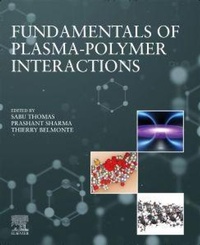
Fundamentals of Plasma-Polymer Interactions
Will be published approx. on 1. October 2026
Book
Paperback/Softback
530 pages
978-0-443-40598-3 (ISBN)
Description
Fundamentals of Plasma-Polymer Interactions bridges the gap between theoretical knowledge and practical application, offering a comprehensive overview of the complex interaction between plasma and polymers. The book begins by discussing radiation generation, damage mechanisms in polymers, and molecular-level interactions to establish a fundamental understanding of plasma-polymer interactions. It then thoroughly describes radiation processing techniques, plasma polymerization mechanisms, and practical examples illustrating how plasma irradiation affects polymer properties, synthesis methods, and physical characteristics. The book's chapters also explore the diverse applications of plasma polymers across industries and provide insights into future research directions, challenges, emerging trends, and scale up processes to industrial applications.
By offering a comprehensive review of plasma-enhanced processing and modification of polymers, the book serves as an ideal entry point for researchers engaged in interdisciplinary studies and as a guide for professionals interested in the utilization of plasma-processed polymers in various industries.
By offering a comprehensive review of plasma-enhanced processing and modification of polymers, the book serves as an ideal entry point for researchers engaged in interdisciplinary studies and as a guide for professionals interested in the utilization of plasma-processed polymers in various industries.
More details
Language
English
Place of publication
Philadelphia
United States
Target group
Professional and scholarly
Product notice
Paperback (trade)
Unsewn / adhesive bound
Dimensions
Height: 235 mm
Width: 191 mm
Weight
449 gr
ISBN-13
978-0-443-40598-3 (9780443405983)
Copyright in bibliographic data and cover images is held by Nielsen Book Services Limited or by the publishers or by their respective licensors: all rights reserved.
Schweitzer Classification
Persons
Prof. Sabu Thomas is a globally renowned scientist and one of the leading researchers in polymer science and nanotechnology. He currently serves as Professor of Polymer Science & Engineering and was the former Vice Chancellor of Mahatma Gandhi University, Kerala, India. Prof. Thomas is internationally recognized for his pioneering work on polymer blends, nanocomposites, green materials, and sustainable polymers. Dr. Prashant Sharma is affiliated with School of Metallurgy and Materials, University of Birmingham, Edgbaston, Birmingham,
B15 2TT, UK. With a background in Materials Science and Engineering, Dr. Sharma specializes in studying materials under extreme conditions, particularly in fusion reactor environments. Beginning his academic journey in Metallurgical & Materials Engineering at the Indian Institute of Technology Kharagpur, India, Dr. Sharma has conducted research on radiation damage, plasma irradiation, and ion irradiation of metals. Dr. Sharma's research covers areas such as developing insulating materials for fusion applications and studying radiation-induced defects in metals and ceramics, providing insights into the effects of neutron and ion irradiation on material properties, particularly in tungsten under extreme conditions.
Prof. Thierry Belmonte is the Research Director of the French National Centre for Scientific Research (CNRS). His research focuses on cold plasmas, with a particular emphasis on material surface applications. His research involves modeling and characterizing high-pressure plasmas and their interactions with surfaces. For the past decade, he has specialized in synthesizing nanoparticles using plasmas in dielectric liquids.
B15 2TT, UK. With a background in Materials Science and Engineering, Dr. Sharma specializes in studying materials under extreme conditions, particularly in fusion reactor environments. Beginning his academic journey in Metallurgical & Materials Engineering at the Indian Institute of Technology Kharagpur, India, Dr. Sharma has conducted research on radiation damage, plasma irradiation, and ion irradiation of metals. Dr. Sharma's research covers areas such as developing insulating materials for fusion applications and studying radiation-induced defects in metals and ceramics, providing insights into the effects of neutron and ion irradiation on material properties, particularly in tungsten under extreme conditions.
Prof. Thierry Belmonte is the Research Director of the French National Centre for Scientific Research (CNRS). His research focuses on cold plasmas, with a particular emphasis on material surface applications. His research involves modeling and characterizing high-pressure plasmas and their interactions with surfaces. For the past decade, he has specialized in synthesizing nanoparticles using plasmas in dielectric liquids.
Content
Part I. Introduction
1. Radiation Generation and Characteristics
2. Introduction to Radiation Damage in Materials
3. Interaction of Radiation with Polymers
Part II. Methods
4. Plasma-Polymer Interactions
5. Radiation and Plasma Processing Techniques of Polymers
6. Plasma Polymerization on Polymer Substrates. Mechanisms and Applications
7. Modelling and Simulation Approach
Part III. Case Studies and Applications
8. Effects of Plasma Irradiation on Polymer Properties
9. Polymer Synthesis by Plasma Processing Technique
10. Impact of Radiation Damage on Physical Properties of Polymers
11. Effect of Irradiation Parameters on Mechanical, Thermal, and Optical Properties of Polymers
12. Characterization of Plasma-Irradiated Polymers
13. Radiation Dosimetry and Measurement Techniques
14. Applications of Plasma Irradiation in Polymer Science and Engineering
15. Impact of Radiation on Polymer Applications and Advancements
Part IV. Future Research Directions
16. Challenges and Limitations in Plasma Irradiation of Polymers
17. Future Perspectives and Emerging Trends
18. Lab to Industry
19. Life Cycle Assessment (LCA)
20. Foreseeable Developments and the Future Landscape of Plasma Irradiation in Polymers
1. Radiation Generation and Characteristics
2. Introduction to Radiation Damage in Materials
3. Interaction of Radiation with Polymers
Part II. Methods
4. Plasma-Polymer Interactions
5. Radiation and Plasma Processing Techniques of Polymers
6. Plasma Polymerization on Polymer Substrates. Mechanisms and Applications
7. Modelling and Simulation Approach
Part III. Case Studies and Applications
8. Effects of Plasma Irradiation on Polymer Properties
9. Polymer Synthesis by Plasma Processing Technique
10. Impact of Radiation Damage on Physical Properties of Polymers
11. Effect of Irradiation Parameters on Mechanical, Thermal, and Optical Properties of Polymers
12. Characterization of Plasma-Irradiated Polymers
13. Radiation Dosimetry and Measurement Techniques
14. Applications of Plasma Irradiation in Polymer Science and Engineering
15. Impact of Radiation on Polymer Applications and Advancements
Part IV. Future Research Directions
16. Challenges and Limitations in Plasma Irradiation of Polymers
17. Future Perspectives and Emerging Trends
18. Lab to Industry
19. Life Cycle Assessment (LCA)
20. Foreseeable Developments and the Future Landscape of Plasma Irradiation in Polymers