

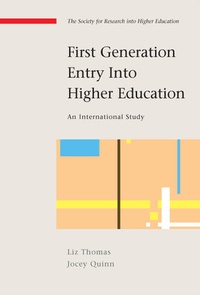
First Generation Entry into Higher Education
Published on 16. December 2006
Book
Paperback/Softback
168 pages
978-0-335-21790-8 (ISBN)
Description
"This book does not focus simply on the employment prospects of first generation higher education entrants but rather engages with the wider possibilities of social engagement and transformation that can arise from participation in higher education. It provides essential reading for administrators, policy-makers, managers, academics and indeed anyone else interested in how to widen the socio-economic base of higher education so that the process is informed by a significant concern with social justice and reducing inequality."
Rosemary Deem, Professor of Education, University of BristolThis book examines the proposition that parental education is a key factor contributing to the access and success of students, but that insufficient attention is paid to this by researchers, national systems and institutional interventions. Analysis of research findings from ten countries, plus a UK wide study, indicates that parental education is more important in determining access to higher education than parental employment or financial status. The book provides a clear conceptualisation of first generation entry, exploring its complex interrelationship with social class. Furthermore, it demonstrates that when first generation entry is used as a lens, it disrupts the taken for granted assumptions regarding widening participation and helps produce much more effective approaches to targeting access and supporting student success.First Generation Entry into Higher Education provides a unique and insightful examination of how first generation entrants are supported or otherwise by different national approaches and institutional responses. The book is essential reading for all with an interest in widening participation in higher education.
Rosemary Deem, Professor of Education, University of BristolThis book examines the proposition that parental education is a key factor contributing to the access and success of students, but that insufficient attention is paid to this by researchers, national systems and institutional interventions. Analysis of research findings from ten countries, plus a UK wide study, indicates that parental education is more important in determining access to higher education than parental employment or financial status. The book provides a clear conceptualisation of first generation entry, exploring its complex interrelationship with social class. Furthermore, it demonstrates that when first generation entry is used as a lens, it disrupts the taken for granted assumptions regarding widening participation and helps produce much more effective approaches to targeting access and supporting student success.First Generation Entry into Higher Education provides a unique and insightful examination of how first generation entrants are supported or otherwise by different national approaches and institutional responses. The book is essential reading for all with an interest in widening participation in higher education.
More details
Persons
Liz Thomas is Senior Adviser for Widening Participation at the Higher Education Academy, and Vice-President (Research and Publications) of the European Access Network. Formerly she was Director of the Institute for Access Studies, a specialist research centre at Staffordshire University. She is editor of Widening Participation and Lifelong Learning journal. Jocey Quinn is Professor of Education in the Institute for Policy Studies in Education at London Metropolitan University and Visiting Professor in the School of Education and Lifelong Learning at Exeter University.
Content
List of tablesIntroduction to the book
From a distance you can see more clearly: Developing an international methodology with local benefits for student access and success
The access and success of students from lower socio-economic groups in higher education
Conceptualizing first generation entry
The potential impact of parental education on access and success in higher education
Empirical exploration of the implications of first generation entry for higher education experiences
National and institutional approaches to supporting first generation entrants
The implications of first generation entry for redefining widening participation
References
Index
From a distance you can see more clearly: Developing an international methodology with local benefits for student access and success
The access and success of students from lower socio-economic groups in higher education
Conceptualizing first generation entry
The potential impact of parental education on access and success in higher education
Empirical exploration of the implications of first generation entry for higher education experiences
National and institutional approaches to supporting first generation entrants
The implications of first generation entry for redefining widening participation
References
Index