

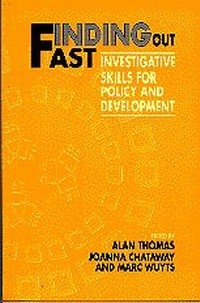
Finding Out Fast
Investigative Skills for Policy and Development
1st Edition
Published on 20. April 1998
Book
Hardback
352 pages
978-0-7619-5836-9 (ISBN)
Description
Finding Out Fast provides readers with key skills and approaches for research designed to inform policies, particularly on development.
Recognizing that policy decisions are typically made under pressure of time and on the basis of incomplete data or with limited resources with which to obtain information, the authors provide guidance on how to locate, evaluate and use relevant information, fast.
They explain and critically review a variety of research methods for `finding out fast', in the belief that these methods can still be rigorous. Finding Out Fast will assist readers to become competent investigators, to understand how to use research more effectively and how to commission and critically evaluate research done by others.
This book is essential reading for development managers in non-governmental organizations (NGOs) and public sector agencies and students of development management and development studies more generally. However, the ideas and approaches will also appeal to anyone involved in policy making and research with developmental goals.
It is a course text for two courses in the Open University Global Programme in Development Management: Capacities for Managing Development (TU870) and the Development Management Project (TU874).
Recognizing that policy decisions are typically made under pressure of time and on the basis of incomplete data or with limited resources with which to obtain information, the authors provide guidance on how to locate, evaluate and use relevant information, fast.
They explain and critically review a variety of research methods for `finding out fast', in the belief that these methods can still be rigorous. Finding Out Fast will assist readers to become competent investigators, to understand how to use research more effectively and how to commission and critically evaluate research done by others.
This book is essential reading for development managers in non-governmental organizations (NGOs) and public sector agencies and students of development management and development studies more generally. However, the ideas and approaches will also appeal to anyone involved in policy making and research with developmental goals.
It is a course text for two courses in the Open University Global Programme in Development Management: Capacities for Managing Development (TU870) and the Development Management Project (TU874).
Reviews / Votes
`The book is a useful, interesting and worthwhile contribution to an important area of policy investigation.... It will be a useful reference for development managers, policy analysts and budding researchers at large' - Management and Change`A welcome addition to the literature for development practitioners... It will undoubtedly also be useful for students and researchers... it illustrates approaches with case studies that are well integrated in the text, and offers summaries and key questions in tables, boxes and pictures. For many this will be a timely book... For many it could become a much-consulted handbook' - Development in Practice
`This book is unique and fills a glaring gap in the field of development practice. It deals with the dilemmas that every practitioner faces - the need to make decisions fast, provide advice on the basis of incomplete information, and navigate complex political waters' - Gita Sen, Professor of Economics and Social Sciences, Indian Institute of Management
More details
Series
Language
English
Place of publication
Thousand Oaks
United States
Target group
College/higher education
Weight
775 gr
ISBN-13
978-0-7619-5836-9 (9780761958369)
Copyright in bibliographic data and cover images is held by Nielsen Book Services Limited or by the publishers or by their respective licensors: all rights reserved.
Schweitzer Classification
Content
Introduction - Alan Thomas
PART ONE: CONCEPTUALISING POLICY-RELATED INVESTIGATION
Information Needs and Policy Change - Stephen Potter and Ramya Subrahmanian
Boundaries for Thinking and Action - Chris Blackmore and Ray Ison
Grabbing Attention - Joseph Hanlon
PART TWO: THINKING WITH PAPER
How to Do a Literature Study - Stephanie Barrientos
Interpreting Institutional Discourses - Bridget O'Laughlin
PART THREE: THINKING WITH PEOPLE AND ORGANIZATIONS
People as Informants - Philip Woodhouse
Investigation as Empowerment - Hazel Johnson and Linda Mayoux
Using Participatory Methods
Organizational Assessment and Institutional Footprints - Chris Roche
Dilemmas of Researching Poverty - Dina Abbott
Communicating Results - Joanna Chataway and Avril Joffe
PART FOUR: THINKING WITH DATA
Thinking with Quantitative Data - Chandan Mukherjee and Marc Wuyts
Analysing Institutional Accounts - Geoff Jones
Critical Issues in Using Data - Sue Mayer
Challenging Cases - Alan Thomas
Conclusion - Alan Thomas and Joanna Chataway
Personal Effectiveness and Integrity
PART ONE: CONCEPTUALISING POLICY-RELATED INVESTIGATION
Information Needs and Policy Change - Stephen Potter and Ramya Subrahmanian
Boundaries for Thinking and Action - Chris Blackmore and Ray Ison
Grabbing Attention - Joseph Hanlon
PART TWO: THINKING WITH PAPER
How to Do a Literature Study - Stephanie Barrientos
Interpreting Institutional Discourses - Bridget O'Laughlin
PART THREE: THINKING WITH PEOPLE AND ORGANIZATIONS
People as Informants - Philip Woodhouse
Investigation as Empowerment - Hazel Johnson and Linda Mayoux
Using Participatory Methods
Organizational Assessment and Institutional Footprints - Chris Roche
Dilemmas of Researching Poverty - Dina Abbott
Communicating Results - Joanna Chataway and Avril Joffe
PART FOUR: THINKING WITH DATA
Thinking with Quantitative Data - Chandan Mukherjee and Marc Wuyts
Analysing Institutional Accounts - Geoff Jones
Critical Issues in Using Data - Sue Mayer
Challenging Cases - Alan Thomas
Conclusion - Alan Thomas and Joanna Chataway
Personal Effectiveness and Integrity