

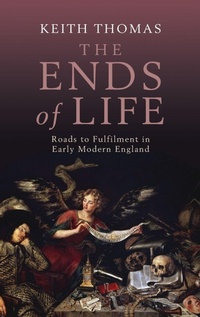
The Ends of Life
Roads to Fulfilment in Early Modern England
Published on 12. February 2009
Book
Hardback
428 pages
978-0-19-924723-3 (ISBN)
Description
How should we live? That question was no less urgent for English men and women who lived between the early sixteenth and late eighteenth centuries than for this book's readers. Keith Thomas's masterly exploration of the ways in which people sought to lead fulfilling lives in those centuries between the beginning of the Reformation and the heyday of the Enlightenment illuminates the central values of the period, while casting incidental light on some of the perennial problems of human existence.
Consideration of the origins of the modern ideal of human fulfilment and of obstacles to its realization in the early modern period frames an investigation that ranges from work, wealth, and possessions to the pleasures of friendship, family, and sociability. The cult of military prowess, the pursuit of honour and reputation, the nature of religious belief and scepticism, and the desire to be posthumously remembered are all drawn into the discussion, and the views and practices of ordinary people are measured against the opinions of the leading philosophers and theologians of the time.
The Ends of Life offers a fresh approach to the history of early modern England, by one of the foremost historians of our time. It also provides modern readers with much food for thought on the problem of how we should live and what goals in life we should pursue.
Consideration of the origins of the modern ideal of human fulfilment and of obstacles to its realization in the early modern period frames an investigation that ranges from work, wealth, and possessions to the pleasures of friendship, family, and sociability. The cult of military prowess, the pursuit of honour and reputation, the nature of religious belief and scepticism, and the desire to be posthumously remembered are all drawn into the discussion, and the views and practices of ordinary people are measured against the opinions of the leading philosophers and theologians of the time.
The Ends of Life offers a fresh approach to the history of early modern England, by one of the foremost historians of our time. It also provides modern readers with much food for thought on the problem of how we should live and what goals in life we should pursue.
Reviews / Votes
It is full of surprises, packed with information that no one else could have found and so witty and absorbing. * Claire Tomalin, The Guardian * No one else could have broached such an ambitious subject. * Jonathan Sumption, Spectator * A great historian...remarkable book. * Jonathan Sumption, Spectator * A compellingly readable book, richly researched, fascinatingly detailed, delightfully written. * Eamon Duffy, London Review of Books * Thomas has formidable organisational ability, and an unerring eye for detail. Almost every page offers something to intrigue, amuse, provoke. * Eamon Duffy, London Review of Books * 'The Ends of Life' is a compellingly readable book, richly researched, fascinatingly detailed, delightfully written. * Eamon Duffy, London Review of Books * This is...a masterly series of impressions designed to provoke the reader to further thought and study. * Jonathan Barry, History Today * It takes phenomenal learning and scholarly chutzpah to pull off a book like this. * Jonathan Wright The Independent * Pure delight. * John Morrill, BBC History Magazine * Let's thanks Keith Thomas for writing such a brave and sensitive book. * Jonathan Wright, The Independent * Any new book by Sir Keith Thomas is a major event. * John Morrill, BBC History Magazine * It's full of wonderful sentences and phrases. * David Sexton, Evening Standard. * The Ends of Life is captivating. * David Sexton, Evening Standard * The sheer wealth and diversity of material in 'The Ends of Life' makes it a fascinating read. * Lisa Jardine, Financial Times * It is hard indeed to imagine a better introduction to the early modern world. It will be immediately and universally recognized as indispensable, not just for historians, but for anyone with an interest in the past.' * David Wootton, Times Literary Supplement * Thomas's connecting prose is graceful and sometimes crisply epigrammatic, 'The Ends of Life' is a pleasure to read. * Michael Dirda, Washington Post * 'The Ends of Life'...scatters bright insights into the habits of thought of early modern England. * Graham Parry, The Guardian * Endlessly fascinating...elegant, incisive and entertaining book. * Tim Blanning, Sunday Telegraph * The writing is lucid and elegant, peppered with dry wit and overseen by an infallible eye for anecdotes. * Peter Marshall, Literary Review * Where Thomas excels, as ever, is in his eye for luminous supporting detail. * D. J. Taylor, The Independent * A teeming historical survey. * Sunday Times * A triumphal demonstration that one of our leading historians is still at the height of his powers. * Peter Marshall, Literary Review * Exhilaratingly illuminating. * Michael Kerrigan, The Scotsman * Fascinating book. * John Carey, Sunday Times *More details
Language
English
Place of publication
Oxford
United Kingdom
Target group
College/higher education
Illustrations
14 black and white plates and 10 black and white halftones
Dimensions
Height: 240 mm
Width: 161 mm
Thickness: 27 mm
Weight
801 gr
ISBN-13
978-0-19-924723-3 (9780199247233)
Copyright in bibliographic data and cover images is held by Nielsen Book Services Limited or by the publishers or by their respective licensors: all rights reserved.
Schweitzer Classification
Other editions
Additional editions
E-Book
02/2010
OUP eBook
€12.49
Available for download
Book
02/2010
Oxford University Press
€31.50
Shipment within 15-20 days
E-Book
02/2009
1st Edition
Oxford University Press
€64.88
Available for download
Person
Sir Keith Thomas is a Fellow of All Souls College and former President of Corpus Christi College, Oxford. He is the author of several highly acclaimed books on early modern England, including Religion and the Decline of Magic, which won the Wolfson Literary Award for History in 1972. A former trustee of the National Gallery and the British Museum, he holds honorary doctorates from eleven universities. He is an Honorary Vice-President of the Royal Historical Society and was President of the British Academy between 1993 and 1997.
Content
Introduction ; 1. Fulfilment in an Age of Limited Possibilities ; 2. Military Prowess ; 3. Work and Vocation ; 4. Wealth and Possessions ; 5. Honour and Reputation ; 6. Friendship and Sociability ; 7. Fame and the After-Life ; Note on References ; Notes ; Index