

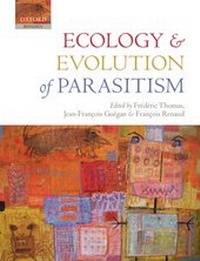
Ecology and Evolution of Parasitism
Published on 11. December 2008
Book
Hardback
240 pages
978-0-19-953532-3 (ISBN)
Description
Is it possible to omit parasites when studying free-living organisms? The answer is clearly no! Parasites have evolved independently in numerous animal lineages, and now make up a considerable proportion of the biodiversity of life. Ecologists, epidemiologists, conservationists and evolutionary biologists are increasingly aware of the universal significance of parasites to the study of ecology and evolution where they have become a powerful model system. This book
provides a summary of the issues involved as well as an overview of the possibilities offered by this research topic including the practical applications for disease prevention. It uses well-documented case-studies across a range of scales to illustrate the main trends and prospects in this area,
outlining areas for future research.
Ecology and Evolution of Parasitism is the first book to provide a broad synthesis of both the roles and consequences of pathogens on the ecology and evolution of free living systems. It focuses on hosts rather than the parasites themselves, integrating those aspects related to the ecology and the evolution of free-living species (sexual selection, behaviour, life history traits, regulation of populations etc.). The book includes examples across a range of scales from individuals to
populations, communities and ecosystems.
provides a summary of the issues involved as well as an overview of the possibilities offered by this research topic including the practical applications for disease prevention. It uses well-documented case-studies across a range of scales to illustrate the main trends and prospects in this area,
outlining areas for future research.
Ecology and Evolution of Parasitism is the first book to provide a broad synthesis of both the roles and consequences of pathogens on the ecology and evolution of free living systems. It focuses on hosts rather than the parasites themselves, integrating those aspects related to the ecology and the evolution of free-living species (sexual selection, behaviour, life history traits, regulation of populations etc.). The book includes examples across a range of scales from individuals to
populations, communities and ecosystems.
More details
Language
English
Place of publication
Oxford
United Kingdom
Target group
College/higher education
Illustrations
65 line and 5 halftone illustrations
Dimensions
Height: 254 mm
Width: 196 mm
Thickness: 18 mm
Weight
689 gr
ISBN-13
978-0-19-953532-3 (9780199535323)
Copyright in bibliographic data and cover images is held by Nielsen Book Services Limited or by the publishers or by their respective licensors: all rights reserved.
Schweitzer Classification
Other editions
Additional editions
Frederic Thomas | Jean-Francois Guegan | Francois Renaud
Ecology and Evolution of Parasitism
Hosts to Ecosystems
Book
12/2008
Oxford University Press
€96.20
Shipment within 15-20 days
Persons
Frederic Thomas, Jean-Francois Guegan and Francois Renaud are all Senior Research Fellows in two French research institutions (CNRS and IRD), and they are interested by the ecology and the evolution of host-parasite interactions. Their areas of research are various, involving population genetics, population dynamics, behavioural ecology, modelling and ecology of health. They regularly published in international journals (Nature, Current
Biology, Evolution, Journal of Evolutionary Biology, PLoS, Proceedings B, Trends in Parasitology).
Biology, Evolution, Journal of Evolutionary Biology, PLoS, Proceedings B, Trends in Parasitology).
Content
Preface ; Introduction ; 1. The evolutionary ecology of the immune response ; 2. Parasitism and evolution of life history traits ; 3. Parasites and sexual selection ; 4. Parasites and behaviour ; 5. Parasitism and hybrid zones ; 6. Parasitism and host population regulation ; 7. Parasitism and biological control ; 8. Health ecology: a new tool, the macroscope ; 9. Parasitism, biodiversity and conservation biology ; Conclusion ; Appendix: Methodological chapter