

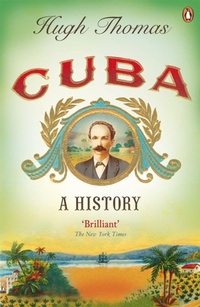
Cuba
A History
Published on 25. November 2010
Book
Paperback/Softback
1184 pages
978-0-14-103450-8 (ISBN)
Description
From award-winning historian Hugh Thomas, Cuba: A History is the essential work for understanding one of the most fascinating and controversial countries in the world.
Hugh Thomas's acclaimed book explores the whole sweep of Cuban history from the British capture of Havana in 1762 through the years of Spanish and United States domination, down to the twentieth century and the extraordinary revolution of Fidel Castro.
Throughout this period of over two hundred years, Hugh Thomas analyses the political, economic and social events that have shaped Cuban history with extraordinary insight and panache, covering subjects ranging from sugar, tobacco and education to slavery, war and occupation.
Encyclopaedic in range and breathtaking in execution, Cuba is surely one of the seminal works of world history.
'An astonishing feat ... the author does more to explain the phenomenon of Fidel's rise to power than anybody else has done so far'
Spectator
'Brilliant'
The New York Times
'Immensely readable. Thomas's notion of history's scope is generous, for he has not limited himself to telling old political and military events; he describes Cuban culture at all stages ... not merely accessible but absorbing. His language is witty but never mocking, crisp but never harsh'
New Yorker
'Thomas seems to have talked to everybody not dead or in jail, and read everything. He is scrupulously fair'
Time
Hugh Thomas is the author of, among other books, The Spanish Civil War (1962), which won the Somerset Maugham Award, Cuba: The Pursuit of Freedom (1971), An Unfinished History of the World (1979), and the first two volumes of his Spanish Empire trilogy, Rivers of Gold (2003) and The Golden Age (2010).
Hugh Thomas's acclaimed book explores the whole sweep of Cuban history from the British capture of Havana in 1762 through the years of Spanish and United States domination, down to the twentieth century and the extraordinary revolution of Fidel Castro.
Throughout this period of over two hundred years, Hugh Thomas analyses the political, economic and social events that have shaped Cuban history with extraordinary insight and panache, covering subjects ranging from sugar, tobacco and education to slavery, war and occupation.
Encyclopaedic in range and breathtaking in execution, Cuba is surely one of the seminal works of world history.
'An astonishing feat ... the author does more to explain the phenomenon of Fidel's rise to power than anybody else has done so far'
Spectator
'Brilliant'
The New York Times
'Immensely readable. Thomas's notion of history's scope is generous, for he has not limited himself to telling old political and military events; he describes Cuban culture at all stages ... not merely accessible but absorbing. His language is witty but never mocking, crisp but never harsh'
New Yorker
'Thomas seems to have talked to everybody not dead or in jail, and read everything. He is scrupulously fair'
Time
Hugh Thomas is the author of, among other books, The Spanish Civil War (1962), which won the Somerset Maugham Award, Cuba: The Pursuit of Freedom (1971), An Unfinished History of the World (1979), and the first two volumes of his Spanish Empire trilogy, Rivers of Gold (2003) and The Golden Age (2010).
More details
Language
English
Place of publication
London
United Kingdom
Product notice
Paperback (UK-B)
Illustrations
12 pp b/w
Dimensions
Height: 205 mm
Width: 131 mm
Thickness: 56 mm
Weight
819 gr
ISBN-13
978-0-14-103450-8 (9780141034508)
Copyright in bibliographic data and cover images is held by Nielsen Book Services Limited or by the publishers or by their respective licensors: all rights reserved.
Schweitzer Classification
Other editions
Additional editions
Person
Hugh Thomas is the author of, among other books, The Spanish Civil War (1962), which won the Somerset Maugham Award, Cuba: The Pursuit of Freedom (1971), An Unfinished History of the World (1979), and the first volume of his Spanish Empire trilogy, Rivers of Gold (2003). In 2008 he was made a Commandeur de l'Ordre des Arts et Lettres in France and in 2009 received the Calvo Serer Prize in Spain and the Bonino Prize in Italy. He was director of the Centre for Policy Studies in London from 1979 to 1991, and he became a life peer as Baron Thomas of Swynnerton in 1981.