

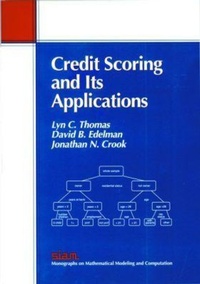
Credit Scoring and Its Application
Will be published approx. on 31. January 2002
Book
Paperback/Softback
262 pages
978-0-89871-483-8 (ISBN)
Description
Tremendous growth in the credit industry has spurred the need for this book, the only one that details the mathematical models that help creditors make intelligent credit risk decisions.
Creditors of all types make risk decisions every day, often haphazardly. This groundbreaking book addresses the two basic types of decisions and offers sound mathematical models to assist with the decision-making process. Creditors must decide whether to grant credit to a new applicant (credit scoring), and how to adjust the credit restrictions or the marketing effort directed at a current customer (behavioral scoring). Currently, only the most sophisticated creditors use the models contained in this book to make these decisions, but all creditors can know these aids to successful lending.
The book contains a comprehensive review of the objectives, methods, and practical implementation of credit and behavioral scoring. The authors review principles of the statistical and operations research methods used in building scorecards, as well as the advantages and disadvantages of each approach. The book also describes practical problems encountered in building, using, and monitoring scorecards and examines some country-specific problems caused by bankruptcy, equal opportunities, and privacy legislation. This important feature addresses the increasingly international nature of the credit lending industry.
Also included in this book is a discussion of economic theories of consumers' use of credit. The reader will gain an understanding of what lending institutions seek to achieve by using credit scoring and the changes in their objectives. Despite their widespread use in business, no other book details credit scoring variations that should be used with standard statistical and operations research techniques such as discriminant analysis, logistic regression, linear programming, neural nets, and genetic algorithms. Other unique features include methods of monitoring scorecards and deciding when to update them, as well as different applications of scoring, including direct marketing, profit scoring, tax inspection, prisoner release, and payment of fines.
Focusing on small data problems is useful pedagogically; therefore, the authors have included a CD-ROM containing a database, mainly to emphasize the data analysis aspects of credit scoring.
Creditors of all types make risk decisions every day, often haphazardly. This groundbreaking book addresses the two basic types of decisions and offers sound mathematical models to assist with the decision-making process. Creditors must decide whether to grant credit to a new applicant (credit scoring), and how to adjust the credit restrictions or the marketing effort directed at a current customer (behavioral scoring). Currently, only the most sophisticated creditors use the models contained in this book to make these decisions, but all creditors can know these aids to successful lending.
The book contains a comprehensive review of the objectives, methods, and practical implementation of credit and behavioral scoring. The authors review principles of the statistical and operations research methods used in building scorecards, as well as the advantages and disadvantages of each approach. The book also describes practical problems encountered in building, using, and monitoring scorecards and examines some country-specific problems caused by bankruptcy, equal opportunities, and privacy legislation. This important feature addresses the increasingly international nature of the credit lending industry.
Also included in this book is a discussion of economic theories of consumers' use of credit. The reader will gain an understanding of what lending institutions seek to achieve by using credit scoring and the changes in their objectives. Despite their widespread use in business, no other book details credit scoring variations that should be used with standard statistical and operations research techniques such as discriminant analysis, logistic regression, linear programming, neural nets, and genetic algorithms. Other unique features include methods of monitoring scorecards and deciding when to update them, as well as different applications of scoring, including direct marketing, profit scoring, tax inspection, prisoner release, and payment of fines.
Focusing on small data problems is useful pedagogically; therefore, the authors have included a CD-ROM containing a database, mainly to emphasize the data analysis aspects of credit scoring.
More details
Series
Language
English
Place of publication
New York
United States
Target group
Professional and scholarly
College/higher education
Product notice
Paperback (trade)
Dimensions
Height: 256 mm
Width: 179 mm
Thickness: 17 mm
Weight
489 gr
ISBN-13
978-0-89871-483-8 (9780898714838)
Copyright in bibliographic data and cover images is held by Nielsen Book Services Limited or by the publishers or by their respective licensors: all rights reserved.
Schweitzer Classification
Other editions
New editions
Lyn Thomas | Jonathan Crook | David Edelman
Credit Scoring and Its Applications
Book
11/2017
2nd Edition
Society for Industrial & Applied Mathematics,U.S.
€138.16
Article not available at the moment
Content
Preface
Chapter 1: The History and Philosophy of Credit Scoring
Chapter 2. The Practice of Credit Scoring
Chapter 3: Economic Cycles and Lending and Debt Patterns
Chapter 4: Statistical Methods for Scorecard Development
Chapter 5: Nonstatistical Methods for Scorecard Development
Chapter 6: Markov Chain Models of Repayment and Usage Behavior
Chapter 7: Measuring Scorecard Performance
Chapter 8: Practical Issues of Scorecard Development
Chapter 9: Implementation and Areas of Application
Chapter 10: Applications of Scoring in Other Areas of Lending
Chapter 11: Applications of Scoring in Other Areas
Chapter 12: New Ways to Build Scorecards
Chapter 13: International Differences
Chapter 14: Profit Scoring, Risk-Based Pricing, and Securitization
References
Index.
Chapter 1: The History and Philosophy of Credit Scoring
Chapter 2. The Practice of Credit Scoring
Chapter 3: Economic Cycles and Lending and Debt Patterns
Chapter 4: Statistical Methods for Scorecard Development
Chapter 5: Nonstatistical Methods for Scorecard Development
Chapter 6: Markov Chain Models of Repayment and Usage Behavior
Chapter 7: Measuring Scorecard Performance
Chapter 8: Practical Issues of Scorecard Development
Chapter 9: Implementation and Areas of Application
Chapter 10: Applications of Scoring in Other Areas of Lending
Chapter 11: Applications of Scoring in Other Areas
Chapter 12: New Ways to Build Scorecards
Chapter 13: International Differences
Chapter 14: Profit Scoring, Risk-Based Pricing, and Securitization
References
Index.