

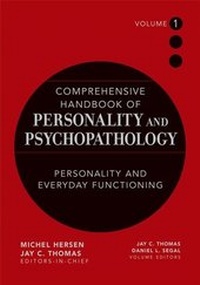
Comprehensive Handbook of Personality and Psychopathology
Volume 1: Personality and Everyday Functioning
Will be published approx. on 2. December 2005
Book
Hardback
496 pages
978-0-471-48837-8 (ISBN)
Description
Personality and Everyday Functioning covers the foundations of personality theory and the impact of personality on normal functioning. Leading personality researchers present chapters on major theories of personality, such as psychoanalytic, developmental, behavioral, and constructivist, to name a few.
Reviews / Votes
"The most impressive aspect of the volume is its breadth of coverage. The volume may also be considered as a unique resource on personality psychology that one could include in a research laboratory and/or clinician's collection of books." (Cognitive Behavorial Therapy Book Reviews, Vol. 3, No. 10, 2007)More details
Edition
1. Auflage
Language
English
Place of publication
New York
United States
Target group
Professional and scholarly
Product notice
sewn/stitched
Cloth over boards
Dimensions
Height: 287 mm
Width: 219 mm
Thickness: 40 mm
Weight
1751 gr
ISBN-13
978-0-471-48837-8 (9780471488378)
Schweitzer Classification
Other editions
Additional editions

Jay C. Thomas | Daniel L. Segal
Comprehensive Handbook of Personality and Psychopathology , Volume 1 , Personality and Everyday Functioning
E-Book
12/2005
Wiley
€280.99
Available for download
Persons
Michel Hersen, Ph.D., editor-in-chief, is Professor and Dean of the School of Professional Psychology at Pacific University in Forest Grove, OR.
Jay C. Thomas, Ph.D., editor-in-chief and volume 1 co-editor, is Associate Professor and Director of the Counseling Psychology program in the School of Professional Psychology at Pacific University in Forest Grove, OR.
Daniel L. Segal, Ph.D., co-editor of volume 1, is Associate Professor in the Department of Psychology at the University of Colorado, Colorado Springs.
Jay C. Thomas, Ph.D., editor-in-chief and volume 1 co-editor, is Associate Professor and Director of the Counseling Psychology program in the School of Professional Psychology at Pacific University in Forest Grove, OR.
Daniel L. Segal, Ph.D., co-editor of volume 1, is Associate Professor in the Department of Psychology at the University of Colorado, Colorado Springs.
Content
VOLUME 1.
Preface.
PART 1: FOUNDATIONS.
Chapter 1. Goals of a Theory of Personality (T. Millon & S. Grossman).
Chapter 2. Dynamics of Individual Relations in Human Development: A Developmental Systems Perspective (R. Lerner, et al.).
Chapter 3. Culture, Personality, and People's Uses of Time: Key Interrelationships (R. Brislin & K. Lo).
PART 2: BROAD RANGE THEORIES AND SYSTEMS.
Chapter 4. Psychodynamic Theories of Personality and Psychopathology (D. Wolitzky).
Chapter 5. Trait and Factor Theories (P. Costa & R. McCrae).
Chapter 6. Developmental Stage Theories (B. Hayslip, et al.).
Chapter 7. Behavioral Theories (M. Bolling, et al.).
Chapter 8. Evolutionary Theories (D. Beaulieu & D. Bugental).
Chapter 9. Cognitive Theories (D. Dozois, et al.).
Chapter 10. Existential and Humanistic Theories (P. Wong).
Chapter 11. Constructivist Theories (J. Raskin).
PART 3: MID-RANGE THEORIES.
Chapter 12. Role Motivation Theories (J. Miner).
Chapter 13. Vocational Interests (K. Low & J. Rounds).
Chapter 14. Positive and Negative Affect: Bridging State and Traits (P. Silvia & J. Warburton).
Chapter 15. Explanatory Style and Well-Being (D. Wise & J. Rosqvist).
Chapter 16. Hardiness: The Courage to Be Resilient (S. Maddi).
Chapter 17. Sensation Seeking, Risk Taking, and Fearlessness (G. Arnaut).
Chapter 18. Personality and the Transformational Leader (R. Aditya).
Chapter 19. Person-Environment Fit and Performance (J. Binning, et al.).
Chapter 20. "Sub-Clinical" Psychopaths (J. LeBreton, et al.).
Chapter 21. Gender, Personality, and Psychopathology (P. Williams & H. Gunn).
Chapter 22. Organizational Climate, Personality Interactions, and Organizational Behavior (D. Svyantek & J. Bott).
Chapter 23. A Classification of DSM-IV-TR Mental Disorders According to their Relation to the Personality System (J. Mayer).