

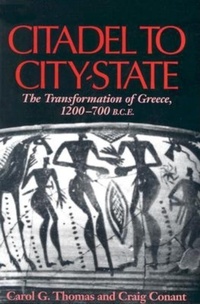
Citadel to City-State
The Transformation of Greece, 1200-700 B.C.E.
Published on 21. January 2003
Book
Paperback/Softback
240 pages
978-0-253-21602-1 (ISBN)
Description
"Citadel to City-State serves as an excellent summarization of our present knowledge of the not-so-dark Dark Age as well as an admirable prologue to the understanding of the subsequent Archaeic and Classical periods." -David Rupp, Phoenix
The Dark Age of Greece is one of the least understood periods of Greek history. A terra incognita between the Mycenaean civilization of Late Bronze Age Greece and the flowering of Classical Greece, the Dark Age was, until the last few decades, largely neglected. Now new archaeological methods and the discovery of new evidence have made it possible to develop a more comprehensive view of the entire period. Citadel to City-State explores each century from 1200 to 700 B.C.E. through an individual site-Mycenae, Nichoria, Athens, Lefkandi, Corinth, and Ascra-that illustrates the major features of each period. This is a remarkable account of the historical detective work that is beginning to shed light on Dark Age Greece.
The Dark Age of Greece is one of the least understood periods of Greek history. A terra incognita between the Mycenaean civilization of Late Bronze Age Greece and the flowering of Classical Greece, the Dark Age was, until the last few decades, largely neglected. Now new archaeological methods and the discovery of new evidence have made it possible to develop a more comprehensive view of the entire period. Citadel to City-State explores each century from 1200 to 700 B.C.E. through an individual site-Mycenae, Nichoria, Athens, Lefkandi, Corinth, and Ascra-that illustrates the major features of each period. This is a remarkable account of the historical detective work that is beginning to shed light on Dark Age Greece.
Reviews / Votes
"There are two ways of assessing this study of the Dark Ages in Greece: as a collection of six studies of Dark Age sites at different chronological points within the period and as an attempt to illuminate stages in the transformation of Greece in the Dark Ages through these six temporally spaced examples intended for a broad readership interested in the processes of change. The book is quite successful from the first perspective but fails in the latter one. The case studies, on quite recent archaeological findings, are finely nuanced and well reasoned. Thomas and Conant fairly describe various schools of thought on interpretation of the archaeological record and put forward some new hypotheses. Although the discussion takes little for granted in the reader's background, those conversant with earlier literature on the Dark Ages will gain the most from these detailed studies. On the other hand, the book is less successful in meeting the needs of the broader intended audience, who may not be able to see the forest for the trees. Perhaps a concluding chapter might have helped. Upper-division undergraduates and above."-R. P. Legon, University of Baltimore , Choice, March 2000"The case studies, on quite recent archaeological findings, are finely nuanced and well reasoned. Thomas and Conant fairly describe various schools of thought on interpretation of the archaeological record and put forward some new hypotheses. . . . Upper-division undergraduates and above.March 2000"-Choice
More details
Language
English
Place of publication
Bloomington, IN
United States
Target group
College/higher education
Professional and scholarly
Product notice
Paperback (trade)
Illustrations
15 b&w photos, 16 figures, 13 maps, 1 bibliog., 1 index
Dimensions
Height: 233 mm
Width: 157 mm
Thickness: 18 mm
Weight
408 gr
ISBN-13
978-0-253-21602-1 (9780253216021)
Copyright in bibliographic data and cover images is held by Nielsen Book Services Limited or by the publishers or by their respective licensors: all rights reserved.
Schweitzer Classification
Persons
Carol G. Thomas is Professor of Ancient Greek History at the University of Washington. Her books include Decoding Ancient History: A Toolkit of the Historian as Detective (with D. Wick); Myth Becomes History; Progress into the Past, 2nd Edition (with William A. McDonald); and Paths from Ancient Greece. She is two-time president of the Association of Ancient Historians.
Craig Conant is a long-time student of ancient Greek history and works as a records manager for the Environmental Protection Agency in Seattle, Washington.
Craig Conant is a long-time student of ancient Greek history and works as a records manager for the Environmental Protection Agency in Seattle, Washington.
Content
TOC:
Preface
Introduction
1. Mycenae: The End of the Bronze Age
2. Nichoria: The Darkest Period of the Dark Age
3. Athens: Tenth Century Breath of Spring
4. Lefkandi: New Heroes of the Ninth Century
5. Corinth: The End of the Dark Age
6. Ascra: The End Product of the Dark Age
Glossary
Abbreviations
Notes
References
Index
Preface
Introduction
1. Mycenae: The End of the Bronze Age
2. Nichoria: The Darkest Period of the Dark Age
3. Athens: Tenth Century Breath of Spring
4. Lefkandi: New Heroes of the Ninth Century
5. Corinth: The End of the Dark Age
6. Ascra: The End Product of the Dark Age
Glossary
Abbreviations
Notes
References
Index