

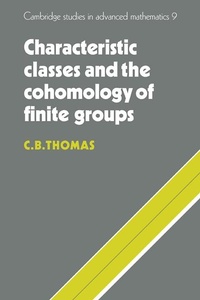
Characteristic Classes and the Cohomology of Finite Groups
Published on 27. November 2008
Book
Paperback/Softback
144 pages
978-0-521-09065-0 (ISBN)
Description
The purpose of this book is to study the relation between the representation ring of a finite group and its integral cohomology by means of characteristic classes. In this way it is possible to extend the known calculations and prove some general results for the integral cohomology ring of a group G of prime power order. Among the groups considered are those of p-rank less than 3, extra-special p-groups, symmetric groups and linear groups over finite fields. An important tool is the Riemann - Roch formula which provides a relation between the characteristic classes of an induced representation, the classes of the underlying representation and those of the permutation representation of the infinite symmetric group. Dr Thomas also discusses the implications of his work for some arithmetic groups which will interest algebraic number theorists. Dr Thomas assumes the reader has taken basic courses in algebraic topology, group theory and homological algebra, but has included an appendix in which he gives a purely topological proof of the Riemann - Roch formula.
More details
Series
Language
English
Place of publication
Cambridge
United Kingdom
Target group
Professional and scholarly
Product notice
Paperback (trade)
Illustrations
Worked examples or Exercises
Dimensions
Height: 229 mm
Width: 152 mm
Thickness: 8 mm
Weight
220 gr
ISBN-13
978-0-521-09065-0 (9780521090650)
Copyright in bibliographic data and cover images is held by Nielsen Book Services Limited or by the publishers or by their respective licensors: all rights reserved.
Schweitzer Classification
Other editions
Additional editions
Book
01/1987
Cambridge University Press
€46.43
Article exhausted; check for reprint
Previous edition
Book
01/1987
Cambridge University Press
€46.43
Article exhausted; check for reprint
Content
1. Group cohomology; 2. Products and change of group; 3. Relations with subgroups and duality; 4. Spectral sequences; 5. Representations and vector bundles; 6. Bundles over the classifying space for a discrete group; 7. The symmetric group; 8. Finite groups with p-rank less than or equal to 2; 9. Linear groups over finite fields.