

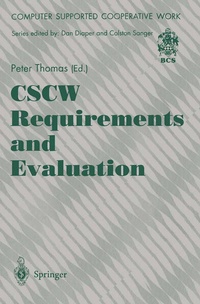
CSCW Requirements and Evaluation
Published on 1. December 1995
Book
Paperback/Softback
XV, 192 pages
978-3-540-19963-2 (ISBN)
Description
There is a rapidly-growing commercial awareness of the need for evaluation in CSCW as major producers push to get cooperative technology taken up in commercial organisations.
CSCW
Requirements and Evaluation
looks at ways of evaluating how well computer systems meet the requirements of organisations and their workforces, and establishing how effective, efficient and satisfactory they are for the actual users. It provides an integrated framework for assessment which reflects both practical and academic perspectives. Descriptions of various methods are given, along with examples of their commercial application and specific case studies. Containing contributions from leading authorities in the field, this book will be welcomed by scientists and practitioners involved in organisational research, CSCW, information and business systems, and HCI.
More details
Series
Edition
Softcover reprint of the original 1st ed. 1996
Language
English
Place of publication
London
United Kingdom
Publishing group
Springer Berlin
Target group
Professional and scholarly
Research
Illustrations
2 s/w Abbildungen
XV, 192 p. 2 illus.
Dimensions
Height: 23.5 cm
Width: 15.5 cm
Weight
340 gr
ISBN-13
978-3-540-19963-2 (9783540199632)
DOI
10.1007/978-1-4471-3056-7
Schweitzer Classification
Other editions
Additional editions
Content
1 Introduction.- 2 CSCW and Requirements Analysis: Requirements as Cooperation/Requirements for Cooperation.- 2.1 Introduction.- 2.2 Promoting Cooperation in Requirements.- 2.3 Cognitive Mapping.- 2.4 Empirical Results.- 2.5 Conclusion.- 3 "They're Supposed to be Fixing it": Requirements and System Redesign.- 3.1 Introduction.- 3.2 The "nth" Phase in the Requirements Process?.- 3.3 Considering Systems in Use.- 3.4 The Bank.- 3.5 Conclusion: "Requirements" and "Configuring the User".- 4 Cooperation, Requirements Analysis and CSCW.- 4.1 Introduction.- 4.2 Approaches to Requirements Analysis.- 4.3 Characteristics of Group Session Approaches.- 4.4 Research Issues.- 4.5 Prototype CRC Tools.- 4.6 Evaluation of the CRC Prototype.- 4.7 Research Issues for CSCW.- 5 User Requirements from a Group Perspective: The Case of Distance Learning Mediated by Computer Conferencing.- 5.1 Introduction.- 5.2 On Approaches to the Evaluation of CCS.- 5.3 Objectives of Case Study.- 5.4 Case Study: Distance Learning via Computer Conferencing.- 5.5 Examining the Social Organisation of the Students' Learning Activity in the CCS Environment, and the Problems they Encountered.- 5.6 Investigation of Participants' Communication Problems.- 5.7 Some General Implications.- 5.8 Summary of Other Findings.- 5.9 Recommendations and Further Development.- 5.10 Conclusions.- 6 Early Evaluation of the Organisational Implications of CSCW Systems.- 6.1 Organisational Impact.- 6.2 Approaches to Evaluation.- 6.3 The User Cost-Benefit Assessment Method.- 6.4 Evaluating the Impact of a Mobile Communications System.- 6.5 Reflections on the Use of the User Cost-Benefit Assessment Method.- 6.6 Conclusions.- 7 Coordination Breakdowns: How Flexible is Collaborative Work?.- 7.1 Introduction.- 7.2 EMailand Communication Problems.- 7.3 Definitions.- 7.4 The Role of Breakdowns.- 7.5 Discussion.- 7.6 Conclusions.- 8 The Why, How and What to Evaluate of Interaction Technology: A Review and Proposed Integration.- 8.1 Introduction.- 8.2 HOW to Evaluate: Methodology for Interaction Technology.- 8.3 Four Research Traditions.- 8.4 Choice of Evaluation Approach.- 8.5 WHAT to Evaluate: A Model of Distributed Social Interaction.- 8.6 Group Evolution.- 8.7 The Complete Evaluation Process.- 9 Measures of Process.- 9.1 Introduction.- 9.2 Common Ground, Effort and Social Salience.- 9.3 Surface Features of Conversational Content.- 9.4 Conversational Structure.- 9.5 Discussion.- 9.6 Conclusions.- 10 Dealing with Uncertainty - Perspectives on the Evaluation Process.- 10.1 Introduction.- 10.2 Evaluation in a Specific Context - Retail Financial Services.- 10.3 Conclusion - What is Evaluation?.- 11 The Use of Breakdown Analysis in Synchronous CSCW System Design.- 11.1 Introduction.- 11.2 Background.- 11.3 Usability Evaluation and CSCW.- 11.4 Breakdown Analysis.- 11.5 Conclusions.- References.- Name Index.