

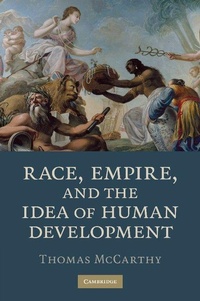
Race, Empire, and the Idea of Human Development
Published on 16. July 2009
Book
Paperback/Softback
264 pages
978-0-521-74043-2 (ISBN)
Description
In an exciting study of ideas accompanying the rise of the West, Thomas McCarthy analyzes the ideologies of race and empire that were integral to European-American expansion. He highlights the central role that conceptions of human development (civilization, progress, modernization, and the like) played in answering challenges to legitimacy through a hierarchical ordering of difference. Focusing on Kant and natural history in the eighteenth century, Mill and social Darwinism in the nineteenth, and theories of development and modernization in the twentieth, he proposes a critical theory of development which can counter contemporary neoracism and neoimperialism, and can accommodate the multiple modernities now taking shape. Offering an unusual perspective on the past and present of our globalizing world, this book will appeal to scholars and advanced students of philosophy, political theory, the history of ideas, racial and ethnic studies, social theory, and cultural studies.
Reviews / Votes
'With a first systematic account of racisms and penetrating criticisms of developmental schemes, this brilliant and beautifully written book is a milestone in the Frankfurt tradition of critical social theory. It provides at the same time a pathbreaking analysis of what should be saved, 'after progress', from developmental thought.' Juergen Habermas 'Global development in an interdependent world is one of the leading ideas of our times. But neoliberal globalizers on the one hand and neconservative interventionists on the other obscure how such developmental visions can foster ideologies of neoracism and neo-colonialism. In this comprehensive work, which ranges from Enlightenment race theories to Kant's philosophy of history, from social Darwinism to the politics of memory, Thomas McCarthy outlines a critical theory of global development which is universalist as well as multiculturalist; critical of Eurocentrism but supporting the binding legacy of practical reason as developed since the Enlightenment. A must reading for all those who want to see critical social theory at work in our times.' Seyla Benhabib, Yale University 'Thomas McCarthy has written a splendid book, an immediately indispensable contribution to ongoing discussions of political philosophical method, racial injustice, liberal imperialism, and globalization. Empirically rich and richly insightful, it is a masterly exemplar of critical history with a practical intent and will be enthusiastically welcomed by all who would understand how racism and the rationalization of empire have shaped the modern world.' Robert Gooding-Williams, The University of ChicagoMore details
Language
English
Place of publication
Cambridge
United Kingdom
Target group
Professional and scholarly
Product notice
Paperback (trade)
Illustrations
Worked examples or Exercises
Dimensions
Height: 229 mm
Width: 152 mm
Thickness: 15 mm
Weight
388 gr
ISBN-13
978-0-521-74043-2 (9780521740432)
Copyright in bibliographic data and cover images is held by Nielsen Book Services Limited or by the publishers or by their respective licensors: all rights reserved.
Schweitzer Classification
Other editions
Additional editions
Thomas McCarthy
Race, Empire, and the Idea of Human Development
Book
07/2009
Cambridge University Press
€119.90
Shipment within 15-20 days
Person
Thomas McCarthy is William H. Orrick Visiting Professor at Yale University and Professor Emeritus of Philosophy at Northwestern University.
Content
Introduction; Part I: 1. Political philosophy and racial injustice: a preliminary note on methodology; 2. Kant on race and development; 3. Social Darwinism and white supremacy; 4. Coming to terms with the past: on the politics of the memory of slavery; Part II: 5. What may we hope? Reflections on the idea of universal history in the wake of Kant; 6. Liberal imperialism and the dilemma of development; 7. From modernism to messianism: reflections on the state of 'development'; Conclusion: the presence of the past.