

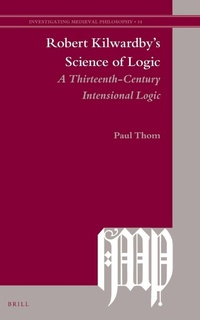
Robert Kilwardby's Science of Logic
A Thirteenth-Century Intensional Logic
Published on 19. September 2019
Book
Hardback
328 pages
978-90-04-40846-3 (ISBN)
Description
Paul Thom's book presents Kilwardby's science of logic as a body of demonstrative knowledge about inferences and their validity, about the semantics of non-modal and modal propositions, and about the logic of genus and species. This science is thoroughly intensional. It grounds the logic of inference on that in virtue of which the inference holds. It bases the truth conditions of propositions on relations between conceptual entities. It explains the logic of genus and species through the notion of essence.
Thom interprets this science as a formal logic of intensions with its own proof theory and semantics. This comprehensive reconstruction of Kilwardby's logic shows the medieval master to be one of the most interesting logicians of the thirteenth century.
Thom interprets this science as a formal logic of intensions with its own proof theory and semantics. This comprehensive reconstruction of Kilwardby's logic shows the medieval master to be one of the most interesting logicians of the thirteenth century.
Reviews / Votes
"Robert Kilwardby (d. 1279) was almost always of interest to medieval philosophers. This interest, however, has seldom been replicated by modern editorial initiatives, leaving our appreciation of the Oxford master's intellectual profile incomplete, and perhaps uneven. We are aware of the different contributions that Kilwardby made to metaphysics and to the naturalphilosophy of his time, and we know that he was a dedicated and influential logician. We may even claim that Kilwardby was a fortunate logician, for he was one of the first scholars in the Latin West to read and to comment on the newly discovered books of Aristotle's logic. This feature is greatly stressed in Paul Thom's second book devoted exclusively to Kilwardby's "science of logic", as described in the title.[...] Thom's volume
already stands as a great and inspiring work for the almost timeless interpretative potential
he fairly attributes to Robert Kilwardby's logic." Edit Anna Lukacs, in Speculum 96/1 , (January 2021).
More details
Series
Language
English
Place of publication
Leiden
Netherlands
Target group
Professional and scholarly
Product notice
sewn/stitched
Cloth over boards
Dimensions
Height: 236 mm
Width: 160 mm
Thickness: 23 mm
Weight
612 gr
ISBN-13
978-90-04-40846-3 (9789004408463)
Copyright in bibliographic data and cover images is held by Nielsen Book Services Limited or by the publishers or by their respective licensors: all rights reserved.
Schweitzer Classification
Person
Paul Thom, B.Phil. (Oxford), is Honorary Professor of Philosophy at the University of Sydney and a Fellow of the Australian Academy of Humanities. He has authored numerous books on the history of logic.
Content
Acknowledgements
List of Figures and Tables
Abbreviations
?Introduction
?1Logic as Science and Art
?1?The Evolution of Logic
?2?The Art of Logic
?3?Branches of the Science of Logic
?4?The Science of Logic as Sermocinal
?5The Science of Logic Distinguished from Other Content in the Organon
?6?Kilwardby's Writings on Logic
?7?Aspects of Kilwardby's Thought
?8?Formalisation
?2?The Logic of Terms: Categories and Complex Terms
?1?The Categories
?2?Complex Terms
?3?Formal Language
?4?Models
?5?Theorems
?3The Logic of Terms: Relations between Terms
?1?The Predicables
?2?Genus and Species
?3?Differentia
?4?Proprium
?5?Accident
?6?Formal Analysis
?7?Formal Language
?8?Models
?9?Truth in a Model
?10?Postulates
?11?Theorems
?4?The Logic of Statements: Assertoric Statements
?1?Propositions and Statements
?2?Assertoric Statements
?3?Truth
?4?Ut nunc assertorics
?5?Simpliciter Assertorics
?6?Natural simpliciter Assertorics
?7?Opposition and Equipollence
?8?Conversion
?9?Non-Aristotelian Consequences among Assertorics
?10?Formal Analysis
?11?Theorems
?5?The Logic of Statements: Necessity and Possibility Statements
?1?Modal Statements
?2?Necessity Statements
?3?Possibility Statements
?4?Formal Analysis
?5?Formal Language
?6?Models
?7?Theorems
?6?The Logic of Statements: Contingency Statements
?1?Unampliated Contingencies
?2?Kilwardby's Examples
?3?Ampliated Contingencies
?4?Kilwardby's Rules for the Truth of Ampliated Contingency Statements
?5?Kilwardby's Examples
?6?Formal Analysis
?7?Theorems
?7?The Logic of Inferences: Consequences
?1?Consequences According to the Relations between Terms
?2?Formal Consequences
?3Pure Rules of Consequence
?4Rules of Consequence and Conversion
?5Rules of Consequence and Opposition
?6Rules of Consequence, Opposition and Repugnance
?7Rules of Consequence and Possibility
?8Rules of Consequence and Assertion
?9Rules of Consequence and Denial
?10Essential Consequences
?11Essential Consequence and Essential Inseparability
?12Syllogistic Consequences
?13Formal Analysis
?14Truth Conditions
?15Postulates
?16Theorems
?8The Logic of Inferences: Assertoric Syllogisms
?1Syllogistic Figures and Moods
?2Reduction
?3Perfection
?4Being Said of All
?5Families of Syllogism
?6Principles, Validity, Perfectibility
?7Mixed ut nunc / simpliciter Inferences
?8Summary
?9Formal Analysis
?10Generative Rules
?11Theorems
?9The Logic of Inferences: Necessity Syllogisms
?1Family 3. The LLL Family
?2Principles for LL Premises
?3Being Said of All
?4Reduction
?5Summary
?6Family 4. The LXlL Family
?7Principles for L / Xl Premises
?8Being Said of All
?9Inferences Related to the Perfect Syllogisms
?10Reduction
?11Summary
?12Formal Analysis
?13Theorems
?10The Logic of Inferences: Contingency Syllogisms
?1Unrestricted Syllogistic Conversion in Family 3
?2Unrestricted Syllogistic Conversion in Family 4
?3Family 5. The Q' Q' Q' Family
?4Family 6. The QXlQ Family
?5Family 7. The QLQ Family
?6Formal Analysis
?11The Logic of Inferences: Non-perfectible Inferences
?1xq Premises
?2Realised Modals
?3Formal Analysis
?4Envoi
?References
?Modern Author Index
?Subject Index
?Ancient an Medieval Author Index
List of Figures and Tables
Abbreviations
?Introduction
?1Logic as Science and Art
?1?The Evolution of Logic
?2?The Art of Logic
?3?Branches of the Science of Logic
?4?The Science of Logic as Sermocinal
?5The Science of Logic Distinguished from Other Content in the Organon
?6?Kilwardby's Writings on Logic
?7?Aspects of Kilwardby's Thought
?8?Formalisation
?2?The Logic of Terms: Categories and Complex Terms
?1?The Categories
?2?Complex Terms
?3?Formal Language
?4?Models
?5?Theorems
?3The Logic of Terms: Relations between Terms
?1?The Predicables
?2?Genus and Species
?3?Differentia
?4?Proprium
?5?Accident
?6?Formal Analysis
?7?Formal Language
?8?Models
?9?Truth in a Model
?10?Postulates
?11?Theorems
?4?The Logic of Statements: Assertoric Statements
?1?Propositions and Statements
?2?Assertoric Statements
?3?Truth
?4?Ut nunc assertorics
?5?Simpliciter Assertorics
?6?Natural simpliciter Assertorics
?7?Opposition and Equipollence
?8?Conversion
?9?Non-Aristotelian Consequences among Assertorics
?10?Formal Analysis
?11?Theorems
?5?The Logic of Statements: Necessity and Possibility Statements
?1?Modal Statements
?2?Necessity Statements
?3?Possibility Statements
?4?Formal Analysis
?5?Formal Language
?6?Models
?7?Theorems
?6?The Logic of Statements: Contingency Statements
?1?Unampliated Contingencies
?2?Kilwardby's Examples
?3?Ampliated Contingencies
?4?Kilwardby's Rules for the Truth of Ampliated Contingency Statements
?5?Kilwardby's Examples
?6?Formal Analysis
?7?Theorems
?7?The Logic of Inferences: Consequences
?1?Consequences According to the Relations between Terms
?2?Formal Consequences
?3Pure Rules of Consequence
?4Rules of Consequence and Conversion
?5Rules of Consequence and Opposition
?6Rules of Consequence, Opposition and Repugnance
?7Rules of Consequence and Possibility
?8Rules of Consequence and Assertion
?9Rules of Consequence and Denial
?10Essential Consequences
?11Essential Consequence and Essential Inseparability
?12Syllogistic Consequences
?13Formal Analysis
?14Truth Conditions
?15Postulates
?16Theorems
?8The Logic of Inferences: Assertoric Syllogisms
?1Syllogistic Figures and Moods
?2Reduction
?3Perfection
?4Being Said of All
?5Families of Syllogism
?6Principles, Validity, Perfectibility
?7Mixed ut nunc / simpliciter Inferences
?8Summary
?9Formal Analysis
?10Generative Rules
?11Theorems
?9The Logic of Inferences: Necessity Syllogisms
?1Family 3. The LLL Family
?2Principles for LL Premises
?3Being Said of All
?4Reduction
?5Summary
?6Family 4. The LXlL Family
?7Principles for L / Xl Premises
?8Being Said of All
?9Inferences Related to the Perfect Syllogisms
?10Reduction
?11Summary
?12Formal Analysis
?13Theorems
?10The Logic of Inferences: Contingency Syllogisms
?1Unrestricted Syllogistic Conversion in Family 3
?2Unrestricted Syllogistic Conversion in Family 4
?3Family 5. The Q' Q' Q' Family
?4Family 6. The QXlQ Family
?5Family 7. The QLQ Family
?6Formal Analysis
?11The Logic of Inferences: Non-perfectible Inferences
?1xq Premises
?2Realised Modals
?3Formal Analysis
?4Envoi
?References
?Modern Author Index
?Subject Index
?Ancient an Medieval Author Index