

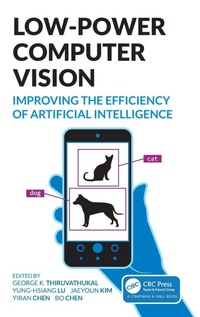
Low-Power Computer Vision
Improve the Efficiency of Artificial Intelligence
1st Edition
Published on 23. February 2022
Book
Hardback
436 pages
978-0-367-74470-0 (ISBN)
Description
Energy efficiency is critical for running computer vision on battery-powered systems, such as mobile phones or UAVs (unmanned aerial vehicles, or drones). This book collects the methods that have won the annual IEEE Low-Power Computer Vision Challenges since 2015. The winners share their solutions and provide insight on how to improve the efficiency of machine learning systems.
Reviews / Votes
On device AI has become increasingly important for reasons of latency, privacy and overall autonomy as computing becomes more and more ambient. Moreover, making AI, in particular computer vision, efficient and run well in low resource computing environments using frameworks like PyTorch is a priority of the industry to enable this. The IEEE Low-Power Computer Vision Challenge is one such effort that has and continues to push the field forward allowing us to make progress in this area. Facebook has been a proud sponsor and supporter of this challenge since 2018 and this book presents the winners' solutions from previous challenges and can guide researchers, engineers, and students to design efficient on device AI.-- Joe Spisak, Product Lead at Facebook Artificial Intelligence
Computer vision is at the center of recent breakthroughs in artificial intelligence. Being able to process visual data in low-power computing environments will enable great advances in the field in areas such as edge computing and Internet of Things. This book presents work by experts in the field and their winning solutions. It is an indispensable resource for anyone interested creating AI technologies in resource constrained computing environments
-- Mark Liao, Director, Institute of Information Science, Academia Sinica
From mobile phones to wearable health monitors, improved energy efficiency is the enabling technology of everything we take for granted today. Computer vision is at the center of artificial intelligence and machine learning. Today, artificial intelligence and low power are often at different ends of the spectrum. Low-power computer vision will enable greater adoption of the technologies in battery-powered IoT (Internet of Things) systems. This book collects the winners' solutions of the Low-Power Computer Vision Challenge and provides insight on how to improve efficiency of artificial intelligence.
-- Edwin Park, Principal Engineer at Qualcomm
More details
Series
Language
English
Place of publication
Oxford
United Kingdom
Publishing group
Taylor & Francis Ltd
Target group
College/higher education
Professional and scholarly
Academic, Postgraduate, and Professional
Illustrations
39 s/w Abbildungen, 62 farbige Abbildungen, 1 Farbfoto bzw. farbiges Rasterbild, 39 s/w Zeichnungen, 61 farbige Zeichnungen, 58 s/w Tabellen
58 Tables, black and white; 61 Line drawings, color; 39 Line drawings, black and white; 1 Halftones, color; 62 Illustrations, color; 39 Illustrations, black and white
Dimensions
Height: 240 mm
Width: 161 mm
Thickness: 28 mm
Weight
816 gr
ISBN-13
978-0-367-74470-0 (9780367744700)
Copyright in bibliographic data and cover images is held by Nielsen Book Services Limited or by the publishers or by their respective licensors: all rights reserved.
Schweitzer Classification
Other editions
Additional editions
George K. Thiruvathukal | Yung-Hsiang Lu | Jaeyoun Kim
Low-Power Computer Vision
Improve the Efficiency of Artificial Intelligence
Book
10/2024
1st Edition
Chapman & Hall/CRC
€103.00
Shipment within 15-20 days
George K. Thiruvathukal | Yung-Hsiang Lu | Jaeyoun Kim
Low-Power Computer Vision
Improve the Efficiency of Artificial Intelligence
E-Book
02/2022
1st Edition
Chapman & Hall/CRC
€63.49
Available for download
George K. Thiruvathukal | Yung-Hsiang Lu | Jaeyoun Kim
Low-Power Computer Vision
Improve the Efficiency of Artificial Intelligence
E-Book
02/2022
1st Edition
Chapman & Hall/CRC
€63.49
Available for download
Persons
George K. Thiruvathukal is a professor of Computer Science at Loyola University Chicago, Illinois, USA. He is also a visiting faculty at Argonne National Laboratory. His research areas include high performance and distributed computing, software
engineering, and programming languages.
Yung-Hsiang Lu is a professor of Electrical and Computer Engineering at Purdue University, Indiana, USA. He is the first director of Purdue's John Martinson Engineering Entrepreneurial Center. He is a fellow of the IEEE and distinguished scientist of the ACM. His research interests include computer vision, mobile systems, and cloud computing.
Jaeyoun Kim is a technical program manager at Google, California, USA. He leads AI research projects, including MobileNets and TensorFlow Model Garden, to build state-of-the-art machine learning models and modeling libraries for computer vision and natural language processing.
Yiran Chen is a professor of Electrical and Computer Engineering at Duke University, North Carolina, USA. He is a fellow of the ACM and the IEEE. His research areas include new memory and storage systems, machine learning and neuromorphic
computing, and mobile computing systems.
Bo Chen is the Director of AutoML at DJI, Guangdong, China. Before joining DJI, he was a researcher at Google, California, USA. His research interests are the optimization of neural network software and hardware as well as landing AI technology in products with stringent resource constraints.
engineering, and programming languages.
Yung-Hsiang Lu is a professor of Electrical and Computer Engineering at Purdue University, Indiana, USA. He is the first director of Purdue's John Martinson Engineering Entrepreneurial Center. He is a fellow of the IEEE and distinguished scientist of the ACM. His research interests include computer vision, mobile systems, and cloud computing.
Jaeyoun Kim is a technical program manager at Google, California, USA. He leads AI research projects, including MobileNets and TensorFlow Model Garden, to build state-of-the-art machine learning models and modeling libraries for computer vision and natural language processing.
Yiran Chen is a professor of Electrical and Computer Engineering at Duke University, North Carolina, USA. He is a fellow of the ACM and the IEEE. His research areas include new memory and storage systems, machine learning and neuromorphic
computing, and mobile computing systems.
Bo Chen is the Director of AutoML at DJI, Guangdong, China. Before joining DJI, he was a researcher at Google, California, USA. His research interests are the optimization of neural network software and hardware as well as landing AI technology in products with stringent resource constraints.
Content
Section I Introduction
Book Introduction
Yung-Hsiang Lu, George K. Thiruvathukal, Jaeyoun Kim, Yiran Chen, and Bo Chen
History of Low-Power Computer Vision Challenge
Yung-Hsiang Lu and Xiao Hu, Yiran Chen, Joe Spisak, Gaurav Aggarwal, Mike Zheng Shou, and George K. Thiruvathukal
Survey on Energy-Efficient Deep Neural Networks for Computer Vision
Abhinav Goel, Caleb Tung, Xiao Hu, Haobo Wang, and Yung-Hsiang Lu and George K. Thiruvathukal
Section II Competition Winners
Hardware design and software practices for efficient neural network inference Yu Wang, Xuefei Ning, Shulin Zeng, Yi Kai, Kaiyuan Guo, and Hanbo Sun, Changcheng Tang, Tianyi Lu, Shuang Liang, and Tianchen Zhao
Progressive Automatic Design of Search Space for One-Shot Neural Architecture Search
Xin Xia, Xuefeng Xiao, and Xing Wang
Fast Adjustable Threshold For Uniform Neural Network Quantization
Alexander Goncharenko, Andrey Denisov, and Sergey Alyamkin
Power-efficient Neural Network Scheduling on Heterogeneous SoCsYing Wang, Xuyi Cai, and Xiandong Zhao
Efficient Neural Network ArchitecturesHan Cai and Song Han
Design Methodology for Low Power Image Recognition SystemsSoonhoi Ha, EunJin Jeong, Duseok Kang, Jangryul Kim, and Donghyun Kang
Guided Design for Efficient On-device Object Detection ModelTao Sheng and Yang Liu
Section III Invited Articles
Quantizing Neural Networks Marios Fournarakis, Markus Nagel, Rana Ali Amjad, Yelysei Bondarenko, Mart van Baalen, and Tijmen Blankevoort
A practical guide to designing efficient mobile architecturesMark Sandler and Andrew Howard
A Survey of Quantization Methods for Efficient Neural Network InferenceAmir Gholami, Sehoon Kim, Zhen Dong, Zhewei Yao, Michael Mahoney, and Kurt Keutzer
Bibliography
Index
Book Introduction
Yung-Hsiang Lu, George K. Thiruvathukal, Jaeyoun Kim, Yiran Chen, and Bo Chen
History of Low-Power Computer Vision Challenge
Yung-Hsiang Lu and Xiao Hu, Yiran Chen, Joe Spisak, Gaurav Aggarwal, Mike Zheng Shou, and George K. Thiruvathukal
Survey on Energy-Efficient Deep Neural Networks for Computer Vision
Abhinav Goel, Caleb Tung, Xiao Hu, Haobo Wang, and Yung-Hsiang Lu and George K. Thiruvathukal
Section II Competition Winners
Hardware design and software practices for efficient neural network inference Yu Wang, Xuefei Ning, Shulin Zeng, Yi Kai, Kaiyuan Guo, and Hanbo Sun, Changcheng Tang, Tianyi Lu, Shuang Liang, and Tianchen Zhao
Progressive Automatic Design of Search Space for One-Shot Neural Architecture Search
Xin Xia, Xuefeng Xiao, and Xing Wang
Fast Adjustable Threshold For Uniform Neural Network Quantization
Alexander Goncharenko, Andrey Denisov, and Sergey Alyamkin
Power-efficient Neural Network Scheduling on Heterogeneous SoCsYing Wang, Xuyi Cai, and Xiandong Zhao
Efficient Neural Network ArchitecturesHan Cai and Song Han
Design Methodology for Low Power Image Recognition SystemsSoonhoi Ha, EunJin Jeong, Duseok Kang, Jangryul Kim, and Donghyun Kang
Guided Design for Efficient On-device Object Detection ModelTao Sheng and Yang Liu
Section III Invited Articles
Quantizing Neural Networks Marios Fournarakis, Markus Nagel, Rana Ali Amjad, Yelysei Bondarenko, Mart van Baalen, and Tijmen Blankevoort
A practical guide to designing efficient mobile architecturesMark Sandler and Andrew Howard
A Survey of Quantization Methods for Efficient Neural Network InferenceAmir Gholami, Sehoon Kim, Zhen Dong, Zhewei Yao, Michael Mahoney, and Kurt Keutzer
Bibliography
Index