

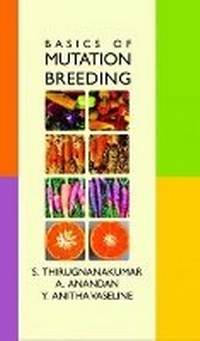
Basics of Mutation Breeding
Published on 15. January 2015
Book
Paperback/Softback
114 pages
978-81-19002-76-4 (ISBN)
Description
The text discusses the various types of mutagens and their impacts, as well as the methods of using mutagens for crop improvement. Additionally, the book covers the different types of mutations (micro and macro) and the statistical techniques used to manage the mutation population. The subject matter is relevant to both undergraduate and postgraduate students studying agriculture.
More details
Language
English
Place of publication
New Delhi
India
Target group
Professional and scholarly
Dimensions
Height: 229 mm
Width: 120 mm
Weight
335 gr
ISBN-13
978-81-19002-76-4 (9788119002764)
Copyright in bibliographic data and cover images is held by Nielsen Book Services Limited or by the publishers or by their respective licensors: all rights reserved.
Schweitzer Classification
Persons
S. Thirugnanakumar, Professor and Head, Department of Genetics & Plant Breeding, Faculty of Agriculture, Annamalai University, Annamalai Nagar -608 002, Tamil Nadu, India.
Content
1. Mutation and Crop Improvement
2. Classification of Mutagens and Their Effects
3. Procedure for Mutation Breeding
4. Effect of Mutagens on Germination and Survival in M1 Generation
5. Chlorophyll Mutations
6. Macromutations
7. Micromutations
8. Mutagenic Effectiveness and Efficiency
9. Correlation Between M1 and M2 Generation
10. Variability Parameters in M2 and M3 Generations in Sesame
11. Heritability and Genetic Advance as Percent in Sesame of Mean in M2 and M3 Generations
12. Frequency Distribution in M2 and M3 Generations in Sesame
2. Classification of Mutagens and Their Effects
3. Procedure for Mutation Breeding
4. Effect of Mutagens on Germination and Survival in M1 Generation
5. Chlorophyll Mutations
6. Macromutations
7. Micromutations
8. Mutagenic Effectiveness and Efficiency
9. Correlation Between M1 and M2 Generation
10. Variability Parameters in M2 and M3 Generations in Sesame
11. Heritability and Genetic Advance as Percent in Sesame of Mean in M2 and M3 Generations
12. Frequency Distribution in M2 and M3 Generations in Sesame