


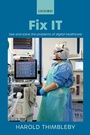
Fix IT
See and solve the problems of digital healthcare
Published on 8. October 2021
Book
Paperback/Softback
600 pages
978-0-19-886127-0 (ISBN)
Description
New technologies like AI, medical apps and implants seem very exciting but they too often have bugs and are susceptible to cyberattacks. Even well-established technologies like infusion pumps, pacemakers and radiotherapy aren't immune.
Until digital healthcare improves, digital risk means that patients may be harmed unnecessarily, and healthcare staff will continue to be blamed for problems when it's not their fault.
This book tells stories of widespread problems with digital healthcare. The stories inspire and challenge anyone who wants to make hospitals and healthcare better. The stories and their resolutions will empower patients, clinical staff and digital developers to help transform digital healthcare to make it safer and more effective.
This book is not just about the bugs and cybersecurity threats that affect digital healthcare. More importantly, it's about the solutions that can make digital healthcare much safer.
Until digital healthcare improves, digital risk means that patients may be harmed unnecessarily, and healthcare staff will continue to be blamed for problems when it's not their fault.
This book tells stories of widespread problems with digital healthcare. The stories inspire and challenge anyone who wants to make hospitals and healthcare better. The stories and their resolutions will empower patients, clinical staff and digital developers to help transform digital healthcare to make it safer and more effective.
This book is not just about the bugs and cybersecurity threats that affect digital healthcare. More importantly, it's about the solutions that can make digital healthcare much safer.
Reviews / Votes
This is an extraordinary book: a potent and engaging compendium of revelatory stories, bold insights, wise advice, and fresh thinking. * Daniel Jackson (Professor of Computer Science, MIT) * This is a brilliant and hugely enjoyable book which should be compulsory reading for anyone with high-level responsibility for patient care. * Martin Elliott (former Medical Director, Great Ormond Street Hospital for Children) *More details
Edition
1
Language
English
Place of publication
Oxford
United Kingdom
Target group
College/higher education
Dimensions
Height: 234 mm
Width: 156 mm
Thickness: 32 mm
Weight
901 gr
ISBN-13
978-0-19-886127-0 (9780198861270)
Copyright in bibliographic data and cover images is held by Nielsen Book Services Limited or by the publishers or by their respective licensors: all rights reserved.
Schweitzer Classification
Other editions
Additional editions
E-Book
10/2021
1st Edition
OUP eBook
€20.99
Available for download
Person
Prof Harold Thimbleby is See Change Fellow in Digital Health, based at Swansea University, Wales. He is Expert Advisor on IT to the Royal College of Physicians, a member of the World Health Organization's Patient Safety Network, and an advisor to the Clinical Human Factors Group and to the UK Medicines Healthcare products Regulatory Agency (MHRA).
Although a professor of computer science, he is an Honorary Fellow of the Royal College of Physicians, the Edinburgh Royal College of Physicians, and of the Royal Society of Arts; he's also a fellow of the Royal Society of Medicine. He has been a Royal Society-Wolfson Research Merit Award Holder and a Leverhulme Trust Senior Research Fellow, and he is 28th Gresham Professor of Geometry. Harold won the British Computer Society's Wilkes Medal and his last book, Press On: Principles of Interaction Programming (MIT Press), won several international awards.
Although a professor of computer science, he is an Honorary Fellow of the Royal College of Physicians, the Edinburgh Royal College of Physicians, and of the Royal Society of Arts; he's also a fellow of the Royal Society of Medicine. He has been a Royal Society-Wolfson Research Merit Award Holder and a Leverhulme Trust Senior Research Fellow, and he is 28th Gresham Professor of Geometry. Harold won the British Computer Society's Wilkes Medal and his last book, Press On: Principles of Interaction Programming (MIT Press), won several international awards.
Content
1: How to read this book
PART 1: Diagnosis - riskier than you think
2: We don't know what we don't know
3: Cat Thinking
4: Dogs dancing
5: Fatal overdose
6: Swiss Cheese
7: Victims & second victims
8: Side-effects and scandals
9: The scale of the problem
10: Medical apps and bug blocking
PART 2: Treatment - Finding solutions
11: Cars have got safer
12: Safety Two
13: Computational Thinking
14: Risky calculations
15: Who's accountable?
16: Regulation needs fixing
17: Safe and secure
18: Who profits?
19: Interoperability
20: Human Factors
21: Computer Factors
22: User Centered Design
23: Iterative Design
24: Wedge Thinking
25: Attention to detail
26: Planes have got safer
27: Stories for developers
28: Finding bugs
29: Choose safety
Part 3: Prognosis - a better future
30: Signs of life
31: The pivotal pandemic?
32: Living happily ever after
33: Good reading
34: Notes
35: Healthcare openness and acknowledgements
PART 1: Diagnosis - riskier than you think
2: We don't know what we don't know
3: Cat Thinking
4: Dogs dancing
5: Fatal overdose
6: Swiss Cheese
7: Victims & second victims
8: Side-effects and scandals
9: The scale of the problem
10: Medical apps and bug blocking
PART 2: Treatment - Finding solutions
11: Cars have got safer
12: Safety Two
13: Computational Thinking
14: Risky calculations
15: Who's accountable?
16: Regulation needs fixing
17: Safe and secure
18: Who profits?
19: Interoperability
20: Human Factors
21: Computer Factors
22: User Centered Design
23: Iterative Design
24: Wedge Thinking
25: Attention to detail
26: Planes have got safer
27: Stories for developers
28: Finding bugs
29: Choose safety
Part 3: Prognosis - a better future
30: Signs of life
31: The pivotal pandemic?
32: Living happily ever after
33: Good reading
34: Notes
35: Healthcare openness and acknowledgements