

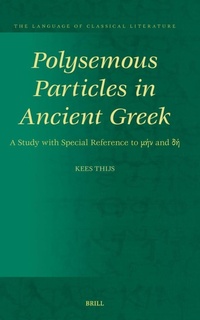
Polysemous Particles in Ancient Greek
A Study with Special Reference to ??? and ??
Published on 6. March 2025
Book
Hardback
460 pages
978-90-04-71498-4 (ISBN)
Description
Anyone reading an Ancient Greek text will notice the abundance of pragmatic particles (e.g. ???, ???, ??, ??, ??, ???, ???, ???), a much-debated and challenging class of expressions. What are their semantic contributions, and how should we account for their notorious polyfunctionality? In this book, Kees Thijs provides a state of the art of modern particle theory, which he then applies to two of the most versatile Greek particles, ??? and ??. Using a diachronically oriented polysemy approach and a large-scale, varied research corpus, Thijs offers a new, unified account that significantly improves on both traditional handbooks (e.g. Denniston) and more recent particle studies.
More details
Series
Language
English
Place of publication
Leiden
Netherlands
Target group
Professional and scholarly
Product notice
sewn/stitched
Cloth over boards
Dimensions
Height: 242 mm
Width: 160 mm
Thickness: 29 mm
Weight
821 gr
ISBN-13
978-90-04-71498-4 (9789004714984)
Copyright in bibliographic data and cover images is held by Nielsen Book Services Limited or by the publishers or by their respective licensors: all rights reserved.
Schweitzer Classification
Person
Kees Thijs (PhD 2021) is a lecturer in logic and Ancient Greek at Radboud University Nijmegen. His research is at the crossroads of Ancient Greek, linguistics, and philosophy of language, with a focus on pragmatic particles and Greek word order.
Content
Acknowledgements
List of tables and figures
Abbreviations, symbols, and translations
1 General introduction
?1.1?Setting the scene
?1.2?Earlier scholarship
?1.3?Data
?1.4?Methodology
?1.5?Outline of the present study
Part1 Theoretical background
2 Pragmatic particles
?2.1?Introduction
?2.2?Preliminaries on linguistic categorization
?2.3?Particles
?2.4?Pragmatic markers
?2.5?Conclusion
3 Outline of the functional spectrum
?3.1?Introduction
?3.2?Connectives
?3.3?Attitudinal-interactional markers
?3.4?Focus modifiers
?3.5?Intensifiers
?3.6?Markers of non-straightforward communication
?3.7?Conclusion
4 Polyfunctionality and diachronic change
?4.1?Introduction
?4.2?Diachronic change
?4.3?Homonymy, monosemy, and polysemy
?4.4?Methodological reflections
?4.5?Conclusion
5 Position and scope of Greek particles
?5.1?Introduction
?5.2?Greek syntax and word order
?5.3?Prepositives
?5.4?Postpositives
?5.5?Conclusion: the position of particles as linguistic evidence
Part2 Case studies
6 ???
?6.1?Setting the scene
?6.2?Earlier accounts
?6.3???? as an attitudinal-interactional particle
?6.4???? as a discourse-connective particle
?6.5?Conclusion
7 ??
?7.1?Setting the scene
?7.2?Earlier accounts
?7.3??? as an attitudinal-interactional particle
?7.4??? as a discourse-connective particle
?7.5??? as a phrasal modifier
?7.6?Conclusion
8 General conclusion
?8.1?Summary overview
?8.2?Suggestions for further research
Appendix A: Quantitative data
Bibliography
Index Locorum
List of tables and figures
Abbreviations, symbols, and translations
1 General introduction
?1.1?Setting the scene
?1.2?Earlier scholarship
?1.3?Data
?1.4?Methodology
?1.5?Outline of the present study
Part1 Theoretical background
2 Pragmatic particles
?2.1?Introduction
?2.2?Preliminaries on linguistic categorization
?2.3?Particles
?2.4?Pragmatic markers
?2.5?Conclusion
3 Outline of the functional spectrum
?3.1?Introduction
?3.2?Connectives
?3.3?Attitudinal-interactional markers
?3.4?Focus modifiers
?3.5?Intensifiers
?3.6?Markers of non-straightforward communication
?3.7?Conclusion
4 Polyfunctionality and diachronic change
?4.1?Introduction
?4.2?Diachronic change
?4.3?Homonymy, monosemy, and polysemy
?4.4?Methodological reflections
?4.5?Conclusion
5 Position and scope of Greek particles
?5.1?Introduction
?5.2?Greek syntax and word order
?5.3?Prepositives
?5.4?Postpositives
?5.5?Conclusion: the position of particles as linguistic evidence
Part2 Case studies
6 ???
?6.1?Setting the scene
?6.2?Earlier accounts
?6.3???? as an attitudinal-interactional particle
?6.4???? as a discourse-connective particle
?6.5?Conclusion
7 ??
?7.1?Setting the scene
?7.2?Earlier accounts
?7.3??? as an attitudinal-interactional particle
?7.4??? as a discourse-connective particle
?7.5??? as a phrasal modifier
?7.6?Conclusion
8 General conclusion
?8.1?Summary overview
?8.2?Suggestions for further research
Appendix A: Quantitative data
Bibliography
Index Locorum